InterFood Krasnodar and KubanProdExpo are not merely trade shows. They are the commercial heart of Southern Russia’s food and beverage industry, a three-day convergence where federal brands, regional producers, retailers, and HoReCa professionals negotiate the future of the region’s food supply. The 2026 edition alone drew over 140 companies from Russia, Belarus, Italy, Armenia, and Abkhazia, with more than 80 food and beverage exhibitors occupying the halls of Expograd Yug.
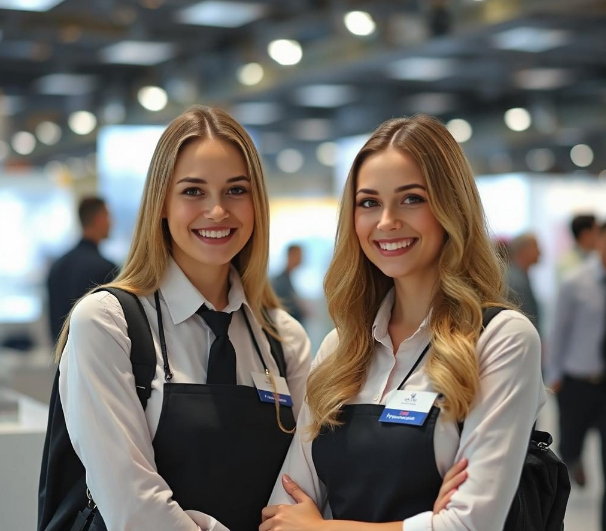
But behind the product samples, tasting stations, and negotiation tables lies a professional class whose work determines whether commercial relationships actually form. These are the stand assistants, hostesses, models, and interpreters who form the human interface between exhibitors and the buyers they seek to reach.
The Scale That Demands Professional Staff
The numbers explain why professional on-site personnel matter. The combined exhibitions—InterFood Krasnodar, KubanProdExpo, FoodTech Krasnodar, and Vinorus.Vinotech—attract more than 5,400 visitors from dozens of Russian regions, with audiences composed overwhelmingly of business decision-makers: executives, managing directors, category managers from federal and regional retail chains, and HoReCa specialists.
This is not a consumer exhibition. Visitors arrive with commercial objectives: finding new suppliers, negotiating exclusive terms, and updating product ranges. For exhibitors, the quality of the human interface at their booth directly determines whether these professionals stop, engage, or walk past.
Hostesses: The First Filter
At exhibitions of this scale, first impressions form in seconds. A hostess positioned at the front of a booth serves as the initial filter, welcoming guests, distributing tasting samples, and drawing qualified visitors toward the stand.
The role demands more than a welcoming presence. Professional hostesses at InterFood Krasnodar handle visitor registration and initial qualification—asking preliminary questions to determine whether a visitor represents a retail chain, a HoReCa enterprise, a wholesale distributor, or a casual attendee. This triage function saves valuable time for sales and category managers who need to focus on qualified leads.
For international exhibitors—particularly those from Belarus, Italy, Armenia, and Abkhazia—local Russian hostesses offer distinct advantages. They understand Russian business culture, speak the language natively, and can navigate the social nuances that shape interactions with food industry professionals from across the country.
Models: Visual Representation in a B2B Context
The presence of models at InterFood Krasnodar differs from consumer trade shows. At a food industry exhibition, the model’s role is not to attract casual passersby but to embody the brand’s identity for a professional audience. A beverage company launching a new product line or a confectionery manufacturer presenting premium offerings may deploy models for visual impact at tasting stations or product displays.
The work requires sustained engagement through long exhibition days. InterFood Krasnodar runs from 10:00 to 18:00 on the first two days, with the final day closing at 15:00. Standing for hours, maintaining poise through repetitive interactions, and projecting enthusiasm regardless of fatigue are professional skills, not merely presence.
Interpreters: The Linguistic Bridge
Interpretation at InterFood Krasnodar is not a generic language service. The exhibition covers highly specialized ground: meat and meat products, dairy and cheeses, confectionery and bakery, beverages, and ingredients for food production. The terminology alone—from food safety standards and packaging specifications to logistics terms and regulatory compliance—requires domain familiarity that generalist interpreters may lack.
The demand for interpretation reflects the exhibition’s international character. With exhibitors from Belarus, Italy, Armenia, and Abkhazia participating in the 2026 edition, and with business sessions addressing topics ranging from innovation and technological solutions in the agro-industrial complex to how producers can get onto retail shelves and earn, the stakes for accurate communication are commercial.
For foreign exhibitors, the interpreter is the bridge between their product and potential Russian buyers. Accuracy in discussing product specifications, certification requirements, or contract terms can determine whether a negotiation advances or stalls.
Stand Assistants: Beyond Greeting
The stand assistant role at InterFood Krasnodar operates in a specific professional context. Visitors include representatives of wholesale food bases, retail chains, and public catering enterprises—professionals who know exactly what they are looking for and expect efficient engagement.
In this environment, the stand assistant functions as a triage specialist. A visitor approaching a booth may be a category manager from a federal retail chain evaluating new suppliers, a restaurant owner seeking local ingredients, or a distributor looking for exclusive regional products. The assistant must assess the visitor’s purpose, answer basic inquiries, and determine when to escalate to the company’s senior representatives.
The Negotiation Center: Where Human Skills Converge
The centerpiece of InterFood Krasnodar’s commercial infrastructure is the Negotiation Center with retail chains and distributors, operating exclusively for exhibition participants on April 22 and 23. Here, producers meet directly with representatives from major retail chains including Magnit, VkusVill, and others.
The Negotiation Center is where the human skills of exhibition personnel converge. Interpreters facilitate conversations across language barriers. Stand assistants coordinate meeting schedules and manage the flow of participants. Hostesses ensure the professional atmosphere that high-stakes commercial negotiations demand. These are not peripheral roles—they are the operational backbone of the exhibition’s most valuable commercial function.
The Unseen Labor of Regional Food Trade
When the pavilions close and the exhibitors dismantle their stands, the work of InterFood Krasnodar’s human infrastructure fades from view. The photographs capture signed agreements, product tastings, and the barista championship final. They do not capture the interpreter who spent twenty minutes clarifying a certification requirement, the hostess who guided a lost delegation to the correct negotiation room, or the stand assistant who managed a crowded tasting station with composure.
InterFood Krasnodar and KubanProdExpo are platforms for the development of Southern Russia’s food industry. The exhibitions serve as commercial infrastructure connecting local producers with national retail chains and international buyers. Behind these institutional functions lies human interaction. Every bilateral meeting, every product evaluation, every follow-up negotiation requires linguistic and cultural mediation.
The professionals who provide that mediation—the stand assistants, hostesses, models, and interpreters—are the ones who make food industry cooperation a functional reality rather than a policy aspiration. At InterFood Krasnodar, the products may be the attraction. But the deals depend on the people who can explain them.