Beauty Show Krasnodar is not merely an exhibition. It is the largest beauty industry event in Southern Russia, a three-day convergence where professional cosmetics manufacturers, salon owners, cosmetologists, hairdressers, nail technicians, and makeup artists gather to test products, attend master classes, and negotiate partnerships. The 2026 edition, the 24th in the series, drew over 120 companies and more than 4,000 visitors to the Expograd Yug complex in Krasnodar from May 27 to 29.
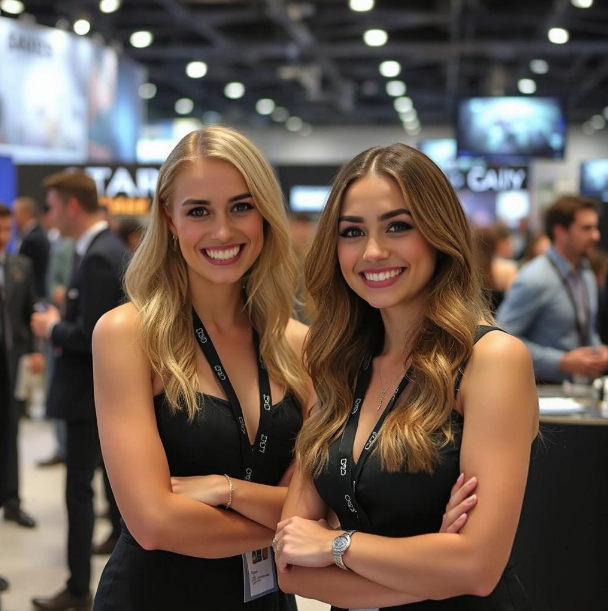
But behind the product displays, the championship stages, and the master class podiums lies a professional class whose work determines whether exhibitors actually connect with their audience. These are the interpreters, stand assistants, hostesses, and models who form the human interface of the beauty industry’s most important regional gathering.
The Scale That Demands Professional Staff
The numbers explain why professional on-site personnel matter. Beauty Show Krasnodar occupies seven exhibition sections covering cosmetology preparations and equipment, nail service products, hairdressing tools, professional makeup, workwear, disinfection products, and salon furniture. The business program spans more than 100 events across two stages, two competition areas, and multiple conference spaces.
The audience is overwhelmingly professional: salon owners and managers, private masters, cosmetologists, and specialists across all beauty industry directions. These visitors arrive with specific commercial objectives—testing new products, evaluating suppliers, and negotiating terms. For exhibitors, the quality of the human interface at their booth directly determines whether these professionals stop, engage, or walk past.
Hostesses: The First Impression
At an exhibition where visual presentation is the industry’s currency, first impressions form in seconds. A hostess positioned at the front of a booth serves as the initial filter, welcoming guests, distributing samples, and drawing qualified visitors toward the stand.
The role demands more than a welcoming presence. Professional hostesses at Beauty Show Krasnodar handle visitor registration, guide attendees toward product testing stations, and manage the flow of traffic during peak hours. This triage function saves valuable time for brand representatives who need to focus on qualified leads and product demonstrations.
For the 2026 edition, the event’s format emphasized direct contact between producers and beauty industry professionals. Hostesses served as the human bridge in this process—welcoming visitors, answering preliminary questions, and ensuring that the booth’s visual and behavioral standards reflected the brand’s identity.
Models: The Living Canvas
The presence of models at Beauty Show Krasnodar differs fundamentally from consumer trade shows. In the beauty industry, models are not decorative accessories—they are living demonstrations of products and techniques.
The exhibition’s championship programs illustrate this integration. The Championship of the Southern Federal District included categories such as Podium Makeup, performed on female models, and Fantasy Makeup, where models serve as canvases for artistic expression. The minimum age for both participants and models is 18, reflecting the professional nature of the work.
Beyond the competition stages, models at exhibitor booths demonstrate makeup products, showcase hair coloring techniques, and display nail art designs. A model’s role is to embody the brand’s aesthetic for a professional audience—to show, not merely tell, what a product can achieve.
The work requires sustained engagement through long exhibition days. Beauty Show Krasnodar runs from morning until evening across three days, with championship events and master classes continuing throughout. Standing for hours, maintaining poise through repetitive interactions, and projecting the polished appearance that the beauty industry demands are professional skills, not merely presence.
Interpreters: The Linguistic Bridge
Interpretation at Beauty Show Krasnodar is not a generic language service. The exhibition covers highly specialized ground: aesthetic cosmetology, hairdressing, nail service, and the full spectrum of professional beauty products. The terminology alone—from ingredient names and chemical peels to color theory and sanitation protocols—requires domain familiarity that generalist interpreters may lack.
The demand for interpretation reflects the exhibition’s evolving international character. While the 2026 edition was predominantly Russian in exhibitor composition, the beauty industry’s supply chains are global. Brands presenting imported equipment or foreign-made products need interpreters capable of navigating technical specifications, certification requirements, and regulatory compliance.
For international exhibitors—whether from Europe, Asia, or neighboring CIS countries—the interpreter is the bridge between their product and potential Russian buyers. Accuracy in discussing product formulations, training requirements, or distribution terms can determine whether a negotiation advances or stalls.
Stand Assistants: Beyond Greeting
The stand assistant role at Beauty Show Krasnodar operates in a specific professional context. Visitors include salon owners evaluating new product lines, private masters seeking professional-grade supplies, and distributors looking for exclusive regional partnerships.
In this environment, the stand assistant functions as a triage specialist. A visitor approaching a booth may be a cosmetologist interested in equipment demonstrations, a salon manager comparing competitor offerings, or a procurement specialist negotiating bulk pricing. The assistant must assess the visitor’s purpose, answer basic inquiries about product availability and pricing, and determine when to escalate to the company’s senior representatives.
The exhibition’s layout—seven sections covering everything from cosmetics to furniture—means stand assistants must also provide navigational guidance, directing visitors toward the products most relevant to their professional needs.
The Unseen Labor of Beauty Trade
When the pavilions close and the exhibitors dismantle their stands, the work of Beauty Show Krasnodar’s human infrastructure fades from view. The photographs capture championship winners, master class demonstrations, and product launches. They do not capture the interpreter who spent twenty minutes clarifying a certification requirement, the hostess who managed a crowded reception desk with composure, or the model who held a demonstration pose while answering questions from passersby.
Beauty Show Krasnodar is a platform for the development of Southern Russia’s beauty industry. The exhibition connects local producers with national distributors, brings international brands to regional markets, and provides professional development through its extensive business program. Behind these institutional functions lies human interaction. Every product demonstration, every supplier negotiation, every championship performance requires the coordinated work of professionals whose skills in language, presentation, and communication make the exhibition function.
At Beauty Show Krasnodar, the products may be the attraction. But the connections depend on the people who can present them.