YUGAGRO is not merely an agricultural exhibition. It is Russia’s largest showcase of crop production machinery, equipment, and materials, a four-day event that transforms Krasnodar’s Expograd Yug complex into the epicenter of the country’s agro-industrial complex. The 2025 edition alone drew over 19,700 agricultural professionals from 77 Russian regions and 40 countries, with more than 650 exhibitors from 14 nations occupying 65,000 square meters of exhibition space. Minister of Agriculture Oksana Lut and Krasnodar Governor Veniamin Kondratyev personally inaugurated the event.
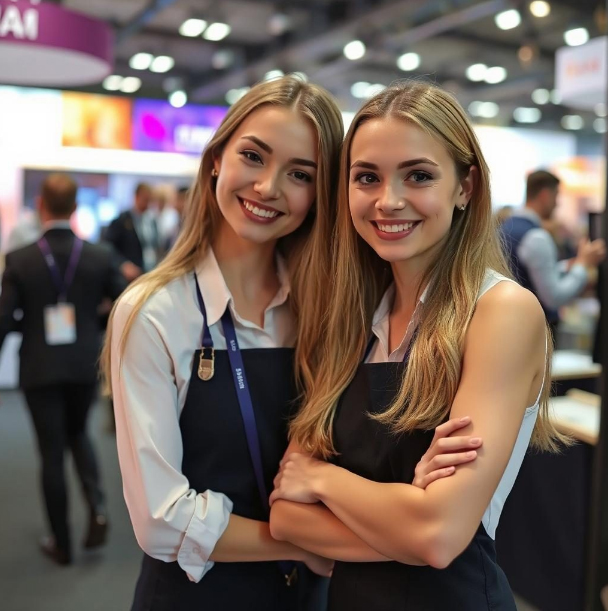
But behind the combines, seed varieties, and agrochemical displays lies a professional class whose work determines whether international agricultural cooperation actually happens. These are the hostesses, models, interpreters, and stand assistants who form the human interface between exhibitors and the world.
The Scale That Demands Professional Staff
The numbers explain why professional on-site personnel matter. YUGAGRO 2025 hosted visitors from Turkey, China, India, Spain, and the Czech Republic, with national stands organized by Turkish and Chinese companies. Iran and Abkhazia sent official delegations to the exhibition. The audience composition was overwhelmingly professional: 30% company executives and owners, 14% deputy heads, 21% department heads, and 28% managers and specialists.
This is not a consumer trade show. Visitors arrive with specific business objectives. In 2025, 31% came looking for products and services for their operations, while 27% sought general industry information. For exhibitors, the quality of the human interface at their booth directly determines whether these professionals stop, engage, or walk past.
Hostesses: The First Impression
At an exhibition of YUGAGRO’s scale, first impressions are formed in seconds. A hostess positioned at the front of a booth serves as the initial filter, welcoming guests, distributing promotional materials, and drawing visitors toward the stand.
The role demands more than a welcoming smile. Professional hostesses at YUGAGRO handle visitor registration, badge scanning, and initial qualification—asking preliminary questions to determine whether a visitor is a farm director, an agronomist, a procurement manager, or simply browsing. This triage function saves valuable time for technical and sales staff who need to focus on qualified leads.
Recruitment for YUGAGRO 2025 illustrates the practical requirements. One posting for hostesses specified height from 173 cm, clothing size XS-S, and “communicative, smiling” candidates. The work involved distributing promotional materials and attracting clients to the client’s stand, with hours from 10:00 to 16:00 across three days. The rate was 650 rubles per hour, or 3,900 rubles per day. Another posting offered 550 rubles per hour for “active girls with pleasant appearance” to work at a stand.
For international exhibitors, local Russian hostesses offer distinct advantages. They understand Russian business culture, speak the language natively, and can navigate the social nuances that shape interactions with agricultural professionals from across the country.
Models: Visual Representation in a B2B Context
The presence of models at YUGAGRO differs from consumer trade shows. At an agricultural exhibition, the model’s role is not to attract casual passersby but to embody the brand’s identity for a professional audience. A manufacturer of agricultural machinery or crop protection products may deploy models for visual impact at a product launch or to draw attention to a new seed variety.
The work requires sustained engagement through long exhibition days. YUGAGRO’s schedule runs from 9:00 to 17:00 on the first three days, with the final day closing at 15:00. Standing for hours, maintaining poise through repetitive interactions, and projecting enthusiasm regardless of fatigue are professional skills, not merely presence.
Interpreters: The Linguistic Bridge
Interpretation at YUGAGRO is not a generic language service. The exhibition covers highly specialized ground: agricultural machinery and spare parts, agrochemicals and seeds, storage and processing equipment, irrigation and greenhouse technologies. The terminology alone—from soil cultivation equipment and plant protection products to grain drying systems and precision agriculture technologies—requires domain familiarity that generalist interpreters may lack.
The demand is visible in recruitment for the exhibition. A posting for a Russian-English interpreter for YUGAGRO described the role as providing “accurate and prompt translation of business negotiations, presentations, and technical descriptions” for participants from different countries. Responsibilities included simultaneous and consecutive interpretation, accompanying guests at stands, and “timely adaptation of terminology to the agro-industrial complex.”
The stakes are commercial. Russian agricultural professionals—particularly those from regional farms and agro-enterprises—may not speak English or other foreign languages. For foreign exhibitors, the interpreter is the bridge between their product and potential Russian buyers. Accuracy in discussing technical specifications, regulatory compliance, or contract terms can determine whether a negotiation advances or stalls.
Stand Assistants: Beyond Greeting
The stand assistant role at YUGAGRO operates in a specific professional context. Visitors include representatives of agricultural firms, agro-complexes, and peasant farms (7,164 in 2024), suppliers of agricultural machinery and spare parts (3,532), and suppliers of agrochemical products or seed materials (2,325).
In this environment, the stand assistant functions as a triage specialist. A visitor approaching a booth may be a farm director looking for irrigation equipment, a distributor evaluating a new product line, or a government official on an official tour. The assistant must assess the visitor’s purpose, answer basic inquiries, and determine when to escalate to the company’s senior representatives. This requires product knowledge, situational awareness, and the cultural fluency to adjust communication styles.
The Unseen Labor of Agricultural Trade
When the pavilions close and the exhibitors dismantle their stands, the work of YUGAGRO’s human infrastructure fades from view. The photographs capture signed agreements, machinery demonstrations, and the award ceremony for the AGROLEADER 2025 prize. They do not capture the interpreter who spent twenty minutes clarifying a technical term, the hostess who guided a lost delegation to the correct conference hall, or the stand assistant who managed a crowded reception desk with composure.
YUGAGRO is a platform for the development of Russia’s agro-industrial complex. Minister Lut emphasized that the exhibition is “the most large-scale exhibition of means of production for crop production, our main industry.” Governor Kondratyev noted that the event “has become part of the brand of the Krasnodar region.”
Behind these institutional statements lies human interaction. Every bilateral meeting, every technical discussion, every follow-up negotiation requires linguistic and cultural mediation. The professionals who provide that mediation—the hostesses, models, interpreters, and stand assistants—are the ones who make agricultural cooperation a functional reality rather than a policy aspiration.
At YUGAGRO, the machinery may be the attraction. But the deals depend on the people who can explain them.