Expograd Yug is the largest exhibition platform in Southern Russia. The complex spans 35,600 square meters of enclosed exhibition space across four pavilions, with an additional 16,000 square meters of open-air exhibit areas, five conference halls, seven meeting rooms, and parking for 2,400 vehicles. Built in 2015 to UFI standards, it sits in the northern part of Krasnodar, a fast-growing district of a city that has positioned itself as a strategic center for trade between Russia and its southern neighbors.
The venue hosts a dense calendar of exhibitions: YugBuild for construction and finishing materials, YugAgro for agricultural machinery, the Kuban Fair for regional producers, and the Region of Innovation South forum for industrial technology. Each of these events attracts international exhibitors, regional buyers, and government delegations. And each depends on a professional class whose work rarely appears in the official program: the interpreters, stand assistants, hostesses, and models who make international trade possible at the human level.
The Infrastructure of Communication
Expograd Yug was designed with international events in mind. The technical equipment available to exhibitors includes sound and multimedia systems, projection and lighting equipment, and—critically for a venue serving foreign delegations—simultaneous interpretation systems. The complex offers a range of conference spaces, from a 400-seat main hall to smaller meeting rooms of 30 to 74 square meters, each suited to different scales of negotiation and presentation.
But technology alone does not bridge languages. The human interpreter remains the essential element. At Expograd Yug, the demand for interpretation spans languages that reflect the region’s commercial geography: Turkish for agricultural machinery buyers, Chinese for industrial technology delegations, and English for the broadest range of international contacts.
One recruitment notice from a 2024 exhibition at the venue illustrates the specificity of this demand. The posting sought hostesses with Turkish language skills for UMIDS, the international exhibition of furniture, interior, and woodworking. The requirement stated explicitly: “Translator level preferred.” This is not a generalist role. It reflects the reality that at Expograd Yug, the person at the reception desk may also be the person who negotiates a technical specification in a second language.
Stand Assistants and Hostesses: The Frontline
The stand assistant at a Southern Russian trade fair operates in a particular context. Visitors are not casual consumers but industry professionals: agroholdings, distributors, farm owners, construction companies, and procurement specialists actively seeking suppliers. YugAgro alone draws more than 19,000 visitors and 650 exhibitors from over 40 regions. The Kuban Fair fills over 40,000 square meters with more than 800 producers from across the Krasnodar region.
In this environment, the stand assistant functions as a triage specialist. A visitor approaching a booth may be a farmer looking for irrigation equipment, a distributor evaluating a new product line, or a government official on an official tour. The assistant must assess the visitor’s purpose, answer basic inquiries, and determine when to escalate to the company’s senior representatives. This requires product knowledge, situational awareness, and the cultural fluency to adjust communication styles.
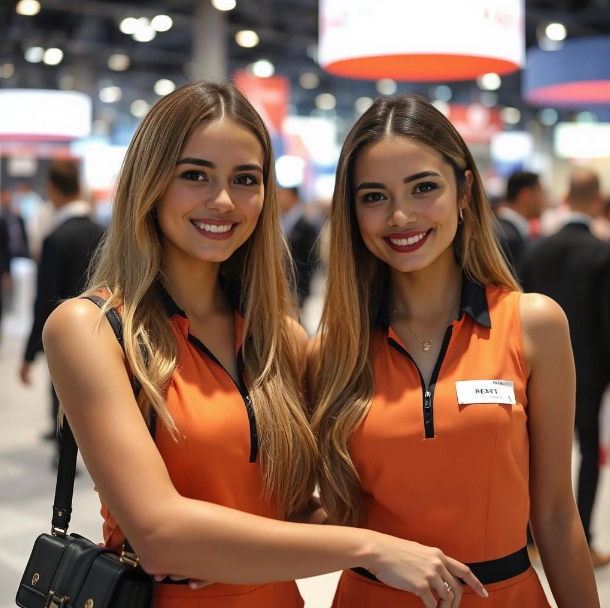
Hostesses at Expograd Yug serve a dual function: reception and representation. They manage the physical space of the booth—greeting guests, coordinating meeting schedules, maintaining the visual standards that brands demand. At a venue where national pavilions and regional collective stands compete for attention, the human presentation of a stand communicates as much as the machinery on display. The design of the venue itself, with its striking black-and-white entrance block and open-plan interiors, sets a visual standard that exhibitors are expected to match.
Models: Visual Representation in a B2B Context
The presence of models at Expograd Yug differs from consumer trade shows. At a construction or agricultural exhibition, the model’s role is not to attract casual passersby but to embody the brand’s identity for a professional audience. A manufacturer of finishing materials presenting at YugBuild may use models to demonstrate product applications. An agricultural equipment company at YugAgro may deploy models for visual impact at a product launch.
The work requires sustained engagement through long exhibition days. Opening hours typically run from 10:00 to 18:00, with the final day closing at 15:00. Standing for hours, maintaining poise through repetitive interactions, and projecting enthusiasm regardless of fatigue are professional skills, not merely presence.
The Local Ecosystem
Expograd Yug’s official services include temporary personnel as a listed offering, signaling that the venue recognizes the need for professional staffing as part of its exhibition infrastructure. The primary tenant is KrasnodarEXPO, a member of the international exhibition operator ITE, which brings additional organizational standards to the venue’s operations.
For international exhibitors, the availability of vetted local personnel solves a critical logistical problem. A Chinese or Turkish company sending a small delegation to Krasnodar cannot staff every booth position with home-country employees. Local interpreters, stand assistants, and hostesses provide the language capabilities and cultural knowledge that make meaningful interaction possible.
The regional context matters. Krasnodar Krai is one of Russia’s leading regions for agricultural production, investment potential, and housing construction. The exhibitions at Expograd Yug serve as commercial infrastructure for this regional economy, connecting local producers with national and international buyers. The professionals who work these exhibitions are the human interface through which those connections are made.
The Unseen Labor of Regional Trade
When the pavilions close and the exhibitors dismantle their stands, the work of Expograd Yug’s human infrastructure fades from view. The photographs capture signed agreements and product demonstrations. They do not capture the interpreter who spent twenty minutes clarifying a technical term, the stand assistant who guided a lost delegation to the correct conference hall, or the hostess who managed a crowded reception desk with composure.
The exhibitions at Expograd Yug are platforms for the economic development of Southern Russia. That development depends on infrastructure, policy, and investment. But at the ground level, in the exhibition halls and meeting rooms, it depends on people—professionals whose skills in language, communication, and presentation transform a collection of booths into a functioning marketplace.