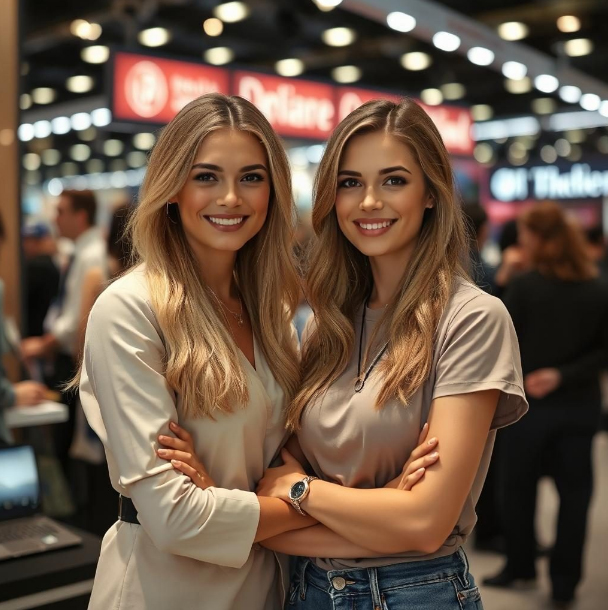
Ekaterinburg-Expo is not merely a venue. It is Russia’s largest international exhibition center, a 47,000-square-meter complex of four pavilions positioned strategically on the border between Europe and Asia. With a congress center capable of hosting 4,000 people, 6,000 parking spaces, and proximity to Koltsovo Airport measured in minutes rather than kilometers, it is designed for scale.
But scale is inert without human translation. The exhibitions that fill Ekaterinburg-Expo’s halls—INNOPROM, the Russia-China Expo, and dozens of specialized trade fairs—rely on a professional class whose work determines whether international industrial cooperation actually happens. These are the interpreters, stand assistants, hostesses, and models who form the connective tissue between exhibitors and the world.
The Venue That Demands Support
The numbers explain why professional personnel matter. INNOPROM alone draws over 850 organizations occupying 50,000 square meters, with national pavilions from Indonesia, Kazakhstan, Uzbekistan, Kyrgyzstan, and Belarus. The Russia-China Expo in Yekaterinburg featured over 300 Chinese companies from 18 provinces, with more than 130 Russian and Chinese companies participating in business contact exchanges.
This volume of international traffic requires a workforce capable of operating across languages and cultural contexts. Interpreters must navigate specialized vocabulary across industries that span metallurgy, digital technology, energy, chemical production, and machine building. Stand assistants must triage inquiries from industry professionals who know exactly what they are looking for. Hostesses and models must represent brand identities under the pressure of continuous public engagement.
Interpreters: The Technical Bridge
Interpretation at Ekaterinburg-Expo is not a generic language service. The demand is for specialists who understand industrial processes, technical specifications, and the commercial stakes of the conversations they facilitate.
The Ural Chamber of Commerce and Industry, which provides interpretation services for events at the venue, emphasizes that success in international negotiations depends 90% on communication quality. Their roster includes simultaneous interpreters working at the level of company and government leaders, with equipment including soundproof cabins, infrared language distribution systems, and professional conference systems.
The practical demands are visible in the profiles of working interpreters. One Yekaterinburg-based Chinese interpreter with seven years of life and work experience in China lists expertise spanning food industry, mining, precious stones, electrical equipment, factory machinery, metalworking, and equipment commissioning. This is not a generalist profile. It reflects the reality that at Ekaterinburg-Expo, the interpreter must function as a technical communication specialist, not merely a language conduit.
University partnerships reinforce this specialization. Ural State Pedagogical University staff serve annually as interpreters at INNOPROM, accompanying foreign businesspeople and consular officials. They note that work at the exhibition requires knowledge of current international business agendas and the ability to conduct negotiations amid loud music, dynamic location changes, and simultaneous conversations with large groups.
Stand Assistants and Hostesses: Beyond Reception
The stand assistant role at an industrial exhibition differs fundamentally from consumer trade shows. Visitors are not casual shoppers but industry professionals with specific questions about manufacturing capacity, logistics capabilities, or partnership terms. A stand assistant must quickly assess whether an approaching visitor warrants escalation to senior representatives.
The staffing ecosystem in Yekaterinburg reflects this need. Local agencies provide hostesses, stand assistants, promotional models, helpers, interpreters, promoters, and project coordinators as integrated services. The bundling signals that effective exhibition participation requires a coordinated human interface, not isolated role fulfillment.
The work itself is physically and emotionally demanding. A first-hand account from a hostess at INNOPROM describes six hours of standing in one place, with phones confiscated for security, professional hair and makeup applied before shifts, and strict behavioral standards enforced through fines. The same account notes that while the hourly rate of 250 rubles attracted many university students, the reality of standing without meaningful work for hours proved exhausting.
Models: Visual Representation Under Pressure
The presence of models at Ekaterinburg-Expo reflects the exhibitions’ dual nature as both business platforms and brand showcases. At a venue where national pavilions compete for attention, the human presentation of a stand communicates as much as the machinery on display.
INNOPROM’s hostess casting is described as rigorous and multi-stage. Applicants submit video introductions in both Russian and English, undergo personal interviews, and face selection criteria emphasizing both language capability and what the organizers describe as model appearance. Preference is given to candidates who can demonstrate spontaneous English communication with foreign guests.
The work requires sustained engagement despite repetitive interactions. Models and hostesses serve as the first point of contact for VIP guests, manage reception desks, and maintain the visual standards that major brands demand. The emotional labor of projecting enthusiasm through long exhibition days is a professional skill, not merely presence.
The Unseen Labor of International Trade
When the plenary sessions conclude and the pavilions empty, the work of Ekaterinburg-Expo’s human infrastructure fades from view. The cameras capture handshakes and prototypes. They do not capture the interpreter who spent twenty minutes clarifying a technical specification, the stand assistant who guided a lost delegation to the correct pavilion, or the hostess who managed a crowded reception desk with composure under pressure.
The Russia-China Expo, held at Ekaterinburg-Expo, symbolizes the strategic importance of these events: a platform facilitating expansion and diversification of partnership between two major economies. INNOPROM positions itself as Russia’s main industrial, trade, and export platform, organized by the Ministry of Industry and Trade and the Sverdlovsk regional government.
Behind these institutional statements lies human interaction. Every bilateral meeting, every technical discussion, every factory visit during the exhibition’s ancillary programs requires linguistic and cultural mediation. The professionals who provide that mediation—the interpreters, stand assistants, hostesses, and models—are the ones who make international cooperation a functional reality rather than a diplomatic aspiration.
At Ekaterinburg-Expo, the machines may be the attraction. But the deals depend on the people who can explain them.