INNOPROM is not merely an exhibition. It is Russia’s flagship industrial platform, a four-day summit where prime ministers walk the halls, where Rostec and Roscosmos unveil prototypes, and where delegations from fifty countries converge on Yekaterinburg to negotiate the future of manufacturing. With over 850 companies occupying 50,000 square meters across all four pavilions of the Ekaterinburg-EXPO center, the scale is formidable.
But scale is inert without human translation. Between the titanium alloys and the robotics demonstrations, between the plenary sessions and the booth negotiations, there exists a professional class whose work determines whether international industrial cooperation actually happens. These are the interpreters, stand assistants, hostesses, and models—the human interface of industrial diplomacy.
The Linguistic Bridge in a Technical Terrain
INNOPROM’s content is aggressively technical. Discussions span hydrogen electrolyzers, digital twin simulators, 5G+AR remote collaboration platforms, and high-precision CNC machining tolerances. A Japanese or German engineer explaining tolerance parameters to a Russian plant manager cannot afford a translator who guesses.
This is why interpretation at INNOPROM is not a generic language service. The recruitment requirements explicitly demand interpreters with relevant technical backgrounds. The vocabulary alone creates a barrier: a generalist interpreter fluent in business Russian will falter when the conversation shifts to rare-earth metal extraction or radio-pharmaceutical production.
The stakes are commercial and sometimes diplomatic. When five heads of government toured the exposition on opening day—including the Prime Ministers of Russia, Armenia, Belarus, Kazakhstan, and Kyrgyzstan—the information flowing between them and the exhibitors passed through professional interpretation. At the plenary session, where Mikhail Mishustin emphasized international technological cooperation, the message reached international audiences through simultaneous interpretation systems requiring teams of at least two interpreters per language working in shifts.
The Ecosystem of Exhibition Personnel
The roles at INNOPROM form a hierarchy of skill and responsibility.
Stand assistants are the frontline. They greet visitors, manage inquiries, and determine whether a passing engineer is a potential partner or a casual observer. At an industrial fair, this requires more than a smile. A stand assistant must understand the product sufficiently to triage inquiries—to recognize when a conversation warrants escalation to a company representative. The distinction between a general attendant and one with foreign language capability is reflected in pricing: in the Russian exhibition market, a stand attendant without languages commands approximately 7,308 rubles per day, while one with basic foreign language skills earns around 9,576 rubles.
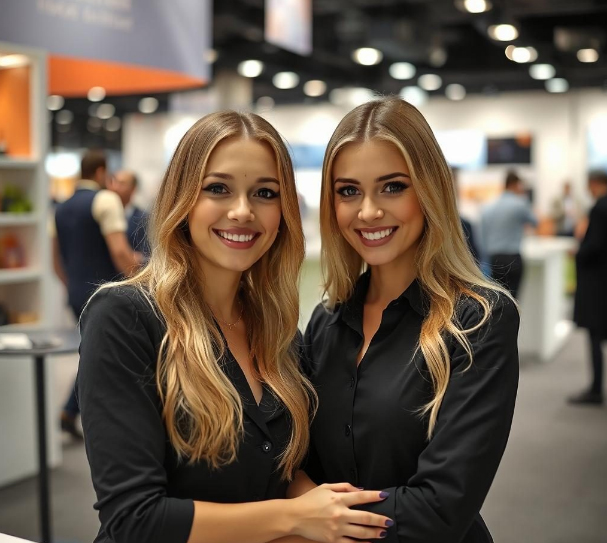
Hostesses and models serve a dual function: reception and representation. They manage the physical space of the booth—greeting guests, coordinating meeting schedules, maintaining the visual standards that a brand like Rostec or Roscosmos demands. At a fair where national pavilions compete for attention, the human presentation of a stand communicates as much as the machinery on display. Indonesia’s 1,512-square-meter national pavilion, the largest at INNOPROM 2026, was described as not only an exhibition space but also a platform for business communication, negotiations, and presentations. The personnel staffing such a space are part of that communication.
Interpreters occupy the most specialized tier. In the Russian exhibition context, a professional interpreter with a linguistics degree working a Moscow exhibition commands rates starting at 160-190 euros per day, with technical translation priced higher. At INNOPROM, where the technical density is extreme and the international delegations include high-level government officials, the premium on qualified interpretation is correspondingly higher.
The Yekaterinburg Advantage
Unlike Moscow or St. Petersburg, Yekaterinburg possesses a distinctive interpretation ecosystem that has matured over decades. Since 1994, the city has hosted the Business-Bureau of the Association of Interpreters, an institution known for rigorous training and what one account describes as special forces style practical courses.
This local capacity matters for international exhibitors. A Chinese industrial delegation arriving in Yekaterinburg for INNOPROM cannot rely on machine translation for high-stakes B2B negotiations. The cultural dimensions of Russian business etiquette—when to be direct, when to leave negotiating room—require human judgment that no application can replicate. Local interpreters who understand both the technical vocabulary and the cultural choreography become essential infrastructure.
The Work Behind the Deals
The numbers from INNOPROM 2026 tell a story of scale: over 50,000 visitors across four days, delegations from more than 50 countries, 24 Russian regions presenting collective stands, and 5 national expositions from Indonesia, Kazakhstan, Uzbekistan, Kyrgyzstan, and Belarus.
Behind each of those statistics lies human interaction. The Indonesian delegation alone comprised more than 250 people, with over 50 companies participating in the business program. Every bilateral meeting, every technical discussion, every factory visit during the exhibition’s ancillary programs required linguistic mediation.
The interpreters who staff these interactions are not interchangeable. They must prepare in advance, often requesting terminology glossaries and testing their familiarity with specific sub-sectors—metallurgy, industrial IT, unmanned systems, or aerospace. Professional agencies recommend booking top technical interpreters months before the exhibition, because the most qualified are locked into contracts by major Russian enterprises and international delegations well before the doors open.
The Unseen Labor
When the plenary session concludes and the prime ministers depart, when the last contract is signed and the pavilions begin to empty, the work of the exhibition’s human infrastructure fades from view. The cameras capture handshakes and prototypes. They do not capture the interpreter who spent twenty minutes clarifying a tolerance specification, the stand assistant who guided a lost delegation to the correct pavilion, or the hostess who managed a crowded reception desk with composure under pressure.
INNOPROM’s theme for 2026 was Industry 360: Manufacturing Without Borders. The phrase captures the aspiration of industrial cooperation across national boundaries. But borders exist in language, culture, and business practice. The professionals who work the booths and the negotiating tables are the ones who make without borders a functional reality rather than a slogan.
At INNOPROM, the machines may be the attraction. But the deals depend on the people who can explain them.