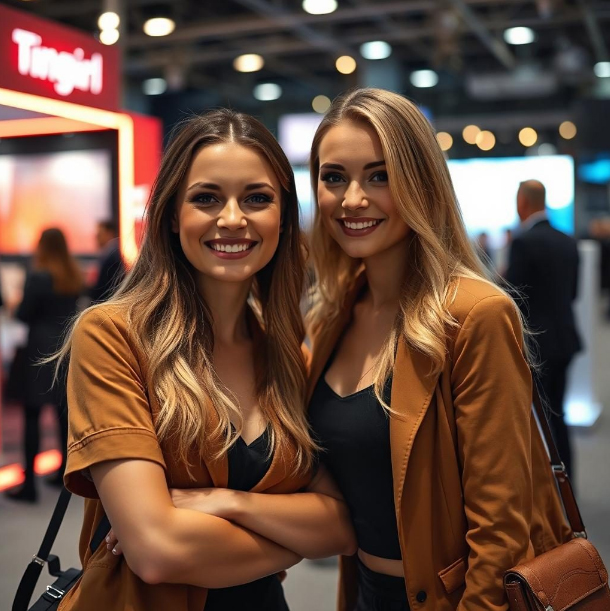
When Italy’s innovation ecosystem gathers at Allianz MiCo for SMAU Milano, the exhibition halls become a dynamic landscape of startups, corporates, investors, and digital pioneers. Amidst the speed pitching sessions, Startup Safaris, and networking areas, a specialized workforce operates at the frontlines of every exhibitor’s space: hostesses, models, interpreters, and booth assistants. Their role is often overlooked, yet they frequently determine whether a visitor stops to engage or walks past a carefully designed exhibition space.
The Specific Demands of an Innovation Trade Show
SMAU is not a general consumer exhibition. The attendees are entrepreneurs, corporate innovation managers, investors, and public administration representatives from across Italy and abroad. With over 50,000 companies involved each year, the event serves as the reference platform for open innovation and business matching. Conversations at a typical stand involve technology partnerships, investment opportunities, and co-innovation projects.
This environment demands a caliber of front-line staff that differs from traditional industrial fairs. Exhibitors require personnel who can navigate the language of innovation while maintaining the energy and professionalism expected at a fast-paced B2B event. The ideal booth assistant at SMAU must grasp enough product knowledge to distinguish whether a visitor is an investor evaluating a startup, a corporate scout seeking solutions, or a journalist covering the innovation beat, and route them accordingly.
What Exhibitors Are Actually Hiring For
The practical scope of these roles at Italian trade fairs is well documented. Professional hostess and booth assistant services cover a range of functions: welcoming visitors, starting conversations, introducing the company and its products, guiding people to scan QR codes and collect contact details, handing out materials, and keeping the booth tidy during breaks and meetings. This description captures the hybrid nature of the modern booth assistant: part receptionist, part lead-generation specialist, part operational support.
For SMAU specifically, exhibitors often need staff who can manage the flow of visitors during speed pitching sessions and ensure that interested parties are connected with the right team members. The ability to work efficiently in a high-energy environment where multiple conversations happen simultaneously is essential.
Interpreters as Business Enablers
The international dimension of SMAU makes interpretation services valuable for exhibitors engaging with foreign partners. SMAU hosts events in London, Paris, Stockholm, and New York, and the Milan edition attracts international delegates through cooperation with the Italian Trade Agency. While Italian and English are the primary working languages, participants from other European markets and beyond may require native-language support.
Professional trade fair interpreters do more than translate words. They serve as bridges between cultures and languages, supporting exhibitors and international visitors in facilitating communication and negotiation. Beyond language proficiency, they understand the technical vocabulary of reference sectors and the specific terminology of trade fairs, business, and legal contexts. For SMAU exhibitors, an interpreter who can fluently discuss technology solutions and investment terms while accurately conveying partnership intentions can transform a superficial booth interaction into a substantive business discussion.
Models and Brand Ambassadors: Innovation Representation
The term “model” in the context of an innovation trade show carries a different connotation than in consumer fashion or automotive exhibitions. At events like SMAU, models function as brand ambassadors selected for presentation, communication skills, and the ability to project a professional image that aligns with the company’s identity. Their role is representational rather than decorative — embodying the forward-thinking, dynamic qualities that innovation partners expect.
Agencies providing models for Italian trade fairs emphasize that their role includes brand image coordination, stand representation, product presentations, live demonstrations, and professional stage presence with clear communication. For startups and corporate innovation labs exhibiting at SMAU, the selection criteria emphasize communication ability, linguistic competence, and the capacity to engage visitors intelligently about technology solutions, not merely to attract foot traffic.
Why This Support Function Matters More Than Ever
SMAU Milano 2026 continues to evolve as a comprehensive platform for the Italian innovation ecosystem, offering Startup Safaris, speed pitching sessions, and dedicated networking areas where participants can analyze business opportunities. The event’s format is designed to maximize direct involvement — visitors can learn, be inspired, meet people, and touch real innovation through immersive experiences.
In this fast-paced, content-driven environment, the first thirty seconds a visitor experiences at a stand carry disproportionate weight. A knowledgeable hostess who can immediately identify whether a visitor needs to speak with the technical founder, the business development lead, or the investor relations contact saves everyone time. A multilingual interpreter who can facilitate a spontaneous meeting with a walk-in partner from a target market creates value that no amount of pre-scheduled appointments can replicate. A booth assistant who captures complete contact details and follows up post-show converts a passing curiosity into a qualified lead.
Practical Considerations for Exhibitors
For companies planning their SMAU presence, staffing decisions should begin as early as stand design. The size of the exhibition space, the number of meeting areas, the languages represented among target partners, and the intended daily flow of visitors all inform how many hostesses, interpreters, and support staff are required.
Agencies specializing in Italian trade fair staffing recommend early booking, particularly for multilingual personnel who are in highest demand. The two-day show schedule — typically running from mid-morning through late afternoon — demands stamina and consistency from front-line staff. Rotating personnel across shifts prevents fatigue from degrading the quality of interactions. Proper briefing is essential: staff should receive clear instructions about the exhibitor’s products, target audience, and desired tone before the event begins.
For exhibitors, the investment in professional booth staffing should be viewed not as overhead but as a component of the overall commercial strategy. At a show where a single new partnership can justify the entire cost of participation, the personnel who make those connections possible are not a luxury — they are essential infrastructure.