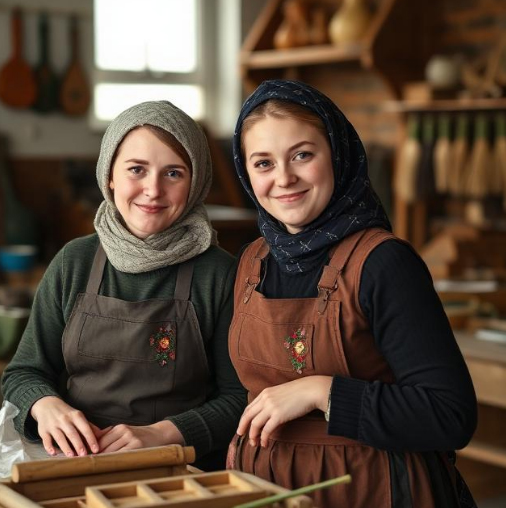
The Russian handicraft market is experiencing a remarkable renaissance, blending centuries-old traditions with modern entrepreneurial energy. From the iconic Dymkovo clay toys of Kirov to the intricate Vologda lace and Gzhel porcelain, Russia’s folk arts are not merely surviving—they are evolving into a significant economic force. With a projected market size reaching nearly $45 billion by 2034, this sector is carving out a unique space in the national economy.
Market Size and Economic Impact
The handicrafts sector in Russia is substantial and growing. The broader handicrafts market was valued at USD 23.58 billion in 2025 and is expected to nearly double, reaching USD 44.95 billion by 2034, representing a compound annual growth rate of 7.36%.
Within this larger ecosystem, entrepreneurs specializing in folk arts and crafts (Narodnye Khudozhestvennye Promysly, or NHP) generated over 24 billion rubles in annual income. Approximately 1,300 such enterprises operate in this space, employing about 5,000 people, while a broader community of more than 35,000 small and medium-sized businesses can be classified as artisans—seamstresses, carpenters, jewelers, blacksmiths, and other handcraft producers.
Product Diversity and Leading Segments
Among product categories, ceramics dominate the handicrafts market, holding the largest market share in 2025 and projected to deliver the fastest growth through 2034. Other key segments include woodware, art metal ware, hand-printed textiles and scarves, embroidered and crocheted goods, imitation jewelry, and sculptures.
Russia is home to nearly one hundred recognized folk arts and crafts items registered as regional brands. These include world-famous crafts such as:
- Gzhel – blue-and-white porcelain painting
- Vologda Lace – intricate handwoven lacework
- Dymkovo Toy – hand-molded and painted clay figurines from Kirov, with over 400 years of history
- Tula Samovars – traditional metal tea urns
- Fedoskino Miniature – lacquer painting on papier-mâché
- Bashkir Shawls and Carpets – traditional textiles from the Republic of Bashkortostan
The peoples of the Caucasus, as well as indigenous communities from the North, Siberia, and the Far East, have also contributed protected regional brands, including Yakut boots (untas) and Koryak-style ornaments from Kamchatka.
The Digital Transformation and E-Commerce Growth
One of the most significant drivers of the handicraft market’s growth has been the rise of online platforms. Marketplaces like “Yarmarka Masterov” (Masters Fair) have become the primary channels for artisans to reach consumers. In 2023 alone, 75,500 new stores were registered on the platform, and the number of new buyers exceeded 420,000.
The trend extends beyond dedicated craft platforms. The turnover of goods for handicrafts and sewing increased by 21% over the past year, with the number of purchases rising 10% and the average check reaching 4,201 rubles. Artisans are increasingly using online storefronts, mini-apps in messengers, and various payment solutions to monetize their crafts—a shift from the earlier practice of selling through personal social media pages.
The Demographic Profile: Women Leading the Way
The handicraft sector has a distinctly female face. Women account for 67% of all individual entrepreneurs in folk arts and crafts, reflecting a broader trend of women turning creative pursuits into sustainable businesses. The sector also demonstrates remarkable stability: 73% of these enterprises have been operating for more than three years, creating a stable framework for the industry and providing 96% of sector employment.
Government Support and Legal Protection
The Russian government has been actively fostering the development of folk arts and crafts through both legal and financial mechanisms. Since 2016, approximately 100 NHP enterprises have received subsidies for utility costs, production modernization, material purchases, and insurance premiums. In 2022, the government expanded the use of these subsidies to include online store development, internet advertising, branded packaging creation, and exhibition space expansion.
A key development has been the legal protection of regional crafts through Geographical Indications (GI) and Appellations of Origin (AO) mechanisms. While Russia introduced the concept of “Appellation of Origin” in 1992, the Civil Code was amended in 2020 to introduce Geographical Indications, which have less stringent criteria regarding the place of production and do not require an authorized certificate. This has led to a surge in registrations, with the Ryazan, Moscow, and Nizhny Novgorod regions accounting for 21 regional brands between them.
International Recognition and Export Potential
Russian handicrafts are gaining international attention. At the INNOPROM 2025 exposition in Yekaterinburg, the Department Store of the National Centre RUSSIA set attendance records with over 100 producers from 46 regions showcasing their crafts. The success was so significant that the official delegation of Saudi Arabia, the partner country of the event, invited Russian artisans to present at INNOPROM 2026 in Riyadh.
The Dymkovo toy, with its 400-year history, has been a particular highlight at international events, including a trade fair in Uzbekistan where master craftswoman Larisa Ushakova demonstrated traditional painting techniques. As Ushakova explained, the craft’s value lies precisely in the manual labor: “If we remove manual labour, the main thing — the living energy of the master — disappears.”
Drivers of Growth
Several factors are propelling the handicraft market forward:
- Rising Domestic Tourism: Increased interest in Russian regions and national cultures has boosted demand for authentic local crafts.
- Consumer Preference for Authenticity: Middle-class consumers increasingly view handmade products as higher quality and more emotionally resonant alternatives to mass-produced goods.
- Digital Platforms: Online marketplaces have dramatically expanded artisans’ reach and simplified the purchasing process.
- Government Policy: Legal protection of regional brands and financial support programs have created a more favorable environment for artisans.
Challenges and Future Outlook
Despite its growth, the handicraft industry faces challenges. According to industry associations, financial support alone is insufficient—artisans need help with marketing, finding sales markets, and promotion. There is also an increasing demand for training programs and business consultations.
The sector is transitioning from a cottage industry into a more structured economic segment, with the line between hobby and profession becoming increasingly blurred as more artisans register as self-employed and professionalize their operations.
The future of the Russian handicraft market appears bright. As the sector continues to digitalize and artisans gain access to global markets through platforms and international exhibitions, the unique blend of tradition and modern commerce positions Russian folk arts for sustained growth. The question is not whether the traditions will survive—they have endured for centuries—but whether the market can provide the support artisans need to thrive in an increasingly competitive global landscape.