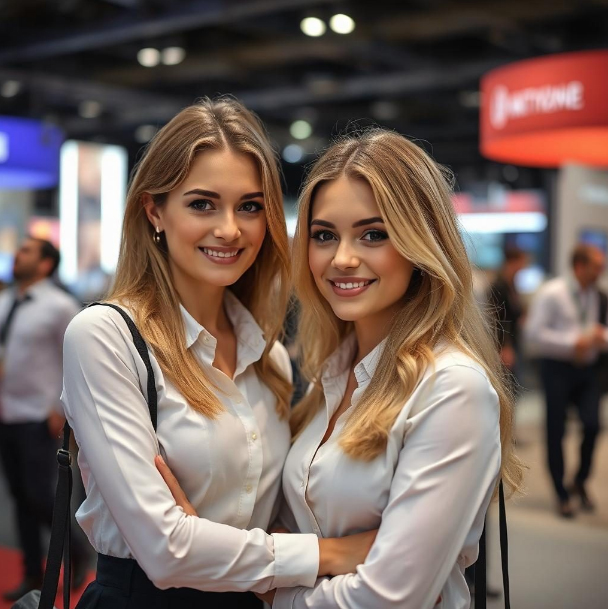
IdeenExpo is not a conventional trade fair. Held every two years on the Hanover exhibition grounds, it is Europe’s largest technology and innovation festival for young people, drawing over 400,000 visitors across nine days in 2026. With more than 330 exhibitors, over 800 hands-on exhibits, and a program of hundreds of workshops and live concerts, the event serves a dual purpose: inspiring young people to pursue STEM careers and connecting companies with the skilled workers of tomorrow. In this high-energy, interaction-heavy environment, the personnel who staff the exhibition floor—stand assistants, hostesses, promotional models, and interpreters—play a distinctive role. Their function is less about formal protocol and more about engagement, explanation, and creating the kind of personal connection that turns a curious teenager into a future applicant.
The Unique Character of IdeenExpo
Understanding the staffing needs at IdeenExpo requires understanding what makes the event different from a standard B2B trade fair. The core audience is students in grades 7 through 13, along with teachers, parents, and young adults. The event’s motto, “Mach doch einfach!” (“Just do it!”), signals its hands-on philosophy: visitors are meant to touch, try, experiment, and ask questions. The exhibitors—companies like Continental, NiedersachsenMetall, ZF, and the German Maritime Centre—are not primarily there to sell products. They are there to present career opportunities, training programs, and the excitement of technical professions.
This purpose shapes every staffing decision. A stand at IdeenExpo must communicate on the level of its young visitors, often through apprentices and dual-study students who can speak authentically about their own paths. The supporting personnel—whether called hostesses, stand assistants, or promotional staff—must be capable of the same kind of accessible, enthusiastic engagement.
Stand Assistants and Hostesses: Engaging the Next Generation
The role of stand assistant at IdeenExpo is more akin to an interactive facilitator than a traditional booth receptionist. According to event staffing agency FAIREVER, which provides personnel for the Hanover event, the requirements include “active engagement with pupils, students, and young talents,” support for hands-on stations and interactive exhibits, communication of training and career opportunities, and management of visitor flows. The staff must be communicative, personable, and capable of understanding and explaining complex technical content in a way that resonates with a young audience.
This is reflected in how exhibitors themselves staff their stands. At the LIAG Institute for Applied Geophysics, student assistants were hired specifically to support “public engagement at the exhibits” and provide “simple explanations” after being briefed with talking points. The German Maritime Centre’s joint stand featured thirteen interactive stations where visitors could use VR headsets to explore a virtual ship engine room—requiring staff who could guide the experience and explain its relevance to maritime careers. At NiedersachsenMetall’s ProductionArena, nine industrial robots performed in a show with a dancer, creating a spectacle that demanded staff capable of managing crowds and channeling excitement into career conversations.
For hostesses working at IdeenExpo, the emphasis is on active, target-group-oriented communication rather than formal reception. The goal is to draw young visitors into the stand, initiate conversations, and create positive experiences that linger in memory. This requires a different energy than a traditional trade fair hostess role—more animation, more patience, and a genuine interest in the subject matter.
Promotional Models: Visual Presence in a Youth-Focused Environment
Promotional models at IdeenExpo serve a function shaped by the event’s scale and competition for attention. With over 330 exhibitors spread across more than 100,000 square meters, standing out requires visual strategy. Models can serve as visual anchors that draw visitor traffic and create photographic moments that extend a brand’s reach through social media—a significant consideration given the presence of influencers like SelfieSandra and Reeze at the 2026 event.
The staffing agency FAIREVER explicitly offers “promotion staff” for IdeenExpo alongside hostesses, positioning them for “promotional activities and activations”. This can range from distributing branded materials and managing interactive prize wheels to participating in stage shows or photo opportunities. The event’s live program, which included concerts by SDP and Zartmann, creates additional contexts where promotional models might be engaged for sponsor activations or brand presence in high-traffic areas.
However, the youth focus means that promotional modeling at IdeenExpo carries a different tone than at consumer fairs. The audience is largely under eighteen, and the event’s educational mission is taken seriously by organizers and exhibitors alike. Promotional staff must fit within that atmosphere—approachable and energetic, but also appropriate for a school-oriented environment.
Interpreters: Language Support in a Predominantly German Context
IdeenExpo’s primary language is German. The event is produced by IdeenExpo GmbH, a German organization, and the vast majority of its visitors come from across Germany. The job listings for IdeenExpo’s own team emphasize “sehr gute Deutschkenntnisse” (very good German skills) as a core requirement, with English described as advantageous rather than essential.
This does not mean interpretation plays no role at IdeenExpo. The event attracts visitors from “ganz Deutschland und dem europäischen Ausland” (all of Germany and European abroad), and exhibitors include international companies and research institutions. For specific delegations, international guests, or exhibitors whose representatives are not fluent German speakers, interpreters may be engaged on a targeted basis. Conference interpreters familiar with the Hanover trade fair circuit have noted IdeenExpo as an event of potential interest alongside CeBIT and the Hanover Fair.
In practice, the need for interpretation at IdeenExpo is likely smaller than at international B2B exhibitions. The event’s core function—inspiring German youth about STEM careers—is inherently local. The more common language-related requirement is for staff who can communicate clearly and engagingly in German, explaining technical concepts to teenagers without jargon or condescension.
The Organizational Context
The staffing ecosystem at IdeenExpo reflects the event’s hybrid nature. IdeenExpo GmbH manages the overall event and employs its own team for communication, marketing, and coordination, but individual exhibitors are responsible for staffing their own stands. Companies and institutions draw on a mix of resources: their own apprentices and dual students, who bring authentic peer-to-peer communication; student assistants hired for the duration of the event; and external service providers like FAIREVER for professional hostesses and promotional staff.
The scale of the operation is substantial. The 2026 event required 5,245 pieces of rental furniture, 1,455 information pillars and presentation modules, and approximately 1,300 spotlights to illuminate the stands and stages. Staffing this environment requires hundreds of individuals working across nine days, from early morning setup to evening concerts.
At IdeenExpo, the personnel who work the exhibition floor are not simply support staff—they are the human interface between industry and the next generation of workers. Stand assistants and hostesses guide young visitors through hands-on experiences, promotional models draw attention in a crowded field, and interpreters (when needed) ensure that language is not a barrier to engagement. The qualities required differ from a traditional trade fair: patience, energy, the ability to explain complex ideas simply, and a genuine interest in connecting with young people. For exhibitors at IdeenExpo, investing in the right staff is not a formality but a direct investment in the event’s core purpose—finding and inspiring the skilled workers of tomorrow.