Gamescom is the world’s largest computer and video game trade fair, held annually in Cologne, Germany. In 2026, the event set new records: over 1,700 exhibitors from 67 countries, 233,000 square meters of fully booked exhibition space, and an expected 350,000 visitors across five days. For the brands exhibiting at this scale, the competition for attention is intense. The personnel who staff the exhibition floor—stand assistants, hostesses, promotional models, and interpreters—play a critical role in turning a booth into a destination. Their function is shaped by the unique culture of gaming: high energy, community-focused, and deeply interactive.
The Character of Gamescom
Gamescom is not a traditional B2B trade fair. It combines a professional business area, where over 30,000 trade visitors network and negotiate, with a massive consumer festival that attracts hundreds of thousands of gaming fans. The event includes the Opening Night Live showcase, esports competitions, cosplay, live concerts, and the first-ever European edition of Games Done Quick speedrunning events. This dual identity means that exhibitors need staff capable of operating in two distinct modes: professional and efficient for trade visitors, and engaging and energetic for the gaming community.
The 2026 edition saw the indie area expand by 16 percent compared to the previous year, with over 420 companies presenting games. Smaller developers competing for visibility against major publishers like Nintendo, Xbox, and Ubisoft rely heavily on booth personnel to draw crowds and create memorable experiences.
Stand Assistants and Hostesses: The Frontline of Engagement
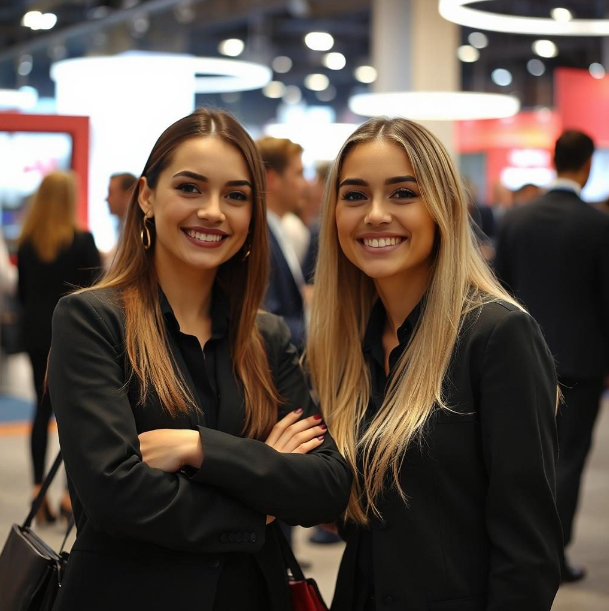
A stand assistant or hostess at Gamescom is the first point of contact for visitors, and the role is more demanding than at a typical trade fair. According to FAIREVER, a Cologne-based event staffing agency that specializes in Gamescom, hostesses and promoters must be capable of active visitor engagement, product presentations in German and English, support for live demos and gameplay sessions, assistance at competitions and cosplay events, and distribution of merchandise and promotional materials.
Job listings for Gamescom 2026 hostess positions reveal the specific expectations. One posting for a themed booth inspired by Middle Eastern fantasy sought candidates whose appearance or background would visually complement the booth’s theme, with tasks including welcoming visitors, guiding large crowds, using tablets to assist visitors, photo and content support, and active guest engagement. Another listing for a Turkish-speaking host specified welcoming visitors, orientation and referral, and general booth support. These examples illustrate that Gamescom hostess roles are often tailored to the specific brand, theme, or demographic an exhibitor is targeting.
The physical demands are significant. Gamescom halls are vast, visitor flows are heavy, and shifts are long. Staff must maintain energy and professionalism throughout. One job listing noted that team members receive water, lunch, and snacks on site, but travel and accommodation are not covered—a reminder that these are often freelance or short-term contract positions.
Promotional Models: Visual Strategy in a Crowded Field
Promotional models at Gamescom serve a distinct function from standard trade fair hostesses. With over 1,700 exhibitors competing for visitor attention, visual impact is a strategic asset. Models can serve as anchors that draw traffic to a stand, create photographic moments that extend a brand’s reach through social media, and add a layer of spectacle to product presentations.
Casting and model agencies like FAMEONME explicitly position models and brand ambassadors for Gamescom, alongside hostesses and promoters. The agency notes that for gaming brands, “credibility, communication strength, and enthusiasm for digital topics” matter as much as appearance. This reflects a shift in the promotional modeling market: gaming audiences are discerning, and models who cannot authentically engage with the content may do more harm than good.
The gaming culture context also creates unique opportunities. Cosplay is a major element of Gamescom, and some exhibitors integrate cosplayers into their booth strategy. The line between promotional model, cosplayer, and brand ambassador can blur, with individuals selected as much for their community credibility as for their visual presentation.
Interpreters: Language Support in a Global Industry
Gamescom is an international event, with exhibitors from 67 countries and visitors from over 130 nations. The business area alone attracts over 30,000 trade visitors, many of whom are negotiating deals, seeking publishing partners, or exploring investment opportunities across language barriers.
Interpretation needs at Gamescom span several contexts. For the business area and gamescom biz platform, professional interpreters facilitate meetings between developers, publishers, and investors from different countries. For exhibitor stands, particularly those of Japanese, Korean, or Chinese companies presenting to a European audience, interpreters may be engaged for product demonstrations and media interviews. The Japanese External Trade Organization (JETRO), for instance, supported 30 Japanese indie titles at Gamescom 2026, a presence that would require Japanese-German or Japanese-English interpretation support.
The languages most in demand at Gamescom reflect the global gaming industry’s centers of gravity: English as the lingua franca, German as the host language, and Japanese, Korean, and Chinese for the major Asian publishers and platform holders. For European exhibitors, French, Spanish, and Polish may also be relevant given the strength of development communities in those countries.
The Service Ecosystem
Cologne has a well-developed infrastructure for supplying Gamescom personnel. Agencies such as FAIREVER, Glowstaff, FAMEONME, and Your Event Scout maintain databases of hostesses, promoters, models, and multilingual staff specifically for the Cologne trade fair circuit. These agencies handle selection, briefing, and on-site coordination, offering exhibitors a turnkey solution for booth staffing.
The staffing model varies. Some exhibitors engage individual freelancers directly through platforms like InStaff or Promotionbasis, paying daily rates that range from approximately 70 to 200 euros depending on experience. Others contract with agencies for full teams, including supervisors for larger crews. The choice depends on budget, the complexity of the booth, and the level of brand representation required.
At Gamescom, the products on display—games, hardware, and technology—are only part of the story. The exhibition’s effectiveness depends on the human layer: the hostess who draws a visitor into a demo, the model who creates a moment worth sharing, the interpreter who ensures that a business negotiation across languages reaches a successful conclusion. For exhibitors at Gamescom 2026, investing in trained, gaming-literate, and multilingual booth personnel is not an auxiliary expense but a core component of a successful trade fair strategy. The venue provides the stage; the people provide the performance.