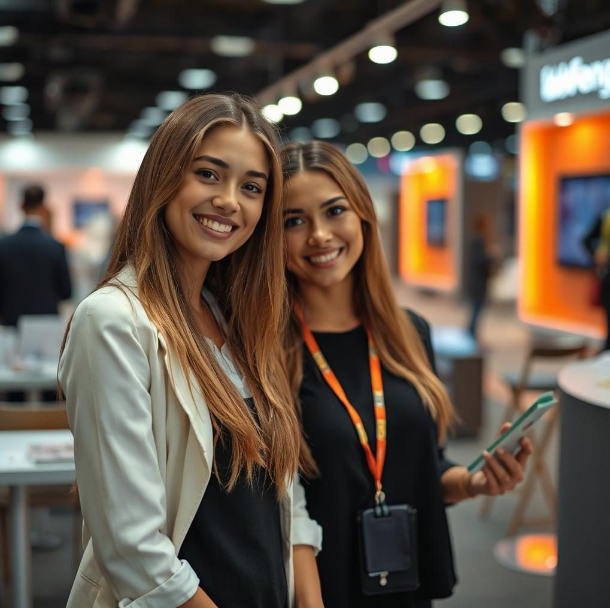
Almaty, Kazakhstan — The Atakent International Exhibition Centre is the undisputed heart of Kazakhstan’s trade show industry. With six modern pavilions spanning nearly 20,000 square meters, it hosts the overwhelming majority of the country’s major exhibitions—from KIOGE and KazBuild to Mining and Metals Central Asia. Year after year, these events draw thousands of exhibitors and visitors from across the region and beyond.
But behind every exhibition hall filled with stands, banners, and business cards, there is a workforce that rarely appears in the official photographs. Interpreters, booth assistants, hostesses, and promotional models are the human infrastructure that makes international trade possible. Their work is demanding, often invisible, and absolutely essential.
The Exhibition Circuit
Almaty’s trade show calendar is dense and relentless. KazBuild alone drew over 8,000 visitors and 639 companies from 30 countries in 2025. Mining and Metals Central Asia featured 515 companies from 30 countries. These are not small regional gatherings—they are international business platforms where deals are initiated, partnerships formed, and markets entered.
Each event generates demand for a specialized workforce that can operate at the intersection of commerce and communication. The roles are distinct, but they share a common foundation: the ability to represent Kazakhstan professionally to the world.
Interpreters: The Bridge Between Languages and Deals
Trade show interpreting in Almaty is a distinct profession within the city’s language services market. Unlike interpreters who work in conference halls or government ministries, trade show interpreters stand at exhibition stands, navigate B2B meetings, and facilitate conversations where a single mistranslated technical term can derail a negotiation.
The work is fast-paced and often improvised. Assignments typically cover the full opening hours of an exhibition—often 10:00 to 18:00 for three consecutive days. Interpreters work standing, moving between stands and meeting rooms, switching between consecutive and whispered simultaneous modes as the situation demands. The content ranges from casual networking to highly technical product specifications, requiring interpreters to absorb specialized vocabulary on the fly.
The defining feature of Almaty’s trade show interpretation market is the dominance of Chinese. The Almaty Chamber of Commerce and Industry has issued open calls for Chinese-language interpreters to participate in business meetings, negotiations, and exhibitions. This reflects the broader structural reality of Kazakhstan’s trade orientation toward its eastern neighbor.
But Chinese is not the only language in demand. One freelance listing for the Central Asia Beauty Expo in May 2026 sought consecutive interpreters between Polish and Russian as well as Polish and Kazakh, with the client explicitly noting that if no single interpreter could handle both pairs, two interpreters working as a team would be acceptable. The lesson is clear: trade show interpreting in Almaty often requires flexibility across multiple language combinations.
For students, trade shows offer a bridge between academic training and professional practice. In April 2026, thirteen students from Kazakh Ablai Khan University’s Faculty of Translation and Philology served as interpreters at the Crystal Bay Tours Expert Exchange Road Show in Almaty. The university framed the experience as gaining “hands-on experience in both simultaneous and consecutive interpreting in a fast-paced, high-pressure context,” developing “resilience under pressure, communicative adaptability, and rapid decision-making.”
Booth Assistants: The First Point of Contact
Booth assistants serve as the first point of contact for visitors navigating Atakent’s sprawling pavilions. Their responsibilities are broad: registration of exhibition visitors, printing of badges, working at the organizers’ stand, and surveying participants and visitors.
Iteca, one of the leading exhibition organizers in the region, regularly recruits students for these roles. The requirements are straightforward but demanding: communication skills, activity, ability to work in a team, organization, punctuality, and PC proficiency. The work assumes full employment during the exhibition—typically three to five days from 9:00 to 18:00.
At private company stands, the role shifts toward lead generation and client engagement. A recent listing for the GCCM CIS 2026 event in Almaty sought “personable, professional assistants to represent the company on the show floor.” The role was focused entirely on front-of-house engagement: welcoming visitors, initiating conversations with potential clients, introducing solutions at a high level, and collecting contact details for follow-up. The requirements were simple and direct: “A friendly personality, strong spoken English, and a professional appearance are essential.”
This is the essence of booth assistance at Atakent: being the human face of a company, the first impression that shapes whether a visitor stops or walks past.
Hostesses: VIP Hospitality and Event Coordination
The term “hostess” carries outdated connotations, but the role itself remains vital in exhibition environments. At Atakent, hostesses handle registration desks, guide VIP guests, and ensure that official ceremonies proceed smoothly.
A typical hostess assignment at the exhibition centre illustrates the practical reality. One listing for work at Atakent described the role as “hostess in the role of a waiter”—making coffee and tea for partners, helping clients at the stand. The requirements were specific: tidy appearance, young, active, responsible, with one’s own promotional uniform (white top and dark bottom). The pay was 1,400 tenge per hour, or 33,600 tenge for the project.
This is not glamorous work. It is hospitality in its most practical form—ensuring that guests feel welcomed, that meetings run smoothly, and that the small details of an event are handled so that business can proceed without interruption.
Promotional Models: The Visual Face of Brands
Promotional models at Atakent serve a function that is part marketing, part performance. They are the visual representatives of brands, trained to attract attention and initiate conversations.
The requirements are explicit in job listings. Promo models are described as “guys and girls who participate in advertising campaigns, promoting goods and services. Promo models are the same promoters, only with higher qualifications and good external appearance. The height of promo models is from 175 cm.”
But the work is more than appearance. Responsibilities include attracting attention to the brand, consulting clients, distributing advertising materials, creating a positive image of the company, working at the stand, interacting with clients, and collecting feedback. At the Beauty Expo, promoters were required to consult guests, distribute promotional materials, present hygiene products, and attract attention to the brand—all for 10,000 tenge per day.
The best promotional models combine presence with genuine communication skills. They are not decoration; they are the first line of customer engagement.
The Common Thread
What unites these four roles—interpreter, booth assistant, hostess, promotional model—is that all of them exist in the space between the exhibitor and the visitor. They are the mediators, the facilitators, the human interface of an exhibition.
Their work is physically demanding and mentally exhausting. They stand for hours, navigate crowded halls, switch between languages and contexts, and maintain professionalism under pressure. They are often young professionals or students gaining their first exposure to international business.
And they matter. At an exhibition centre that hosts events drawing hundreds of companies from dozens of countries, the quality of these human interactions can determine whether a partnership is formed, whether a deal is signed, whether Kazakhstan is seen as a place where business gets done.
The next time you walk through the pavilions of Atakent, look past the stands and the banners. The people handing you a badge, translating a conversation, pouring a cup of coffee, or inviting you to a demonstration—they are the exhibition. Without them, it would just be empty halls.