Almaty, Kazakhstan — For three decades, the Atakent Exhibition Centre has hosted the beating heart of Central Asia’s energy industry. The 30th anniversary Kazakhstan International Oil & Gas Exhibition (KIOGE 2026), held from September 30 to October 2, gathered 501 companies from 58 countries and welcomed 6,567 unique visitors across Pavilions 7 through 11. With 314 international companies and national pavilions from Austria, Germany, India, Italy, China, and Russia, the scale is monumental.
Yet behind every signed contract, every technical demonstration, every high-stakes negotiation between energy ministers and oilfield equipment suppliers lies a workforce that rarely makes the headlines. Interpreters, booth assistants, hostesses, and promotional models are the connective tissue that makes international business possible. This article explores their roles at KIOGE 2026 and why they matter far more than the job titles suggest.
The Multilingual Backbone: Interpreters
Kazakhstan’s position as a bridge between European, Asian, and Middle Eastern energy markets means that a single exhibition hall can buzz with Russian, Kazakh, English, German, Chinese, Arabic, Turkish, and Italian simultaneously. The UAE delegation, led by Minister of Energy and Infrastructure Suhail Al Mazrouei, required Arabic-Russian and Arabic-English interpretation throughout their visit. The German national pavilion, alongside national groups from Austria, India, Italy, China, and Russia, brought distinct language requirements that no single exhibitor could navigate alone.
Interpreters at KIOGE do more than translate words. They must navigate highly technical oil and gas terminology—explaining the difference between a spring support and a heat exchanger to a procurement manager, or clarifying specifications for equipment designed to withstand Kazakhstan’s harsh winters. The conference program alone featured 620 delegates and speakers from 12 countries, covering topics from digital upstream and AI in geology to gas processing and petrochemical development. For a Kazakh exhibitor seeking partnership with a Chinese compressor manufacturer like Kazancompressormash or a UAE energy firm, a skilled interpreter becomes the bridge between entirely different business cultures. Misinterpretation in the energy sector is not merely inconvenient; it can derail multimillion-dollar deals.
The Face of the Brand: Booth Assistants
Booth assistants serve as the first point of contact for visitors navigating the sprawling pavilions. At KIOGE 2026, the business program alone featured strategic sessions on Kazakhstan’s role in global energy value chains, digital upstream, ESG, and localisation 2.0. With 280 B2B and G2B meetings held over three days, attendees often arrived overwhelmed.
A skilled booth assistant must quickly assess whether a visitor is a procurement manager from Tengizchevroil, a government official from the Ministry of Energy, a journalist, or a student. They need to know when to offer technical literature, when to summon an engineer from the GMS Group stand in Pavilion 11, and when to simply direct someone to the coffee station. The sheer diversity of exhibitors—from KAZENERGOCABLE JSC, which has exhibited since 2008, to first-time participants like A&B Technology and Corrocoat Caspian—means booth staff must adapt to vastly different corporate cultures and product lines.
The Art of First Impressions: Hostesses and Models
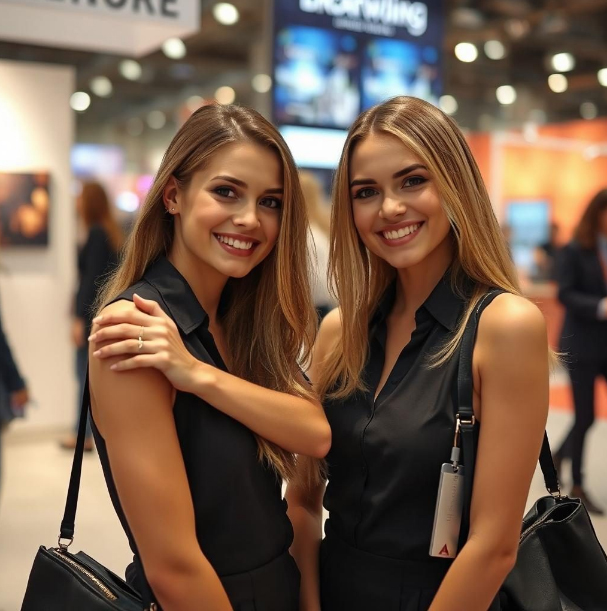
The term “hostess” carries outdated connotations, but the role itself remains vital in exhibition environments. At an event where 187 Kazakhstani companies compete for attention alongside 314 international exhibitors, presentation matters. The official opening ceremony, attended by Vice Minister of Energy Yerlan Akbarov, UAE Minister Suhail Al Mazrouei, and executives from KazMunayGas, QazaqGaz, and Tengizchevroil, required flawless coordination of VIP hospitality.
Hostesses at KIOGE 2026 managed registration desks, guided diplomatic delegations from 14 countries through the exhibition halls, and ensured that the gala ceremony at Almaty Theatre—which honoured oil and gas industry veterans—proceeded smoothly. They are the calm in the storm of a busy trade show, the first impression that shapes an international visitor’s perception of Kazakhstani professionalism.
Promotional models, meanwhile, serve a different function. At stands demonstrating new oilfield equipment, pipeline technologies, or digital solutions, a presenter’s ability to engage passing traffic can mean the difference between a forgotten booth and a productive pipeline of leads. For companies showcasing AI-driven exploration tools or safety equipment across Pavilions 7 through 11, having articulate, approachable talent matters.
Why These Roles Matter
It is tempting to view interpreters, booth assistants, hostesses, and models as peripheral. But examine the numbers from KIOGE 2026: 501 companies, 58 countries, six national pavilions, and a business program with 620 conference delegates. No international exhibition of this scale functions without a small army of professionals who facilitate communication, manage logistics, and create the conditions for business to happen.
Kazakhstan’s oil and gas sector remains the backbone of its economy, and KIOGE has grown into Central Asia’s largest industry platform over three decades. As the exhibition continues to attract new participants—34% of exhibitors in 2026 were first-timers—the demand for skilled, multilingual, professional exhibition staff will only increase. The next KIOGE is scheduled for 2027 at the Atakent Exhibition Centre. For interpreters, booth assistants, hostesses, and models, the work behind the scenes is already being planned—and the industry depends on them more than most visitors ever realize.