The Professional Workforce Behind Russia’s Leading Logistics Exhibition
CeMAT Russia, the International Exhibition of Machinery, Equipment, Automation Tools and Robotics for Warehouse and Industrial Logistics, stands as the largest and most significant industry event of its kind in Russia. The 16th edition, held from 15 to 17 September 2026 at Crocus Expo in Moscow, brought together more than 160 companies from Russia, Belarus, China, Kazakhstan, Germany, India, Turkey, and South Korea across three halls of Pavilion 1. With over 10,000 logistics professionals expected to attend, including representatives from 78 Russian regions, and a business programme of 34 events featuring trend sessions, expert discussions, and case studies, CeMAT Russia serves as the central meeting point for the warehouse and production logistics industry.
The exhibition covers the full spectrum of modern logistics solutions: racking systems, lifting and material handling equipment, automation and robotic solutions, IT platforms, transport packaging, spare parts, engineering systems, and industrial flooring solutions. Foreign exhibitor interest remains particularly strong from China, with 38 Chinese companies participating in 2026, including Kengic, Smart Loop, X-Gen, Yaoli, Damon, and Xilin.
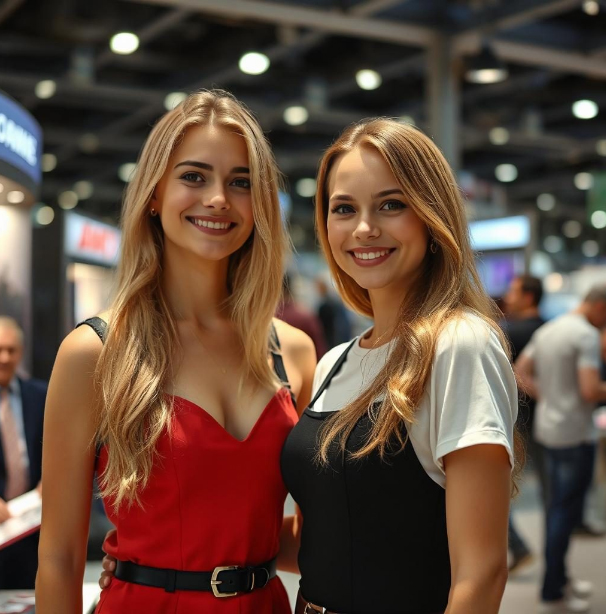
While the exhibitors and their machinery occupy the centre stage, a specialised workforce of hostesses, models, interpreters, and booth assistants works behind the scenes to ensure that the event functions smoothly and that business communication flows without interruption.
Interpreters: Enabling Cross-Border Communication
At an exhibition where companies from China, India, Turkey, South Korea, Germany, and other nations participate alongside Russian and Belarusian exhibitors, interpreters are indispensable. The diverse international presence creates a constant demand for language mediation across the exhibition halls.
Interpreters at CeMAT Russia work in various capacities. Consecutive interpreters accompany foreign exhibitors during negotiations with Russian logistics companies, warehouse operators, distributors, and procurement specialists. They must be fluent not only in general business language but also in the specialised terminology of the logistics industry—racking systems, forklifts, reach trucks, automated storage and retrieval systems (AS/RS), conveyors and sorters, AMR and AGV robots, warehouse management systems (WMS), and transport packaging. A conversation about shuttle robots, picking systems, or automated carousel storage requires an interpreter who understands the technical context, not merely the words.
The business significance of interpretation at CeMAT Russia cannot be overstated. When a Chinese equipment manufacturer such as Kengic, Smart Loop, or X-Gen negotiates with a Russian distributor, or when a Turkish supplier discusses terms with a procurement director from a major retail chain, the negotiation process depends on clear, precise communication. With 94% of visitors influencing equipment selection decisions and 45% representing large corporate customers with more than 250 employees, the commercial stakes are exceptionally high. An interpreter’s ability to convey technical specifications, delivery terms, and service conditions accurately can determine whether a deal is concluded or lost.
Professional interpreting agencies that support industrial exhibitions in Moscow emphasise the importance of preparing press materials in advance and ensuring interpreters have specialised knowledge of industry terminology. For CeMAT Russia, this means interpreters must be briefed not only on general logistics vocabulary but also on the specific product lines and technologies being presented by their assigned exhibitors.
Booth Assistants: The Operational Core of Exhibition Stands
Booth assistants form the operational backbone of exhibitor stands at CeMAT Russia. Their role combines reception duties, product knowledge, and logistical support, making them essential to the smooth functioning of each exhibition space.
A typical booth assistant at CeMAT Russia is responsible for greeting visitors, managing the flow of attendees at the stand, distributing catalogues and technical documentation, and supporting the sales team in identifying serious business prospects. With the exhibition covering the full spectrum of logistics equipment—from basic pallet trucks and stackers to advanced robotic systems and IT solutions—booth assistants must be prepared to engage with a diverse professional audience including logistics directors, supply chain specialists, production directors, engineers, procurement specialists, and IT professionals.
Documented experience from similar industrial exhibitions illustrates the demands of the role. Promotional models and hostesses work at stands greeting visitors, directing them to managers, distributing booklets, providing initial company information, and helping managers collect contacts. At logistics exhibitions, where the equipment on display can be highly technical, booth assistants must quickly assess whether a visitor is a serious buyer or a general observer, and route accordingly.
For international exhibitors, booth assistants often serve a dual function, combining reception duties with interpretation. A Chinese equipment manufacturer may rely on a bilingual booth assistant to handle initial inquiries from Russian visitors, explain product specifications, and collect contact information for follow-up. This requires not only language skills but also a working understanding of the exhibitor’s product range and the Russian logistics market context.
The physical demands of booth work at a three-day exhibition are considerable. Assistants stand for extended periods, manage crowds during peak hours, and maintain a professional demeanour throughout. Crocus Expo’s Pavilion 1, with its three exhibition halls, requires assistants to navigate large distances and remain alert across long working days.
Hostesses: From Greeters to Strategic Brand Ambassadors
The role of hostesses at CeMAT Russia has evolved considerably from simple greeting duties. In an exhibition environment where visitors include logistics directors, supply chain managers, production engineers, and procurement specialists from leading Russian companies, the modern hostess functions as a brand ambassador and a critical component in a company’s lead generation efforts.
At CeMAT Russia, hostesses serve as the first point of contact for visitors, acting as an initial filter who greets attendees and quickly assesses their role and interest level. Is this a curious student, or a high-potential logistics director from a major retail chain? By qualifying visitors through predefined questions, hostesses ensure that technical staff time is optimised for maximum return on investment.
Their responsibilities extend beyond welcoming. Hostesses manage the flow of visitors, schedule meetings, coordinate equipment demonstrations, and capture lead data accurately using tablets and CRM tools. In an industry built on efficiency, reliability, and technological innovation, the hostess projects an image of organised, professional efficiency, making the company appear as well-managed as its logistics solutions.
The CeMAT Russia hostess must also possess product literacy. While not expected to be logistics engineers, top-tier ambassadors are thoroughly briefed on the company’s products and services. They understand key messaging, can identify a qualified lead based on a visitor’s questions, and know exactly which specialist on the team to introduce them to. They can articulate the value proposition of automated storage systems, mobile robots, or warehouse management software with confidence.
The role also requires cultural and linguistic competence. A skilled hostess is often fluent in both Russian and English, and sometimes Chinese or Turkish given the significant participation from those countries. They can seamlessly greet a delegation from a Russian regional logistics company, converse with executives from China, and explain product details to engineers from India or South Korea, all while navigating subtle cultural formalities.
Models: Presentation Beyond Aesthetics
Models at CeMAT Russia serve a functional role that extends beyond visual appeal. In the context of a logistics and automation exhibition, models may be engaged for product presentations, equipment demonstrations, and promotional activities that require a polished, professional presence.
Exhibitors showcasing forklifts, reach trucks, automated storage systems, or mobile robots may use models to create visually compelling demonstrations that attract visitor attention. The exhibition’s emphasis on live equipment demonstrations—with more than 400 pieces of machinery and equipment on stands at the 2025 edition—means that well-presented demonstrations can be a significant draw for visitors. At the stands of SANY, TD Vertikal, SHANN, ASIA MH, RackFork, QSlift, and other lifting equipment manufacturers, visitors can compare technical specifications, and models can help facilitate this comparison process by guiding visitors and highlighting key features.
The distinction between models and hostesses at industry exhibitions can be subtle. Models may focus more on visual presentation and promotional engagement, while hostesses typically handle informational and logistical tasks. In practice, individuals working in these roles often possess overlapping skills, and the boundaries between them may shift depending on the needs of the exhibitor and the dynamics of the event.
For CeMAT Russia specifically, models might be engaged by companies presenting new equipment premieres, innovative automation solutions, or interactive exhibits. The exhibition’s focus on robotics and automation—with dedicated clusters for automated storage systems, conveyors and sorters, mobile robots, integrated robotic systems, machine vision and sensors, and identification and data capture—creates opportunities for exhibitors to use models in presentations that communicate both the technical and commercial value of their products.
A Collaborative Professional Ecosystem
What unites hostesses, models, interpreters, and booth assistants at CeMAT Russia is their shared function as facilitators of communication, experience, and business interaction. The exhibition’s stated purpose is to serve as a platform for demonstrating the latest developments in warehouse and production logistics, discussing industry trends, and facilitating business connections between manufacturers, suppliers, and buyers. The quality of the support workforce directly influences how effectively these objectives are achieved.
CeMAT Russia has maintained its status as the leading platform for the logistics industry in Russia, operating since 2010 and holding the 16th edition in 2026. The exhibition undergoes independent audit according to international standards, verifying and certifying its main statistical characteristics. That longevity and credibility depend not only on the exhibitors and their equipment but also on the professional infrastructure that makes the event navigable, accessible, and productive for all participants. Whether interpreting a technical negotiation, welcoming a delegation from a national pavilion, or ensuring that an international exhibitor’s stand runs smoothly, these professionals contribute to the exhibition’s continued relevance in a changing economic landscape.
The modern CeMAT Russia brand ambassador—whether called hostess, model, interpreter, or booth assistant—is a strategic investment. They are the human face of a technical brand, the friendly guide in a vast sea of logistics solutions, and the critical first connection that can lead to significant business partnerships. In the competitive world of Moscow’s industrial exhibitions, where major contracts are negotiated and technological standards are set, these professionals are the human connection that illuminates the path to new business.