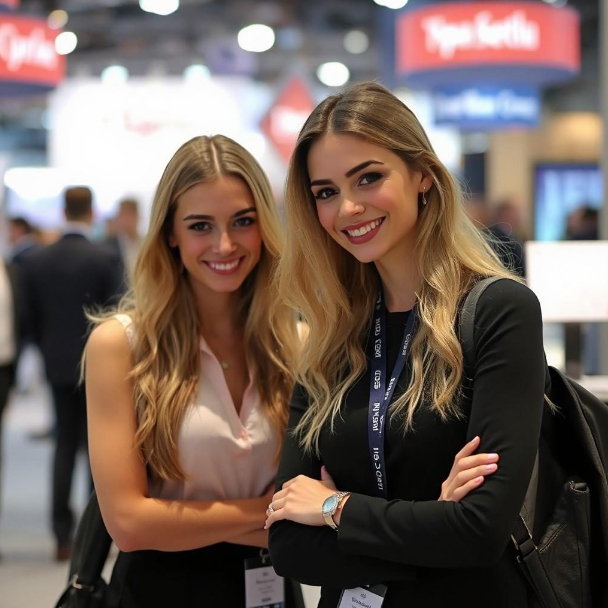
The machine tool industry is measured in microns. A tolerance of a few thousandths of a millimeter can determine whether an aerospace component performs safely or a medical implant fits correctly. CCMT — the China CNC Machine Tool Fair 2027 — is where the world’s leading builders of CNC machining centers, lathes, grinders, EDM systems, and cutting tools gather to display their most advanced technology. The machines on the floor will be engineering marvels. Yet the exhibitors who generate the strongest results will be those who recognize that a trade fair is, at its heart, a human event. Hostesses, interpreters, booth assistants, and models are the professionals who make human connection possible on a crowded, noisy, and highly technical show floor.
Interpreters: Accuracy in a Micron-Sensitive World
Machine tool technology has one of the most demanding vocabularies in all of manufacturing. Conversations at CCMT 2027 will involve discussions of spindle speeds and torque curves, linear guideways, thermal compensation, five-axis kinematics, tool path strategies, G-code programming, surface roughness values, and geometric tolerancing. A general interpreter, however fluent, will be out of depth within minutes.
The interpreters who add genuine value at this show will be carefully matched to exhibitors and thoroughly briefed in advance. They will have studied machine specifications, learned the terminology of cutting tools and controllers, and understood the standards and certification regimes that govern international machine tool trade. When a Chinese machining center builder explains accuracy specifications to a German automotive supplier, or a Japanese cutting tool manufacturer negotiates distribution terms with a Chinese partner, the interpreter must convey both technical precision and commercial nuance without error. In an industry where a misstated tolerance can lead to scrapped parts and lost contracts, accuracy is not a courtesy — it is a requirement.
Skilled interpreters also navigate cultural difference. Negotiation styles, expectations around directness and hierarchy, and approaches to relationship-building vary widely across the machine tool world. An interpreter who understands both the language and the business culture becomes an indispensable part of the commercial process, helping exhibitors and buyers reach agreement faster and with greater confidence.
Booth Assistants: The Operational Backbone of the Stand
A machine tool exhibition stand is a working environment. Machining centers run live demonstrations, cutting tools are tested on sample materials, and technical teams are occupied with machinery. Booth assistants are the operational backbone that keeps everything functioning.
At CCMT 2027, booth assistants will manage visitor registration and badge scanning, coordinate demonstration schedules, distribute catalogues and technical documentation, replenish sample stocks, and keep the stand presentable through long exhibition days. Crucially, they will qualify visitors — distinguishing job shop owners and production engineers from distributors, procurement officers, and students — and route each to the appropriate specialist. This triage function protects the time of senior engineers and sales directors, ensuring that high-value conversations are not lost in the crowd.
The strongest booth assistants absorb product knowledge during the show. When a visitor asks about spindle power, axis travel, or delivery lead times, an assistant who can offer a confident preliminary answer keeps the conversation alive and creates an impression of organizational competence. Multiplied across hundreds of interactions over several days, that responsiveness directly shapes an exhibitor’s results.
Models: Making Scale and Precision Visible
Machine tools are large, heavy, and often difficult to appreciate at a glance. This is where professional models play a distinctive and valuable role at CCMT 2027 — not as decoration, but as visual communicators.
A model standing beside a large machining center helps visitors grasp its scale. A model interacting with an operator panel or demonstrating a loading procedure communicates ergonomics and usability — factors that matter enormously to buyers who will ask their own operators to work with the machine every day. For exhibitors showcasing automation cells, robotic loading systems, or digital factory interfaces, models can bring the workflow to life in a way that static displays cannot. Models also draw crowds and create photogenic moments, generating social media content and press coverage that extends an exhibitor’s reach well beyond the exhibition hall.
For brands launching new machine platforms or automation solutions, professional models add a layer of polish that signals confidence and market positioning. In a vast hall filled with competing stands, that visual energy helps convert passing foot traffic into engaged visitors.
Hostesses: Hospitality That Supports Negotiation
Machine tool deals are rarely impulse purchases. They involve substantial capital, long evaluation cycles, and senior decision-makers. Much of the real work at CCMT 2027 will happen not on the show floor but in meeting rooms, hospitality suites, and evening receptions. Hostesses are the custodians of that environment.
Their responsibilities include welcoming guests at reception areas, guiding VIP buyers and delegations to meeting rooms, managing appointment schedules, coordinating refreshments, and ensuring hospitality areas remain impeccable. They handle the small courtesies that carry real weight: greeting a delegation promptly on arrival, remembering a returning client’s preferences, resolving a scheduling conflict with calm efficiency. In the Chinese business context, hospitality is closely tied to respect, and a well-run reception signals that an exhibitor takes its relationships seriously.
For international visitors traveling long distances to attend, a gracious welcome creates a moment of ease — and ease is the precondition for productive negotiation. Hostesses are therefore not peripheral to the commercial process; they are often the first and most memorable human impression of the brand.
Why Professional Support Staff Are Worth the Investment
Exhibiting at a major international machine tool fair demands substantial investment: stand design, machinery logistics, travel, marketing, and the time of senior technical staff. Economizing on frontline support is a false saving.
Professional staff arrive trained and prepared, requiring minimal supervision and adapting smoothly to the pressures of a busy show. They protect brand image at every interaction, ensuring visitors meet a polished and competent team. They capture and qualify leads systematically, making post-show follow-up efficient. And they bridge linguistic and cultural divides, helping exhibitors and visitors communicate with confidence.
In machine tools, where exhibitors compete for the attention of the same global manufacturers and job shops, the human experience on the stand can be decisive. Two exhibitors may offer comparable technology; the one whose staff communicate more clearly, welcome more warmly, and organize more efficiently will win the relationship.
CCMT 2027 will be a showcase of remarkable engineering — machines that cut faster, hold tighter tolerances, and automate more intelligently. But trade fairs are, at their core, meetings between people. The interpreters who translate technical precision, the booth assistants who keep the stand running, the models who bring scale and usability to life, and the hostesses who make every visitor feel welcome — these professionals transform a display of machinery into a genuine business conversation. Exhibitors who invest in them will find their technology not merely seen, but understood, remembered, and chosen.