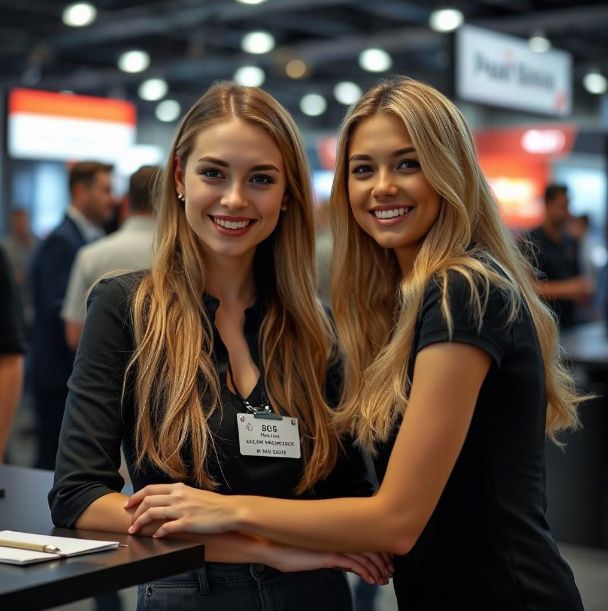
TransLogistica Kazakhstan is the largest transport and logistics exhibition in Central Asia, held annually in Astana as part of Kazakhstan Transport Week. The 29th edition takes place from 14 to 16 October 2026 at the EXPO International Exhibition Center, occupying four exhibition halls across 12,000 square meters of exhibition space. The event brings together approximately 300 companies from 16 countries including Azerbaijan, Belarus, Germany, Georgia, China, Latvia, Lithuania, Luxembourg, the UAE, Russia, Romania, Türkiye, Uzbekistan, Switzerland, and Estonia, with national pavilions from Belarus, Latvia, Lithuania, and Estonia. The 2025 edition attracted 303 companies from 21 countries and 6,463 targeted visitors. Behind the displays of freight transport services, warehouse equipment, and digital supply chain solutions, a specialized workforce makes international business possible: stand assistants, hostesses, models, and interpreters.
Stand Assistants: The Operational Core
Stand assistants at TransLogistica Kazakhstan perform the functional work that keeps exhibition booths productive. Their responsibilities include registering visitors, collecting contact information, distributing technical brochures, managing visitor flow, and directing inquiries to the appropriate sales or technical staff.
For transport and logistics brands exhibiting at the show, stand assistants often perform a qualification function. The visitor profile is exceptionally high-quality: 70% of attendees are top management—managers, owners, and deputy directors—and 97% influence decisions about purchasing goods and services. A visitor approaching a booth may be a freight forwarder, a logistics operator, a distributor, or a government representative. A skilled stand assistant can quickly assess visitor intent and route them appropriately, allowing sales directors and technical experts to focus on high-value conversations.
The scale of TransLogistica Kazakhstan creates unique operational demands. With over 6,000 targeted visitors moving through the exhibition halls over three days, efficient visitor management is critical. Stand assistants help brands capture leads in an environment where exhibitors compete for the attention of decision-makers who directly influence procurement and partnership decisions.
Hostesses: The First Point of Contact
Hostesses serve as the welcoming face of exhibition stands at TransLogistica Kazakhstan. Their primary function is to greet visitors, create a positive first impression, and initiate conversations that can lead to deeper engagement with the brand’s representatives.
At TransLogistica Kazakhstan, the hostess role carries particular weight because of the professional and international nature of the visitor base. Transport and logistics industry attendees include freight forwarders, carriers, logistics operators, and supply chain managers from across Central Asia, the Caucasus, Europe, and Asia. A warm, professional welcome sets a tone that reflects the brand’s organizational competence.
Language proficiency is a key requirement for hostesses working in Astana. Russian fluency is essential for engaging the majority of visitors, while Kazakh proficiency is a valuable additional asset. English proficiency is increasingly sought after by international exhibitors. With participation from countries including Germany, the Netherlands, Poland, China, and Türkiye, hostesses who can communicate across multiple languages provide direct value.
The working conditions for hostesses at TransLogistica Kazakhstan are demanding. Those working major brand booths typically stand for extended periods and may work rotating shifts throughout the three-day exhibition. Hostesses are typically engaged through modeling agencies, event staffing companies, or promotional agencies that maintain databases of vetted personnel with experience in exhibition environments.
Models: Visual Anchors for Logistics Brands
Transport and logistics exhibitions differ fundamentally from consumer-facing events. The products and services on display—freight forwarding, warehouse equipment, port infrastructure, and IT solutions—are B2B solutions designed for professional audiences. Yet models still play a meaningful role at TransLogistica Kazakhstan, though their function is more subdued and professional than at consumer shows.
At TransLogistica Kazakhstan, models typically serve as image and promotional representatives for equipment manufacturers, logistics companies, and national pavilions. They stand beside product displays, engage with visitors, and help draw attention in exhibition halls where hundreds of booths compete for visibility. For brands launching new services or seeking to project a modern, efficient image, professional models contribute to the overall impression of a well-organized enterprise.
Astana has an established modeling industry serving the events sector. Agencies provide professional models for commercial projects, exhibitions, and promotional events across the capital. The role of models at trade shows has become more professionalized, with models expected to present professionally and direct serious business inquiries to technical or sales staff.
Interpreters: Bridging the Technical and Linguistic Divide
TransLogistica Kazakhstan’s international stature makes interpreters indispensable. With exhibitors from 16 countries and national pavilions from Belarus, Latvia, Lithuania, and Estonia, the event is a regional meeting point for the transport and logistics industry. For the first time, the Service Exporters’ Association of Türkiye, representing more than 700 companies, will participate in the exhibition. For international companies demonstrating logistics solutions in the Central Asian market, and for regional companies seeking global partnerships, interpretation services facilitate commercial negotiations and technical discussions.
The linguistic demands at TransLogistica Kazakhstan are substantial. Logistics terminology requires precision: freight forwarding terms, multimodal transport specifications, warehouse automation parameters, and customs documentation procedures must be rendered accurately. Interpreters working the exhibition floor must be comfortable with technical vocabulary spanning road, rail, air, and sea freight, as well as digital supply chain management.
The interpreting work at TransLogistica Kazakhstan spans multiple formats. During the extensive business program—which includes the plenary session on women leaders in transport and logistics, the BreakBulk Kazakhstan Conference on project logistics, the Kazakhstan Warehousing and Logistics Conference, and the New Silk Way International Transport and Logistics Business Forum—simultaneous and consecutive interpreting facilitates knowledge exchange between international experts. On the exhibition floor, consecutive interpreting becomes the primary mode—interpreters accompany brand representatives, facilitate conversations with potential partners, and help international visitors understand complex logistics offerings.
For business travel delegations attending TransLogistica Kazakhstan, interpreter services are often included as part of the business package. Astana has a well-established translation and interpretation industry serving business events, with translation bureaus providing professional interpretation services for exhibitions, conferences, and business negotiations covering Russian, Kazakh, English, and other languages.
Practical Considerations for Exhibitors
Exhibitors planning staff for TransLogistica Kazakhstan should recognize that these roles serve distinct functions and require different skill sets. Stand assistants need operational reliability and crowd management abilities. Hostesses need warmth, professionalism, and often multilingual capabilities in Russian, Kazakh, and English. Models need to combine professional presentation with basic product familiarity. Interpreters require specialized logistics vocabulary and business communication skills.
The recruitment process for major brands typically involves casting calls for models and hostesses, while interpreters and stand assistants may be sourced through staffing agencies or professional networks. Astana has an established market of agencies providing hostesses, promotional models, and event staff for exhibitions and business events.
Budget planning should account for the full duration of the exhibition, which spans three days from 14 to 16 October. The investment in staff quality directly affects brand perception at an event where the visitor base consists primarily of top management and decision-makers who evaluate exhibitors on organizational competence as much as service quality.
TransLogistica Kazakhstan represents the largest transport and logistics gathering in Central Asia and a key platform for the region’s development as a logistics hub connecting Eurasia. The professionals who staff its booths—stand assistants, hostesses, models, and interpreters—are not peripheral to the experience. They are the human interface between logistics solutions and the global professionals who come to evaluate, negotiate, and partner.
TransLogistica Kazakhstan 2026 runs 14–16 October at the EXPO International Exhibition Center in Astana, Kazakhstan, as part of Kazakhstan Transport Week.