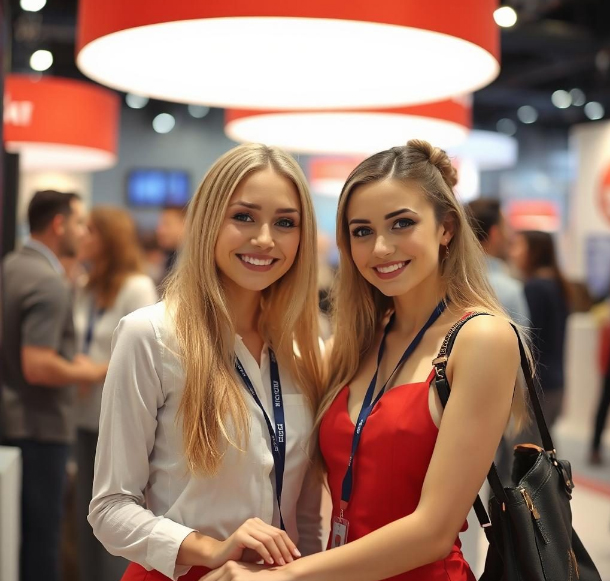
MOSCOW — Each February, the aisles of Crocus Expo fill with the colors, aromas, and ambitions of the global food industry. ProdExpo, Russia’s largest international food and beverage exhibition, brings together thousands of producers, distributors, and retail buyers under one roof. But behind every successful stand, every productive negotiation, and every memorable brand impression stands a team of professionals whose work often goes unnoticed: interpreters, booth assistants, hostesses, and promotional models.
Their roles are distinct, their skills specialized, and their collective contribution to an exhibitor’s return on investment is substantial. Understanding what each position entails—and how they differ—is essential for any company planning to exhibit at ProdExpo.
The Booth Assistant: The Operational Core
The term “hostess” has gradually given way to “booth assistant” or “stand hostess” in professional exhibition circles, reflecting an evolution in expectations. At ProdExpo, where exhibitors range from small regional bakeries to multinational beverage giants, the booth assistant is the operational core of any stand.
Their responsibilities extend well beyond greeting guests. A typical day involves receiving and coordinating visitors, preparing tea and coffee, answering questions about the company and its products, recording contact information left at the stand, and directing serious prospects to sales managers for detailed consultation. One agency’s project description for ProdExpo 2026 noted that stand hostesses “attracted visual attention to the brand” while wearing corporate-colored office suits, informed visitors about the company, distributed brochures, and recorded contacts for follow-up.
The role demands a combination of presentation and practical skill. Employers seek “goodwill” and “presentable appearance,” with exhibition experience preferred. But the most effective assistants bring something more: an intuitive understanding of when to engage and when to step back, allowing sales conversations to develop organically.
The Interpreter: Bridging Commercial Cultures
For international exhibitors at ProdExpo, the interpreter is not a convenience—it is a necessity. The Russian food market operates in Russian, and while many buyers from major retail chains may have some English proficiency, technical discussions about product specifications, certification requirements, and distribution terms demand precision that only native-level fluency can provide.
The distinction between a general interpreter and a technical interpreter matters greatly in the food industry. Conversations at ProdExpo frequently involve terminology that leaves no room for approximation: “shelf life,” “halal certification,” “private label,” “citric acid percentage,” “preservative type.” A technical interpreter must command this vocabulary in both languages, ensuring that a buyer’s question about production specifications receives an accurate and immediate response.
The consequences of inadequate interpretation are direct and commercial. As one industry guide notes, “A foreign exhibitor who tries to go it alone will find themselves smiling helplessly while a potential million-ruble deal walks away to the next booth where someone actually speaks their language.”
Language combinations vary by exhibitor origin. English-Russian and Chinese-Russian interpreters are in highest demand, reflecting the shifting patterns of international trade in the Russian food sector. Some staffing providers specifically offer “technical specialists for negotiations” alongside standard hostess services, recognizing that the two roles require different capabilities.
The Promotional Model: Active Engagement
While booth assistants manage the stand itself, promotional models serve a different function: active engagement with the broader exhibition floor. Their role is to intercept foot traffic in the aisles, distribute samples or promotional materials, and direct visitors toward specific stands.
At ProdExpo, where competition for buyer attention is intense, promotional models often serve as the first point of contact for a brand. They may distribute leaflets and brochures throughout the exhibition territory, sometimes wearing clothing from an exhibitor’s collection. The physical presentation requirements for these roles are explicit: models are selected for their ability to embody a company’s image, with clothing often coordinated to match brand colors.
The line between “model” and “hostess” is sometimes blurred in practice. Some agencies offer combined services—”stand hostess” who also function as promotional models—while others maintain distinct categories with different pay scales and responsibilities. What remains consistent is the expectation of professional appearance and communication ability.
The Evolving Demands of the Food Industry
What distinguishes exhibition staffing at ProdExpo from other trade shows is the specificity of the food industry context. Booth assistants working for food and beverage brands are increasingly expected to possess more than general exhibition experience.
Some industry observers note a trend toward technical competence. A booth assistant working for a beverage company may need to answer questions about preservatives and acid content. One working for a dairy producer may need to discuss pasteurization methods and shelf-life specifications. The most successful assistants are those who can engage substantively, not merely direct inquiries to a waiting sales manager.
This has implications for hiring. Agencies that specialize in food exhibition staffing often seek candidates with backgrounds in food technology, chemistry, or related fields. Local universities such as Moscow State University of Food Production are cited as sources for students who combine academic knowledge with the flexibility to work exhibition schedules.
Practical Considerations for Exhibitors
For companies planning to exhibit at ProdExpo, several practical considerations emerge:
Start early. Qualified interpreters and experienced booth assistants are in high demand during major exhibition periods. Agencies recommend booking staff well in advance of the event.
Define the role precisely. A “hostess” who simply distributes pens and smiles contributes little to commercial objectives. The most valuable staff are trained to qualify leads, understand basic product features, and recognize when to escalate a conversation.
Invest in preparation. Briefing staff on your products, target market, and key messages before the exhibition begins pays dividends. An assistant who understands your brand can answer questions confidently and represent you effectively.
Consider the full cost. Staffing represents a significant portion of exhibition budgets. Rates for experienced bilingual staff in Moscow reflect their value, but the return—in qualified leads, signed contracts, and brand impressions—justifies the investment.
The Human Bridge
ProdExpo is, at its core, a commercial event. Products are displayed, contracts are negotiated, and business relationships are forged. But the machinery of commerce runs on human interaction. The interpreter who ensures a technical specification is accurately conveyed, the assistant who welcomes a buyer with genuine hospitality, the model who draws attention to a new product line—these professionals are the human bridge between an exhibitor’s offer and a buyer’s decision.
For any company planning to exhibit at ProdExpo, the lesson is clear: the difference between a stand that attracts visitors and one that converts them often comes down to the people standing behind the counter. In the competitive landscape of Russia’s food industry, skilled exhibition staff are not a luxury. They are an investment in success.