The Poly World Trade Center Expo, known simply as PWTC Expo, occupies a strategic position in Guangzhou’s Pazhou exhibition district, sitting directly opposite Area B and beside Area C of the Canton Fair Complex. While it may not match the colossal scale of its famous neighbor, the venue has carved out a distinct identity as a specialized platform for international sourcing across home goods, gifts, food, hardware, and fashion.
Its 2026 calendar reflects this focused character. The 54th Jinhan Fair for Home & Gifts spans 90,000 square meters with over 1,200 manufacturers. SIAL Guangzhou brings together 1,500 exhibitors across 15 food and beverage sectors. The Guangzhou Sourcing Fair connects 850 Chinese manufacturers with over 45,000 buyers in hardware, machinery, and appliances. Each of these events depends on a workforce that rarely appears in exhibitor directories: the interpreters, stand assistants, hostesses, and models who transform exhibition space into functioning commercial encounters.
Interpreters: Bridging Technical and Commercial Languages
Interpretation at PWTC Expo is shaped by the venue’s specialized exhibitions. A medical device sourcing event requires familiarity with clinical terminology. A food exhibition demands vocabulary around ingredients, packaging, and cold chain logistics. A hardware fair requires fluency in tool specifications and machinery components.
Recruitment listings for PWTC Expo illustrate the practical requirements. A medical device exhibition organized at the venue sought an English interpreter for accompanying an Indian client through factory visits, with a daily rate of 300 yuan. The requirements were specific: fluent spoken English with accurate pronunciation, familiarity with medical device terminology, and preference given to candidates with medical field backgrounds. The role extended beyond booth interpretation to include escorting foreign buyers to supplier factories—a function that blurs the line between interpreter, guide, and commercial facilitator.
The market for interpretation at PWTC Expo reflects the broader Guangzhou exhibition economy. Rates for general exhibition translation typically range from 300 to 500 yuan per day, with technical specialization and uncommon language pairs commanding higher compensation. The interpreter’s value lies not merely in linguistic accuracy but in the ability to ensure that a specification, a price negotiation, or a product demonstration survives translation intact.
Hostesses and Models: The Visual First Impression
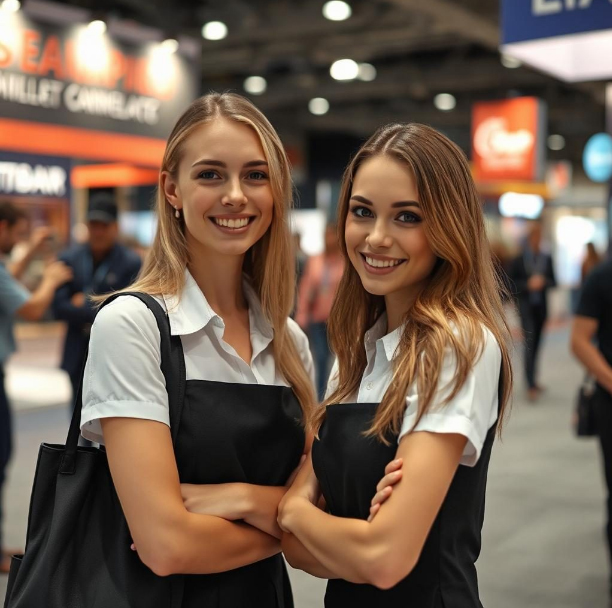
Hostesses and models at PWTC Expo serve overlapping but distinct functions. The hostess greets visitors, directs traffic, and creates a welcoming atmosphere at the booth entrance. The model stands beside displays, holds finished products, and provides the visual anchor that pulls attention from the aisles.
Recruitment for these roles at the venue reveals the compensation structure. A model position advertised for an April 2026 exhibition at Poly World Trade Center Expo offered 500 yuan per day with daily settlement. The requirements were concise: female, minimum height of 165 centimeters, presentable appearance and demeanor, with exhibition hostess or model experience preferred. The job was posted by an exhibitor directly, with no agency fees involved.
The work is physically demanding. Models and hostesses spend hours on their feet, maintaining a polished appearance and engaging demeanor through long exhibition days. For international sourcing events like SIAL Guangzhou, where food products are presented in consumption scenario environments, the visual presentation of the product—and the person presenting it—becomes part of the commercial argument. The visual front is not decoration; it is a strategic investment in foot traffic and brand perception.
Stand Assistants: The Operational Backbone
The stand assistant occupies the least visible but most essential role at PWTC Expo. These are the people who verify booth configurations, distribute catalogs, collect business cards, and handle the logistical details that keep an exhibition running. At a venue that hosts concurrent events with the Canton Fair, the operational demands are amplified by the sheer volume of international visitors circulating through Pazhou.
The role of the stand assistant often overlaps with that of the hostess and interpreter. At smaller booths, a single staff member may be responsible for greeting visitors, explaining basic product information, and recording leads. At larger exhibitions like Jinhan Fair, which welcomes over 200,000 professional buyers from more than 170 countries across its history, the division of labor becomes more specialized.
Recruitment for exhibition support roles at PWTC Expo typically offers 150 to 300 yuan per day for general assistance, with English-capable staff commanding higher rates. The work provides an entry point into the exhibition industry for students and young workers seeking experience in international trade environments.
The Strategic Context
PWTC Expo’s identity is inseparable from its location. Sitting opposite the Canton Fair Complex, it functions as a complementary venue that captures buyers already in Guangzhou for the larger event. The Guangzhou Sourcing Fair explicitly schedules itself concurrent with Canton Fair Phases 1, offering buyers access to hundreds of additional suppliers in a single trip. SIAL Guangzhou positions itself as South China’s only international food exhibition focusing on global trade connections.
This strategic positioning shapes the workforce requirements. Buyers arriving at PWTC Expo are often already navigating the complexities of the Canton Fair. They are experienced international purchasers with limited time and specific sourcing needs. The interpreters, hostesses, and stand assistants who staff the booths must match this professionalism. They must be efficient, knowledgeable, and capable of functioning in a high-pressure commercial environment.
The Invisible Interface
For exhibitors planning their 2026 calendars at PWTC Expo—from Jinhan Fair to SIAL Guangzhou, from the Sourcing Fair to the fashion and lifestyle exhibition—the budget for stand staff is not a line item to minimize. It is the infrastructure that makes participation meaningful.
The interpreter who translates a specification, the hostess who welcomes a buyer, the model who holds a product toward the light, the stand assistant who ensures the catalog is on the table—these are the human interfaces of international sourcing. They are not listed in the exhibition directory. They do not appear in the statistics of 45,000 buyers or 1,200 exhibitors. But without them, the machinery of cross-border commerce would slow to a crawl.
PWTC Expo’s exhibitions are measured in square meters and exhibitor counts. But the quality of the sourcing experience is measured in conversations, handshakes, and the quiet competence of the people who staff the booths. That is where the real work of international trade gets done.