The National Exhibition and Convention Center (Shanghai) is not merely a venue. With 1.47 million square meters of total floor space and a location at the heart of Hongqiao’s transport hub, it is the largest single building complex for exhibition purposes in the world. Its 2026 calendar is staggering in scope: over 330,000 square meters for Bakery China, 280,000 square meters for the China Plastics and Rubber Industry Exhibition, 200,000 square meters for food processing and packaging machinery. Events span baking, plastics, flooring, textiles, medical devices, food ingredients, and industrial machinery.
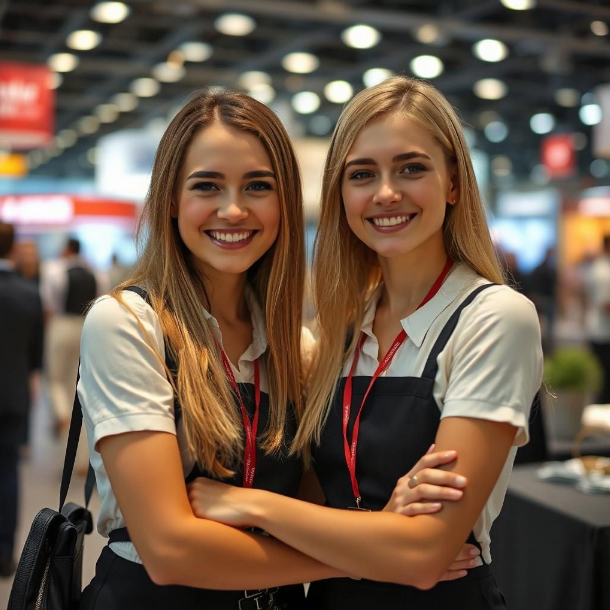
But behind the machinery, the ingredients, and the packaging systems stands a workforce that rarely appears in exhibitor manuals: the interpreters, stand assistants, hostesses, and models who make international trade physically possible on the show floor. Their work is the connective tissue of the exhibition economy.
The Scale That Demands a Workforce
The NECC’s 2026 exhibition list reveals the venue’s extraordinary breadth. In a single month, May, the venue hosts Bakery China across thirteen halls, the Asian Window and Door Shading Exhibition, the China International Flooring Exhibition across seven halls, and the Link Fashion apparel show. June brings the International Solar Photovoltaic and Smart Energy Exhibition, the Water Exhibition, and the Hydrogen Energy and Fuel Cell Exhibition. October sees the China International Textile Fabrics Expo, the China Dental Show, and the China International Fluid Machinery Exhibition.
Each of these shows attracts international exhibitors and buyers. Each requires front-line staff who can navigate technical terminology, cultural expectations, and the relentless pace of a multi-day trade fair. The demand is not for generic labor. It is for people who can function as the human interface of global commerce.
Interpreters: Precision Across Languages
At the NECC, interpretation is rarely a generic skill. The official interpreter service for CHINAPLAS, the plastics and rubber exhibition held at the NECC, publishes a rate card that reflects the premium placed on language precision. A full day of English interpretation costs 1,200 yuan. Japanese and Korean command 1,400 yuan. German, French, Italian, and Spanish reach 1,800 yuan. Thai, Indonesian, Vietnamese, Portuguese, Arabic, and Turkish cost 2,000 yuan.
These rates reflect a simple reality: the vocabulary of a plastics exhibition differs from that of a bakery show. An interpreter at CHINAPLAS must navigate terminology around injection molding, extrusion, and polymer chemistry. An interpreter at Bakery China must handle conversations about tunnel ovens, fermentation profiles, and cold chain logistics. An interpreter at the Dental Show needs familiarity with digital oral equipment and dental materials.
Recruitment postings for NECC exhibitions reveal the operational details. A Korean-language interpreter was sought for a baby and family skincare brand exhibition, responsible for booth operations, product explanation, and communication with buyers. The job required pre-exhibition study of ten products with accompanying materials, and a 90-minute preparatory meeting the day before the show opened. The interpreter’s role was not merely linguistic but commercial: explaining products, facilitating gift events, and ensuring that the brand’s message survived the translation intact.
Stand Assistants: The Operational Backbone
The stand assistant is the first human contact a visitor has with a brand. The role sounds straightforward—greet visitors, distribute catalogs, collect business cards, record inquiries—but the reality at a venue of NECC’s scale is more demanding. Stand assistants must quickly assess whether a passerby is a serious buyer or a casual browser, manage multiple conversations simultaneously, and maintain composure during the chaotic peak hours of an exhibition day.
Recruitment postings for exhibition support roles at Shanghai’s major venues, including the NECC, describe the work in practical terms: entrance ticket checking, crowd guidance, and simple route direction. The requirements are stated simply: presentable appearance, fluent Mandarin, and the ability to work standing for extended periods. Pay ranges from 200 to 300 yuan per day for general support roles, with English-capable staff commanding higher rates.
But the general descriptions obscure the specialized knowledge that effective stand assistants bring to specific shows. A booth at the China International Agrochemical and Crop Protection Exhibition benefits from staff who understand the difference between herbicides and fungicides. A stand at the flooring exhibition benefits from assistants who can speak intelligently about engineered wood, radiant floor heating compatibility, and resilient flooring technology. This is not a role for someone who simply hands out brochures.
Hostesses: The Visual Front
Hostesses at the NECC serve a distinct function: drawing attention, projecting professionalism, and creating a welcoming atmosphere that encourages visitors to stop and engage. Event staffing agencies in Shanghai provide uniformed personnel with optional professional hair and makeup services, ensuring that the visual presentation aligns with a brand’s identity.
The pay range for these roles varies widely. Event staffing agencies list hostess positions at approximately 800 yuan per person per day for major exhibitions, with the rate including a standard professional appearance. For high-profile international exhibitions like Automechanika Shanghai, which occupied the NECC in November 2025, hostess positions were advertised at 1,500 yuan per day, with specific requirements for heeled shoes, hair in a bun, and natural makeup.
The work is physically demanding. Hostesses spend hours on their feet, often in heels, maintaining a polished appearance and an engaging demeanor through long exhibition days. The visual front is not merely decorative; it is a strategic investment in foot traffic and brand perception.
Models: Product Demonstration as Commercial Argument
Models at the NECC serve as living product demonstrations. At sensory industry shows like Bakery China, the visual appeal of a finished product—the texture of a dough, the color of a glaze—is a commercial argument in its own right. Models stand beside display cases, hold finished products, and create the visual anchor that pulls traffic from the aisles.
Bakery China’s programming reinforces the importance of visual presentation. More than ten national skill contests covering bread, pastry, coffee, pizza, and tea brought elite craftsmen from across the globe to demonstrate their work. The show hosted over 2,267 brands from 79 countries and regions, with international brands accounting for more than 20 percent of participants. In this environment, models function not as decoration but as part of the commercial communication strategy: showing, not just telling, what a product or ingredient can become.
The Market Forces Shaping This Workforce
The competition for exhibition support roles at the NECC has intensified. Recruitment for these positions is now conducted through specialized channels, with staffing agencies matching candidates to shows based on language skills, industry familiarity, and physical stamina. The requirements are minimal but firm: age ranges typically span 18 to 35, with a clear preference for a young, professional image.
For international exhibitors, the ideal stand staff member combines linguistic ability, cultural fluency, and the stamina to represent a brand effectively across a multi-day event. The NECC’s location at the Hongqiao transport hub, connected to the city’s high-speed rail and airport, makes it convenient for international visitors. But convenience alone does not close deals. The quality of the human interaction at the booth determines whether a visitor becomes a lead, and whether a lead becomes a customer.
The Invisible Infrastructure
For exhibitors planning their 2026 calendars at the NECC—from Bakery China to CHINAPLAS, from the flooring exhibition to the dental show—the budget for stand staff is not a line item to minimize. It is the infrastructure that makes participation meaningful. Interpreters bridge languages. Stand assistants capture opportunities. Hostesses create the first impression. Models demonstrate the product’s promise.
The NECC’s exhibition list continues to grow. The venue’s scale, its transport connections, and its role as the anchor of Shanghai’s exhibition economy ensure that demand for this workforce will remain strong. The people who staff the booths, speak the languages, and shake the hands that matter are not peripheral to the exhibition industry. They are its operating system.