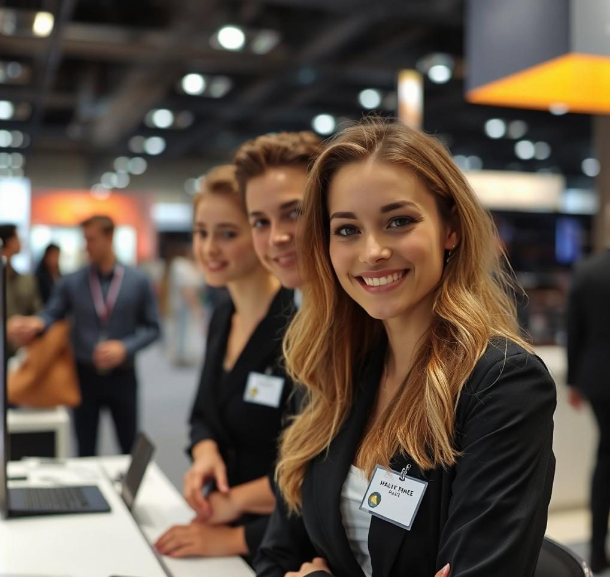
When people discuss Heimtextil, the world’s leading trade fair for home and contract textiles, attention typically focuses on the latest fabric trends, innovative designs, and exhibitors from around the globe. Yet behind a trade fair that draws approximately 48,000 visitors from 133 countries and around 3,000 exhibitors lies a group of often-overlooked but essential professionals: models, interpreters, stand assistants and hostesses. They form the human infrastructure that keeps the fair running smoothly and serve as the most direct bridge between brands and audiences.
The Silent Ambassadors of Brand Image
At Heimtextil, the role of models extends far beyond simply “displaying” products. They are an extension of a brand’s visual language—the tangible embodiment of textile collections and interior solutions. According to descriptions from professional trade fair service agencies, Heimtextil models are positioned as “image models” whose responsibilities include product and collection presentation, support for photo and video content at the stand, elegant and professional brand representation, and increased visibility during launches and demonstrations.
This means an excellent trade fair model must understand a brand’s aesthetic tone and move fluidly between static display and dynamic interaction. They need not only professional presence but also a basic awareness of the exhibits, so that through eye contact and body language they can convey appropriate messages to visitors. At a fair where design and texture are central, the model is themselves part of the brand’s aesthetic.
Professional Bridges Across Language Barriers
Heimtextil is highly international in character. While recent data reflects over 48,000 visitors from 133 countries, the fair’s reach extends even further—one edition recorded visitors from 148 countries. In such an environment, interpreters and multilingual stand personnel become critical communication nodes.
Unlike ordinary trade fair translation, interpretation at Heimtextil stands has its own particularities. From recruitment information for the Frankfurt fair, the work of a stand assistant interpreter is described as “no specialized knowledge required,” but requiring fluent language skills—for example, Japanese and English—and the ability to work from the customer’s perspective. This actually places a subtle demand on practitioners: finding balance between the specialized context of the textile industry and everyday communication.
Descriptions from professional interpretation services confirm this. Multilingual hosts and stand personnel are positioned as “valuable links between international dialogue partners, business associates and customers,” with duties including making connections, responding to inquiries, and translating short conversations. For many exhibitors hoping to expand into international markets, a capable interpreter is often the deciding factor in whether a deal is closed.
The Backbone of Stand Operations
If a stand is a micro-enterprise, then stand assistants and hostesses are the frontline staff who keep this enterprise running day to day. Their work is far more complex than the surface-level “reception” might suggest.
According to trade fair service classifications, Heimtextil hostesses need to undertake multiple functions including professional visitor reception, registration and access management, assisting sales and marketing teams, distributing promotional materials, and supporting meetings and product demonstrations. Another service provider describes it in more granular terms: reception and registration, stand service and product information, cloakroom management, ticketing and runner tasks—all requiring briefing before the fair begins so that staff can work efficiently from day one.
The challenge of this work lies in its intensity and frequency. Fairs typically last several days, and with hundreds or thousands of visitors each day, hostesses must maintain a professional and friendly demeanor throughout. For this reason, reliable service providers emphasize that their staff “almost never miss a shift” and have established strict briefing systems to ensure service quality.
The specific tasks of a trade fair assistant in Frankfurt are described in detail in job listings: greeting visitors professionally, providing information about exhibited products and services, conducting initial conversations with visitors and identifying prospects, distributing materials, catalogs and promotional gifts, recording contact data and leads for the sales team, supporting product demonstrations and presentations, answering questions and forwarding qualified inquiries, and ensuring an inviting atmosphere at the stand. Additional duties include helping with stand setup before the fair, keeping information materials readily available, maintaining an orderly and attractive stand, supporting appointment coordination for professional discussions, documenting contacts systematically, collaborating with other stand staff, participating in stand meetings and briefings, and supporting dismantling after the fair.
These responsibilities paint a picture of a role that is far more than simply “standing at a booth”—it is a multifaceted position requiring communication skills, organizational ability, product knowledge, and the capacity to remain calm under pressure.
A Professional Ecosystem
It is worth noting that this category of human resources services at Heimtextil has developed into a highly specialized market segment. Around the Frankfurt fair, multiple agencies provide comprehensive staffing from models and hostesses to interpreters and setup assistants.
These agencies divide their labor with considerable precision. Some focus on image models and hostesses, emphasizing “professionalism, presentation, communication skills and the ability to manage international audiences.” Others rely on student talent pools, offering flexible staffing with multilingual capabilities—one provider maintains a pool of over 60,000 vetted students across more than 10 cities, with German and English as standard and French, Spanish, Italian, Mandarin and other languages available on request. Still others specialize in specific language markets—for example, bilingual stand assistants for Japanese exhibitors.
This specialization reflects the maturity of Heimtextil as a top-tier industry fair. Exhibitors can choose different tiers of staffing configurations based on their brand positioning, target markets, and budget. For workers, a major international fair like Heimtextil is also an important platform for accumulating experience and building industry connections.
While the spotlight shines on fabrics, design and business deals, models, interpreters, stand assistants and hostesses constitute the indispensable “human infrastructure” of Heimtextil. They are the face of brands, the bridges of communication, and the actual shapers of the trade fair experience. For exhibitors, selecting the right personnel configuration is as important as choosing the right exhibits and stand design—because ultimately, business relationships are built by people.