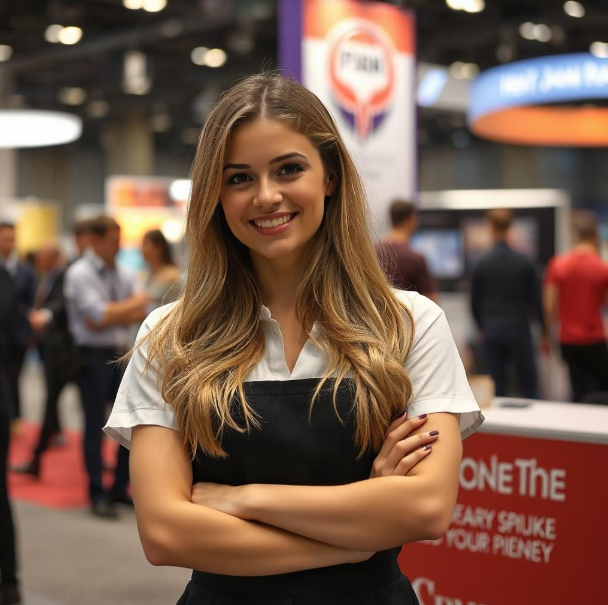
Messe Berlin welcomes millions of visitors and tens of thousands of exhibitors each year across its 190,000 square meters of exhibition space. Behind every successful trade fair stands a workforce of professionals whose roles are often underestimated but absolutely essential: models, interpreters, booth assistants, and hostesses. These individuals are the human interface between global exhibitors and international audiences, shaping first impressions and facilitating the business connections that make Messe Berlin one of the world‘s leading exhibition venues.
The Scope of Messe Berlin
Messe Berlin operates 27 trade fair and event halls, hosting flagship events such as ITB Berlin, InnoTrans, Fruit Logistica, and Grüne Woche. In 2024 alone, the company recorded 121 events, approximately 31,000 exhibitors, and 1.9 million visitors. The scale of these events creates substantial demand for professional exhibition personnel who can operate in multilingual, high-pressure environments.
The venue’s international character is particularly notable. InnoTrans 2026, for example, attracted 175,556 trade visitors from 128 countries and 3,190 exhibitors from 59 countries. Such diversity means that exhibitors cannot rely solely on their own staff—they need locally recruited professionals who understand the Berlin trade fair ecosystem.
Models: More Than Visual Appeal
At trade fairs, models serve specific promotional functions rather than merely providing visual decoration. Their responsibilities include product presentations, brand promotion, product launches, and supporting marketing campaigns. In the context of Messe Berlin‘s major events, promotional models often work at booth entrances, during special presentations, or at branded activation zones.
The distinction between models and hostesses is functional rather than hierarchical. While hostesses typically manage visitor reception, registration, and information distribution, models are deployed primarily for attention-driven activities: drawing foot traffic, participating in photo opportunities, and creating memorable brand impressions. Many agencies supplying personnel for Berlin events categorize these roles separately, recognizing that the skill sets, though overlapping, serve different strategic purposes.
Interpreters: Bridging Language Gaps
Interpretation at Messe Berlin ranges from informal stand assistance to formal conference interpretation. The Italian Trade Agency, for instance, specifies two distinct categories of interpretation services for its Berlin operations: stand interpreters and conference interpreters.
Stand interpreters perform what the agency describes as “mostly normal hostess activity at the info counter” combined with occasional consecutive interpreting when visitors engage with exhibitors. This role requires fluency in at least German and the exhibitor’s language, plus solid English skills. Crucially, stand interpreters are not expected to handle negotiation-level interpreting—that responsibility falls to professional conference interpreters.
Conference interpreting, by contrast, involves simultaneous and consecutive interpretation at formal events, presentations, and high-level meetings. These interpreters typically hold formal qualifications and work under different contractual arrangements than stand personnel.
For InnoTrans and similar international trade fairs, the demand for interpreters spans languages including Italian, English, German, French, Spanish, Chinese, Russian, and Arabic. Exhibitors from Asia, the Americas, and the Middle East increasingly require language support that goes beyond the traditional European language pairs.
Booth Assistants: The Operational Backbone
Booth assistants represent the most flexible category of exhibition personnel. Their duties include distributing promotional materials, supporting stand construction and dismantling, assisting with visitor flow, and providing general operational support.
Unlike hostesses, who are often positioned at reception points, booth assistants move throughout the stand, responding to immediate needs. They may help set up product displays, escort visitors to meeting areas, or manage the logistics of sample distribution. Language requirements for booth assistants vary—some positions require only basic German, while others demand good Italian or English proficiency.
The German Federal Employment Agency’s Munich trade fair job center offers free placement services for exhibitors seeking booth staff, interpreters, hostesses, and other temporary personnel. While this specific service operates in Munich, it illustrates the established infrastructure for matching exhibitors with qualified staff across German trade fair venues, including Berlin.
Hostesses: The First Point of Contact
Hostesses occupy the most visible role at any trade fair stand. Their responsibilities include visitor registration, appointment scheduling, brochure distribution, and commercial support for sales teams. At Messe Berlin‘s major events, hostesses are often the first individuals a visitor encounters—and therefore carry significant responsibility for creating a professional first impression.
The Italian Trade Agency’s specifications for its Berlin office provide concrete examples of hostess functions: bilingual hostesses (German and Italian or English) for reception activities including participant registration; promoters and hostesses for promotional material distribution. These roles require not only language skills but also the ability to manage queues, handle inquiries efficiently, and maintain composure during peak traffic periods.
Contracting conditions for hostesses typically include minimum working hours (often four to six hours), uniform provision, and clearly defined break arrangements in accordance with German employment law. Some agencies offer tiered pricing based on language capabilities—for example, higher hourly rates for hostesses fluent in English plus one additional foreign language compared to those with only one foreign language.
The Agency Ecosystem
Exhibitors at Messe Berlin rarely recruit personnel directly. Instead, they work through specialized agencies that supply trained staff for trade fairs and congresses. The Italian Trade Agency’s Berlin office, for instance, sought a framework contract with an agency capable of covering hostess, stand personnel, promoter, and interpreter services across multiple German trade fair locations including Berlin.
International agencies such as Kappa al Quadrato Events specifically advertise services for InnoTrans Berlin, offering hostesses, promotional models, and multilingual interpreters with “fast response times and dedicated customer support”. These agencies maintain networks of pre-vetted personnel who understand exhibition protocols, dress codes, and the specific demands of different trade fair sectors.
For exhibitors, the agency model offers significant advantages: staff arrive briefed on basic exhibition practices, agencies handle scheduling and replacement logistics, and language capabilities can be matched precisely to target markets. The trade-off is cost—agency-supplied personnel command premium rates compared to direct hiring, reflecting the coordination and quality assurance the agency provides.
What Exhibitors Should Consider
When planning for a Messe Berlin event, exhibitors should define their personnel requirements well in advance. Key considerations include:
Language specifications: Not all “English-speaking” staff have equal proficiency. For technical trade fairs like InnoTrans, interpreters need industry vocabulary in addition to general fluency.
Task clarity: Distinguishing between hostess duties (reception, information) and interpreter duties (active translation) prevents mismatches and ensures appropriate pricing.
Dress and appearance: Many agencies offer uniform rental or specify that hostesses will wear corporate clothing. Exhibitors should communicate brand guidelines clearly.
Working hours and breaks: German employment law governs break periods and maximum working hours. Agencies typically handle compliance, but exhibitors should understand the contractual framework.
Minimum booking periods: Most agencies require minimum engagements, often four to six hours per staff member per day.
The success of Messe Berlin as a global trade fair destination depends not only on its physical infrastructure—the 27 halls, the 190,000 square meters of exhibition space, the excellent transport connections—but on the human infrastructure that brings events to life. Models, interpreters, booth assistants, and hostesses transform empty halls into functioning marketplaces where international business happens.
For exhibitors, investing in qualified personnel is not an expense but a strategic necessity. The right hostess can turn a casual visitor into a qualified lead; the right interpreter can bridge not just languages but cultural expectations; the right booth assistant can ensure that operations run smoothly even during peak demand. At Messe Berlin, where the world gathers to do business, these professionals are the quiet enablers of global commerce.