Minsk, Belarus — Every June, the Minsk International Exhibition Center transforms into the largest agricultural showcase in the country. Belagro, held since 1990 as part of Belarusian Agro-Industrial Week, draws hundreds of companies and tens of thousands of visitors for five days of machinery demonstrations, product tastings, and business negotiations. In 2026, the exhibition attracted 570 companies from 12 countries and over 200,000 visitors. But behind the record-breaking statistics lies a workforce rarely mentioned in the official coverage: the models, interpreters, stand assistants, and hostesses who make the event function as a human interface between complex agricultural technology and an international audience.
The Scale That Demands Support Staff
The numbers explain why such a diverse support team is essential. The 2026 exhibition spanned 42,600 square meters, featuring more than 130 samples of modern agricultural machinery, including over 35 new releases. More than 40 foreign delegations attended, with first-time guests from North Korea, Georgia, Mongolia, and several African nations.
Belarusian industrial giants including Minsk Tractor Works (MTZ), Gomselmash, Amkodor, and Minsk Automobile Plant (MAZ) occupied prominent stands, each presenting dozens of machine models. MTZ alone showcased more than 30 models of equipment, while Amkodor displayed over 40 units including seven new releases. For international visitors, especially those from Africa and Asia who showed particular interest in Belarusian automotive innovations, the ability to understand technical specifications and negotiate terms depends entirely on the language professionals staffing these stands.
Interpreters: Bridging Technical Language
The international character of Belagro makes interpretation services indispensable. Exhibitors came from Russia, China, Turkey, Vietnam, Germany, Italy, Iran, Uzbekistan, and numerous other countries. For the first time in 2026, delegations from North Korea, Georgia, and Mongolia participated, adding new language requirements to the mix.
Interpreters at Belagro must navigate highly specialized agricultural vocabulary. Discussions cover crop farming technologies, livestock breeding, fish farming, food processing, and the latest machinery specifications. When a representative from Gomselmash discusses grain harvesters and forage harvesters with a Russian buyer, or when MTZ presents its 500-horsepower BELARUS 5425 tractor to an African delegation, precise communication determines whether a contract is signed.
The language profile of trade show assistants in Minsk reflects Belarus’s economic orientation. While English remains the baseline for international business, demand for Chinese has grown markedly, and other combinations—Korean, German, Italian—appear consistently in job listings for exhibition work. The role extends beyond booth interpretation to include organizing excursions for foreign citizens, accompanying them during visits, assisting with accommodation, and providing written translation of technical materials.
Models and Stand Assistants: The Face of the Exhibition
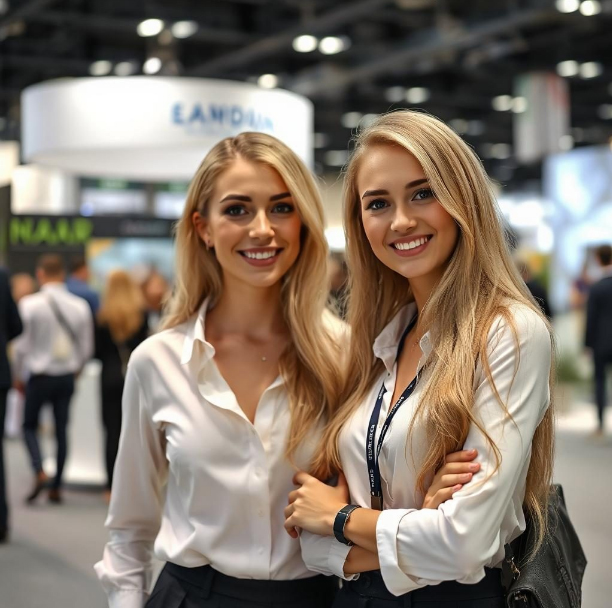
At an agricultural expo, models and stand assistants occupy a unique position. They are not merely decorative—though presentation standards are certainly part of the expectation—but serve as the first point of contact for visitors approaching a company’s booth.
A correspondent from Sputnik Belarus observed the dynamic at work: “Near each stand, representatives are on duty, ready to answer questions in detail. People sincerely take pride in their products and can talk about them for a very long time.” When delegation representatives approached, they inquired about specifications; ordinary visitors mostly examined the machinery and took photographs.
For major manufacturers, stand assistants must be prepared to discuss everything from localization levels to export markets. A Gomselmash marketing executive noted that the exhibition was “an excellent opportunity to conclude new contracts and develop cooperation,” particularly with Russia, where localization across EAEU countries has reached 90%. Assistants staffing such stands need to understand these figures and communicate them effectively.
The outdoor exposition, covering the majority of the exhibition space, presents additional challenges. Stand assistants working these areas must contend with June weather conditions while maintaining professional composure. Equipment on display ranges from tractors and combines to the MAZ 303147 low-floor bus and even a pink-and-white ice cream truck built on a MAZ chassis, requiring staff to be adaptable across vastly different product categories.
Hostesses: Beyond Greeting
The role of hostesses at Belagro extends far beyond welcoming guests at entrances. With visitors required to navigate a sprawling exhibition center and multiple parallel events—Belproduct, Belfarm, ProdMash, and others under the Agro-Industrial Week umbrella—hostesses often serve as logistical guides.
The business program includes seminars, B2B meetings, live demonstrations, presentations, masterclasses, and competitions such as the “Best Ploughman” contest and the “Best Breeding Horse” competition. Hostesses coordinate the flow of delegations between these events, manage meeting schedules, and ensure that VIP visits proceed according to protocol.
Belarusian hospitality is frequently cited as a distinguishing feature of Belagro. Svetlana Kondratenko, deputy director of the Institute of System Research in Agroindustrial Complex of the National Academy of Sciences, described the exhibition’s uniqueness as rooted in “content, atmosphere, and Belarusian hospitality.” Hostesses are the primary embodiment of that hospitality—the first Belarusian faces that foreign visitors encounter and often the ones they remember.
Preparing for the Role
Those working in these positions at Belagro typically undergo preparation before the event opens. This includes familiarization with the exhibition layout across 42,600 square meters, briefings on key companies and their product lines, and coordination with security and protocol teams.
For interpreters, preparation often involves receiving technical glossaries and product documentation in advance. The diversity of exhibitors—from the National Academy of Sciences presenting precision farming technologies to food producers offering tastings in the Belproduct section—means that no single vocabulary list covers every scenario. Adaptability and the ability to ask clarifying questions professionally are valued as much as raw language proficiency.
The personal qualities required for trade show assistants are expansive: the ability to establish contacts with people of different ages and cultures, clear and coherent speech, strong organizational skills, good memory, flexibility of thought, the capacity to pay attention to multiple objects simultaneously, and the ability to make quick decisions in changing situations.
An Overlooked Contribution
The success of Belagro is measured in contracts signed, partnerships formed, and technologies showcased. Deputy Prime Minister Yuri Shuleiko highlighted Belarus’s achievements in dairy, meat production, and food exports during the 2026 opening ceremony. Minister of Agriculture Yuri Gorlov thanked organizers and acknowledged the hard work carried out each day, noting that participants had “demonstrated the unique character, hospitality, and pride of our country.”
Yet none of these outcomes occur without effective human communication. An African delegation understanding the specifications of a BELARUS tractor, a Chinese buyer negotiating terms with a food processor, a Russian partner finding a Belarusian supplier—all depend on the interpreters, stand assistants, models, and hostesses who facilitate these interactions.
As Belagro continues to grow—from 465 companies in 2024 to 570 in 2026, with exhibition space expanding accordingly—the demand for skilled support staff will only increase. For those interested in joining this workforce, experience in hospitality, fluency in Russian and English (with Chinese, German, or Arabic being advantageous), and a genuine interest in agriculture and industrial technology are the qualities most sought by exhibition organizers and participating companies.