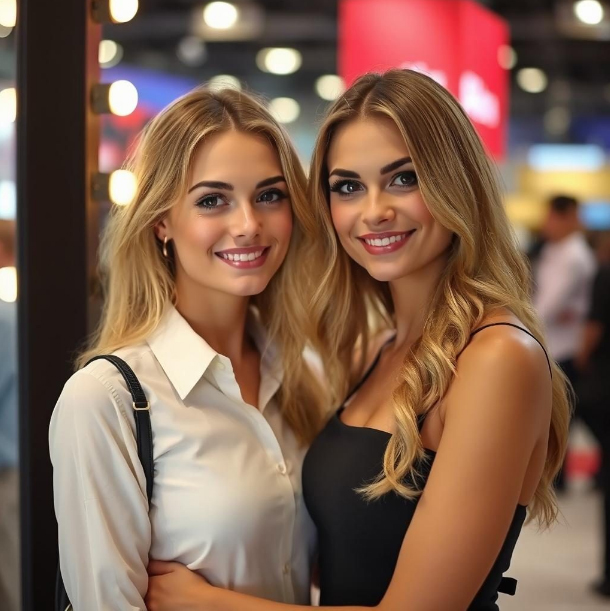
Abstract: While Metal-Expo is fundamentally a showcase of heavy machinery, metallurgical technology, and industrial might, the success of the event relies heavily on a specialized workforce that operates at the intersection of protocol and technical trade. This article examines the distinct yet overlapping roles of models, interpreters, stand assistants, and hostesses at Russia’s premier metallurgical forum, exploring how these professionals facilitate business in a complex regulatory and technical environment.
Introduction: More Than a Pretty Face
The 32nd International Industrial Exhibition Metal-Expo is set to take place in St. Petersburg in November 2026, gathering over 600 companies and 25,000 specialists from the metallurgical, machine-building, and construction sectors. In the popular imagination, industrial trade shows are the domain of massive rolling mills, CNC machines, and grizzled engineers discussing alloy compositions. However, the visual and communicative landscape of the exhibition hall is shaped by a different kind of workforce: the models, interpreters, and stand staff who bridge the gap between complex technology and potential clients.
At an event where a single misunderstanding of a technical specification can stall a multi-million dollar contract, the roles of these professionals have evolved far beyond the traditional “booth babe” stereotype. They are the first point of contact, the cultural diplomats, and often the last line of defense against technical ambiguity.
The Model: Visual Anchor in an Industrial Landscape
The presence of models at an industrial exhibition is not merely about aesthetic appeal; it is a strategic choice in competitive branding. In a venue where hundreds of steel producers and equipment manufacturers compete for attention, visual anchors are essential.
Models at Metal-Expo are typically employed by major metallurgical holdings and equipment distributors to draw foot traffic to expansive stands. Historical records from earlier iterations of the exhibition show that models have been used specifically for the distribution of advertising catalogs and to work at reception desks, inviting guests onto the stand. Their function is to create an immediate, welcoming atmosphere that contrasts with the often austere nature of industrial hardware.
However, the modern model at a B2B industrial exhibition must possess a level of stamina and adaptability rarely required in fashion contexts. They are required to stand for hours, navigate dense crowds, and maintain a professional demeanor while interacting with a highly specialized audience. Their visual presence serves as a psychological signal: a well-designed stand with professional staff suggests a company that is organized, solvent, and serious about its market presence.
The Interpreter: A Technical Diplomat
If the model represents the visual identity of the stand, the interpreter represents its cognitive capability. At an international event like Metal-Expo, where participants hail from China, Turkey, India, Iran, Germany, and beyond, linguistic barriers are the primary obstacle to commercial success.
The role of the interpreter at Metal-Expo is uniquely demanding. Unlike general business translation, metallurgical interpreting requires a lexicon that includes terms like “continuous hot-dip galvanising line,” “electric steelmaking complex,” and “seamless aluminium tube extrusion.” A case study from a previous Metal-Expo illustrates the challenge: an English teacher with seven years of experience was hired by a Chinese equipment manufacturer but found herself navigating discussions about “feed rates,” “tolerance levels,” and “CNC specifications” without a prior engineering background.
Successful interpreters at Metal-Expo are often those who can leverage visual cues. As one interpreter noted, “Schemes, drawings, physical quantities… look the same in all languages,” which often saves the day when vocabulary fails. Their role is not merely to translate words but to translate intent. They facilitate negotiations over pricing, delivery terms, and after-sales service, often working in high-pressure environments where the fate of corporate contracts rests on their accuracy.
The Stand Assistant: The New Hybrid Professional
The days when exhibition hostesses were purely decorative are long gone. In the contemporary Russian exhibition market, the “stand assistant” is a hybrid professional: part technical consultant, part lead qualifier, and part cultural diplomat.
At Metal-Expo, the visitor profile is highly decision-driven. Attendees include procurement directors, chief engineers, and government representatives. Stand assistants must quickly distinguish between casual observers and high-value prospects. This filtering function ensures that the company’s technical experts and sales directors can focus their energy on meaningful commercial conversations.
For international exhibitors, particularly those from Asia, the Russian stand assistant plays a critical role in navigating the regulatory landscape. The GOST (Russian standards) system is dense and unforgiving; a Russian buyer’s first question is rarely about price but about certification. A skilled assistant can preempt these concerns, ensuring that the technical team is not bogged down in regulatory discussions during initial greetings.
The Hostess: Creating Atmosphere and Hospitality
While the term “hostess” is sometimes used interchangeably with “stand assistant,” the hostess role at Metal-Expo retains a distinct focus on hospitality and atmosphere. Documentation from past events shows hostesses working in reception zones, providing information about the company, and serving tea and coffee to guests.
In the Russian business culture, hospitality is a fundamental component of relationship-building. Offering a guest a cup of coffee or tea is not merely a courtesy; it is an invitation to slow down and engage. In the fast-paced environment of a four-day exhibition, the hostess creates a pocket of calm where business discussions can take root. They are often the first smile a visitor sees and the last pleasant interaction before they leave the stand, leaving a lasting impression of the brand’s civility and professionalism.
Economic and Strategic Value
The employment of these professionals represents a significant investment for exhibitors. Agencies classify staff into tiers based on technical ability and risk management: basic promoters for crowd control, technical specialists for equipment demonstrations, and business negotiators for high-level state contracts. The “sweet spot” for most industrial exhibitors is the technical specialist—often a student from a technical university who understands the difference between a lathe and a milling machine and can explain your product’s value proposition without reading from a script.
For Russian companies, the return on investment is measured in lead quality. For foreign companies, particularly those from China and Turkey, the ability to communicate effectively in Russian and navigate local business etiquette is not a luxury but a prerequisite for market entry.
Metal-Expo 2026 will showcase the latest investment projects in Russia’s metallurgical industry, from electric steelmaking complexes to cold rolling mills. Yet, behind every cold-rolled steel sheet and every seamless tube sample stands a human interface. The models draw the eye, the interpreters bridge the technical chasm, and the stand assistants and hostesses transform a transaction into a relationship. In the heavy industry of metallurgy, where precision is paramount, these professionals provide the essential human precision that allows business to flow.