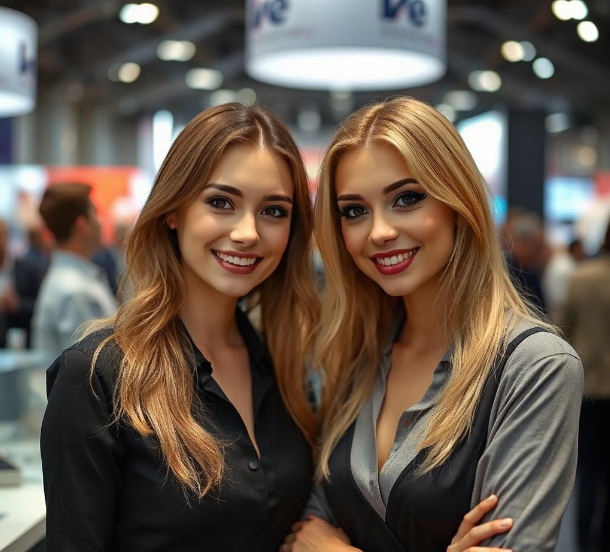
MIPEL is the world’s most important international event dedicated to leather goods and fashion accessories. The 130th edition, running September 13–15, 2026 at Fiera Milano Rho, brings together over 180 Italian and international brands across 4,000 square meters of exhibition space, showcasing Spring/Summer 2027 collections to buyers from around the globe.
For brands exhibiting at this scale—where the audience is dominated by international buyers, retailers, and industry professionals—the professionals staffing the booth shape how collections are perceived and whether commercial conversations translate into orders. This article examines the roles of models, interpreters, booth assistants, and hostesses in the specific context of MIPEL.
Hostesses: The Professional Face of Leather Goods
The hostess role at MIPEL is a recognized professional category in the Italian exhibition market, with specific expectations around presentation, language capability, and stand management. Staffing agencies recruit hostesses specifically for MIPEL, describing them as professionals selected to support exhibitors and brands throughout the exhibition, with responsibilities including visitor reception and registration, exhibition stand assistance, distribution of catalogues and promotional materials, and support during meetings and B2B appointments.
Hostesses at MIPEL typically handle visitor registration, manage access to the stand, distribute catalogues and lookbooks, and support B2B meetings. At an event where buyers come from across Europe, Asia, and the Americas, multilingual capability is a core requirement rather than a bonus. Agencies serving MIPEL explicitly provide hostesses with language skills in English, French, German, Spanish, and other languages on request.
The distinction between a hostess and a greeter matters in this context. A MIPEL hostess must navigate an environment where visitors range from independent boutique owners to department store buyers to fashion press. The ability to identify who requires immediate access to the sales director and who can be directed to a catalogue is a skill that agencies explicitly screen for when selecting personnel for leather goods and fashion accessory fairs.
Models: Visual Representation of Collections
At MIPEL, models serve a function that aligns naturally with the nature of the event. Leather goods and fashion accessories are products where visual presentation and material quality are central, and models contribute to how a brand’s collection is perceived on the stand.
Staffing agencies describe the profiles available for MIPEL as including models for product and collection presentations, promotional activities, professional brand representation, and support during presentations and corporate events. Their roles include showcasing bags, accessories, and leather goods in ways that communicate the craftsmanship and design intent behind each piece.
The presence of models at MIPEL differs from their role at consumer-facing events. At a B2B fair where the audience includes buyers, distributors, and design professionals, the visual element must be integrated with the brand’s collection identity rather than functioning as a standalone attraction. Agencies serving MIPEL explicitly offer models who know how to capture the attention of the public and represent a company in the best possible way, boosting brand image at one of the most prestigious events in the fashion sector.
The overlap between model and hostess roles is practical in the Italian exhibition market. At many stands, a single professional may be expected to combine visual presence with reception and information duties. Agencies list their offerings as hostesses, models, and professional interpreters for MIPEL, acknowledging this integration.
Interpreters: Bridging International Buyer Conversations
MIPEL’s international profile creates consistent demand for professional interpreting services. With exhibitors from over 18 countries and buyers from around the world, the ability to conduct substantive conversations across languages directly affects commercial outcomes. The event benefits from the support of the Italian Trade Agency (ITA), which hosts delegations of top buyers looking for quality and innovation.
Interpreters at MIPEL work in capacities ranging from consecutive interpreting for booth negotiations and buyer meetings to chuchotage (whispered simultaneous interpretation) for small group discussions. Staffing agencies serving MIPEL explicitly list multilingual interpreters as a core offering, with languages including English, French, German, Spanish, and other languages on request.
The technical threshold for leather goods and fashion accessories interpreting is specific to the sector. Discussions may cover leather types (vegetable-tanned, chrome-tanned, patent), construction methods, hardware and components, seasonal collection planning, MOQs, distribution terms, and pricing structures. An interpreter familiar with leather goods terminology performs measurably better than one working from general fashion vocabulary.
For companies engaged in distribution discussions, licensing negotiations, or private label agreements, having an interpreter who understands both the language and the technical context can make the difference between a preliminary conversation and a signed contract. Agencies serving MIPEL emphasize that their interpreters facilitate communication during business meetings and professional appointments, ensuring smooth negotiations with international buyers.
Booth Assistants: The Operational Filter
The booth assistant role at MIPEL extends well beyond greeting visitors. At an event where over 180 brands occupy the exhibition space and the audience is dominated by professional buyers, booth assistants function as the operational layer that allows sales teams to focus on qualified prospects.
The practical functions include:
Visitor qualification. With an audience spanning independent retailers, department store buyers, distributors, journalists, and general trade visitors, booth assistants help identify which visitors warrant time with the sales team. At MIPEL, where the buyer profile is segmented across luxury, fashion, and volume segments, this screening function is particularly valuable.
Lead capture and data management. The commercial value of a leather goods fair is realized through follow-up. MIPEL’s president Claudia Sequi emphasizes that you prepare for the fair all year long and that you cannot expect to come to a trade fair and collect contacts and orders without having done the groundwork first. Booth assistants play a critical role in capturing contact details, recording product interests, and flagging serious buyers for the sales team.
Support during meetings and B2B appointments. Agencies explicitly list visitor assistance and contact collection, and support during meetings and B2B appointments, as core hostess functions for MIPEL.
For international exhibitors, the ideal booth assistant combines Italian fluency, working proficiency in the exhibitor’s language, and enough familiarity with the leather goods sector to distinguish between a casual visitor and a potential buyer.
Practical Considerations for MIPEL Exhibitors
For brands planning a presence at the next edition, several staffing considerations merit attention.
Book early. Milan agencies serving MIPEL advise booking in advance, particularly for profiles requiring specific language combinations or experience in the leather goods and fashion sector. Demand for experienced multilingual staff peaks during the Milan fashion exhibition season, which includes MIPEL alongside MICAM, Lineapelle, and Milano Fashion & Jewels.
Match staffing to the event’s international profile. With exhibitors from over 18 countries and buyers from across Europe, Asia, and the Americas, multilingual staffing at scale is essential for exhibitors targeting export markets. The ITA-supported buyer delegation program brings 27 selected professional operators from 11 countries to each edition, creating specific opportunities for exhibitors with appropriate language support.
Leverage Milan’s agency infrastructure. The city has a mature ecosystem of event staffing agencies with specific experience at MIPEL. Kappa al Quadrato Events, for example, explicitly provides hostesses, models, and professional interpreters for MIPEL, with proven experience in international trade fairs and carefully selected professional staff.
Provide product training. Booth assistants and hostesses who understand the basics of what they are presenting—leather types, construction methods, collection themes—perform better than those working from a script alone. Advance briefing on key products, target buyer profiles, and qualification criteria improves lead quality.
The combined efforts of hostesses, models, interpreters, and booth assistants create the human infrastructure that allows MIPEL to function as a productive international marketplace. While the headlines focus on new collections and emerging designers, the ability to communicate those innovations effectively—across languages, cultures, and professional contexts—remains a fundamental prerequisite for exhibition success.