Almaty, Kazakhstan — When Mining & Metals Central Asia 2026 opened its doors at the Atakent Exhibition Centre from September 16 to 18, the scale was staggering: 533 companies from 30 countries, more than 20,000 square metres of exhibition space, and over 150 units of heavy machinery displayed outdoors.
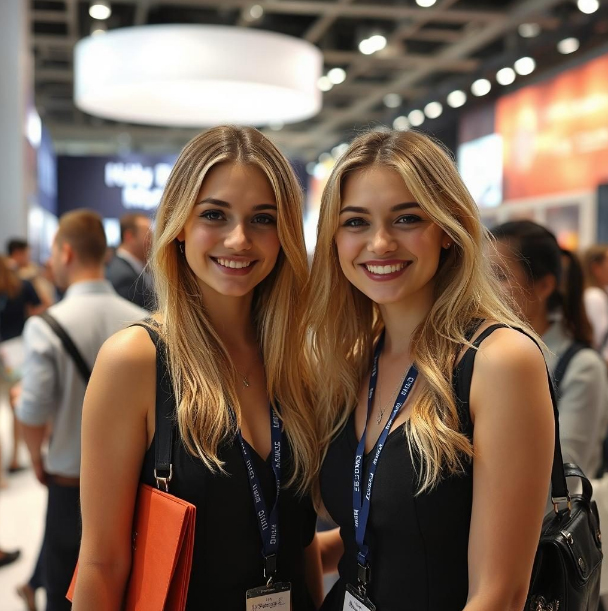
Behind every stand, every negotiation, and every seminar was a workforce that rarely appears in the official statistics—the interpreters, booth assistants, hostesses, and promotional models who serve as the human interface between international exhibitors and the Central Asian market.
A Record-Breaking Industry Platform
The numbers tell the story of the event’s growing significance. Kazakhstan was represented by 161 companies, while 372 exhibitors came from abroad. National pavilions were presented by Austria, Germany, Canada, China, Russia, and Finland. Significantly, 182 companies—34% of the total—participated for the first time, bringing fresh demand for skilled exhibition staff who could navigate both the technical content and the cultural nuances of doing business in Kazakhstan.
The business programme matched the exhibition’s scale: 80 speakers across 14 events, covering everything from critical minerals and investment to digital mining, artificial intelligence, and robotisation. Each of these sessions created demand for interpreters capable of handling specialised terminology across multiple technical domains.
The Roles That Make Exhibitions Work
The terminology of exhibition staffing can be confusing for first-time exhibitors. Booth assistants, hostesses, models, and interpreters represent distinct functions, though their responsibilities frequently overlap during a busy trade fair.
Interpreters are the most technically demanding role—and the hardest to replace. Mining exhibitions require interpreters who can navigate specialised vocabulary across open-pit mining, underground mining, ore processing, geological exploration, industrial safety, and digital technologies. A single day at the Atakent Exhibition Centre can involve back-to-back conversations with mining engineers, metallurgists, procurement managers, government regulators, and technology vendors—each requiring different registers of language and different cultural expectations.
The 2026 business programme added further complexity. The AI Stage featured an Australian expert who has worked with major global mining companies, discussing digital maturity and AI readiness in mining. The GEOTECH FORUM covered Kazakhstan’s new political architecture and the future of the mining industry, while a dedicated session addressed the transition “from automation to intelligent management and robotisation.” Interpreters supporting these sessions must be comfortable with cutting-edge technical terminology and strategic industry concepts alike.
Booth assistants are the operational backbone of any stand. They manage product literature, track visitor inquiries, maintain the presentation of the space, and ensure that conversations flow smoothly. At Mining & Metals Central Asia, where major international equipment manufacturers displayed their latest technologies, booth assistants must absorb product knowledge across categories and convey it accurately to mining company representatives, procurement specialists, and technical directors.
Hostesses handle visitor registration, badge printing, and directing foot traffic to scheduled meetings or presentations. At an exhibition where the Nartas Games and Negotiations Zone offered informal networking opportunities on the second floor of Pavilion 9, hostesses played a critical role in ensuring that formal business meetings and informal connections both proceeded on schedule.
Promotional models serve brand activation purposes—drawing attention to product launches, new technologies, or special exhibits. At Mining & Metals Central Asia, where the scale of equipment on display ranged from laboratory analytical instruments to massive mining trucks, promotional models may be employed for product demonstrations, brand visibility, and guiding visitors through complex exhibition spaces.
Language Combinations in Demand
The linguistic landscape of Almaty’s exhibition industry reflects the city’s position as Kazakhstan’s business capital and the gateway to Central Asia. Russian remains the primary language of business communication across the region. Kazakh is the state language, and English is increasingly important for international exhibitors and technical documentation.
The 2026 exhibition’s geographical reach was extensive: Australia, Austria, Belarus, the United Kingdom, Germany, Greece, India, Iran, Spain, Italy, Kazakhstan, Canada, China, Cyprus, Kyrgyzstan, Latvia, the UAE, Poland, Russia, the USA, Türkiye, Uzbekistan, Ukraine, Finland, France, Croatia, the Czech Republic, Switzerland, Sweden, and South Korea.
National groups from Austria, Germany, Canada, China, Russia, and Finland each created their own interpretation requirements. German exhibitors participating through the official German Pavilion required German-Russian or German-English interpretation. Canadian companies, participating in a dedicated Canadian Group Workshop on “Canadian Expertise and Solutions for the Global Mining Industry,” required English-Russian support. The presence of Belarusian companies through the Belinterexpo operator added demand for Russian-language staff.
Kazakhstan’s bilingual environment—with Kazakh and Russian as official languages—means that exhibition professionals must often navigate both within a single conversation. English-Kazakh-Russian trilingual capability is particularly valuable for exhibitors seeking to engage with both government officials and private sector partners.
What Separates an Effective Exhibition Professional
The demands of a three-day mining trade fair go beyond vocabulary.
Technical versatility matters. Mining & Metals Central Asia covers the full production chain—from open-pit and underground mining equipment to ore beneficiation, from geological exploration to industrial safety solutions, from laboratory analytical equipment to software and computing technology. An interpreter moving from a discussion about flotation cell technology to a negotiation about fire suppression systems for mining equipment must rapidly context-switch between technical vocabularies.
Cultural fluency is equally important. Business etiquette in Kazakhstan places significant weight on relationship-building and respect for hierarchy. The exhibition was officially supported by the Ministry of Industry and Construction of the Republic of Kazakhstan, the Almaty City Akimat, the Atameken National Chamber of Entrepreneurs, and the Association of Mining and Metallurgical Enterprises. Exhibition professionals who understand the protocols of engaging with government delegations and industry associations add considerable value to their employers.
Stamina matters as well. The Atakent Exhibition Centre hosted Mining & Metals Central Asia across Pavilions 8, 9, 10, and 11, plus outdoor exhibition space exceeding 3,000 square metres. Navigating these spaces for three consecutive days, often while managing multiple visitors simultaneously, requires physical as well as mental endurance.
The Organizational Infrastructure
For those seeking work as exhibition staff in Almaty, the primary organiser is Iteca, a leading Kazakhstani exhibition company working in partnership with its international partner, ICA Events Group of Companies.
Almaty has an established ecosystem of exhibition service providers. Local agencies offer staff for exhibitions and trade fairs, including English, French, German, and Italian-speaking booth models with higher education who can work as professional model-translators. These agencies also provide hostess support at major trade exhibition centres.
For interpretation services, the Almaty market includes professional interpreters specialising in mining, metallurgy, and technical fields. Rates for exhibition interpretation in Almaty range from approximately 50 EUR per hour to 250 EUR per day for consecutive interpreting, with conference interpreting commanding higher rates.
Preparing for Mining & Metals Central Asia 2027
For exhibitors planning future participation, the advice from experienced trade fair professionals is consistent: invest in your human interface. The equipment may be impressive, the technology cutting-edge, but deals in Almaty are built through conversations.
The booth assistant who remembers a procurement manager’s name, the interpreter who accurately conveys a technical specification, the hostess who ensures a meeting with a government delegation starts on time—these are the professionals who turn a three-day exhibition into a lasting business relationship.
As Mining & Metals Central Asia continues to grow—with 34% of 2026 exhibitors participating for the first time, and the exhibition already established as the region’s flagship industry platform—the demand for skilled, multilingual exhibition staff will only increase. For Kazakhstan’s professional talent pool, the mining and metallurgy exhibition offers a unique window into global markets—and a chance to be the bridge between Central Asia’s most ambitious resource projects and the international partners who will help develop them.