At a trade fair, the first impression often comes before the first handshake. Light + Building is the world’s leading trade fair for lighting and building services technology, bringing together 1,927 exhibitors from 49 countries and 144,767 visitors from 143 nations in 2026. With 75 percent of exhibitors coming from outside Germany, the show floor is a genuinely global environment where communication, hospitality, and brand presentation are paramount. Behind every well-run stand are professionals whose roles are frequently blurred but essential: stand assistants, hostesses, models, and interpreters.
Distinct Roles, Shared Goals
While these positions often overlap in practice, they serve different primary functions.
Stand assistants focus on operational support and organization. Their tasks include welcoming international visitors, distributing information materials, providing catering services, and ensuring the stand remains presentable throughout the day. They may also assist with visitor registration, recording contact details and areas of interest for later follow-up, and general stand organization to keep everything running smoothly. The duty roster at a well-organized stand establishes who is responsible for individual tasks: ensuring there are sufficient brochures, cleaning seating areas, hospitality services, and breaks.
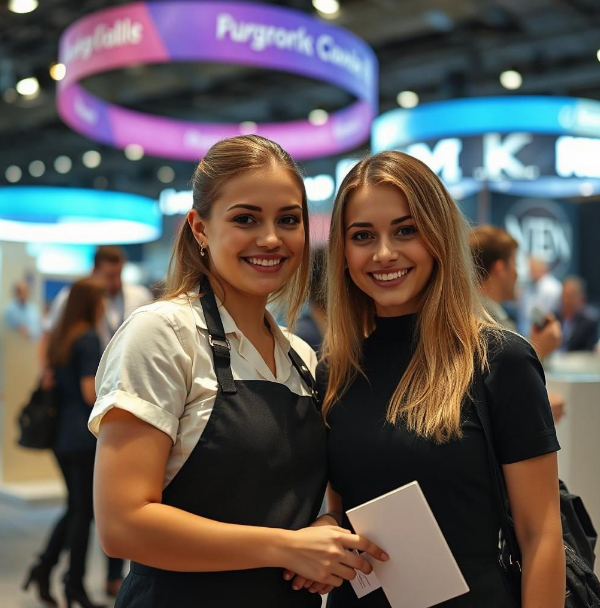
Hostesses (and hosts) are the welcoming face of a company at its booth. They greet visitors, create a pleasant atmosphere, and direct guests to the appropriate representatives. Their role is fundamentally communicative and service-oriented: making attendees feel acknowledged and guiding them through the stand experience. At Light + Building, hostesses often need to engage with visitors continuously, representing the brand professionally. Typical tasks include qualified initial consultation on products and services, forwarding interested customers to specialist advisors, and supporting VIP client care.
Models at trade fairs combine brand representation with guest engagement. Their presence is designed to attract attention, enhance the booth’s visual appeal, and support product presentations. Successful trade show models are also skilled communicators who can engage visitors at a high professional level without being pushy. At a show like Light + Building, where competition for attention across lighting and building technology segments is intense, models help exhibitors stand out.
Interpreters provide professional language mediation. For a fair of Light + Building’s scale, this function is critical. Interpreters in trade fair contexts engage in commercial discussions without assuming the full responsibilities associated with contract negotiations. They must master terminology specific to lighting and building services technology—from LED systems and smart connectivity to electrical infrastructure and energy management. The largest groups of international visitors come from China, the Netherlands, Italy, Switzerland, France, Austria, Belgium, the United Kingdom, Spain, and Greece. While English and German are the primary languages of the show, multilingual support remains valuable for substantive business discussions.
Why These Roles Matter at Light + Building Frankfurt
Light + Building is fundamentally a business event focused on technological transformation. The 2026 edition centered on three key themes: “Sustainable Transformation” (electrification, decarbonisation, and sustainable modernisation of existing buildings), “Smart Connectivity” (intelligent networking of systems, trades, and data), and “Living Light” (quality of light as an integral component of architecture, workplaces, and urban spaces). These are complex, technical subjects that require clear communication across language barriers.
The show is firmly established as a platform for international business and strategic partnerships. For many companies, international business and specific project plans are at the heart of their trade fair presence. An exhibitor presenting a new smart building system or an innovative lighting concept cannot afford misunderstandings. Interpreters and multilingual staff bridge this gap, enabling genuine commercial exchange.
Beyond language, the scale of the fair creates logistical challenges. With nearly 2,000 exhibitors across the Messe Frankfurt halls, visitors must navigate efficiently. Stand personnel who can quickly assess a visitor’s needs and direct them to the right expert add tangible value to the exhibitor’s lead generation efforts. A hostess who handles initial inquiries and coordinates appointments with technical specialists frees up engineers and product managers to focus on substantive conversations.
Qualities That Define Success
Across these roles, certain qualities recur. Communication skills are non-negotiable. Stand staff must be approachable, attentive, and capable of reading visitors’ intentions—knowing when to engage and when to allow browsing. Professional appearance and demeanor matter, particularly for hostesses and models who represent the brand visually. Reliability is essential given the structured schedule of a six-day fair with fixed opening hours.
For interpreters specifically, linguistic precision and preparation are paramount. Familiarity with the lighting and building technology industry’s terminology—from electrical specifications and connectivity protocols to design trends and sustainability certifications—enables smooth, accurate communication. Specialization pays off: general booth staff earn €14 to €16 per hour, while those specializing in VIP care, interpreting, or technical product demonstrations regularly reach €18 to €22.
Behind the Scenes
The professionalism on display is the product of preparation. Before the fair opens, stand supervisors brief their teams on company goals, stand rules, and visitor management procedures. Hostesses and models may receive specific instructions on dress code and behavior. Duty rosters are organized, and daily briefings keep everyone informed about important visitors and priorities. This structure ensures that even temporary staff can contribute effectively from day one.
A well-managed trade fair team ensures that the stand is kept clean, no shortages occur of advertising material or refreshments, the atmosphere remains friendly and relaxed, and details of conversations with visitors are recorded and evaluated. Hospitality on the stand—offering beverages and snacks in a welcoming manner—is a quality aspect of German trade fairs that contributes to the overall impression a company makes.
The Bottom Line
At a trade fair, the overall impression a company makes depends heavily on the people visitors encounter. Stand assistants, hostesses, models, and interpreters each play distinct but complementary roles in creating that impression. They are not merely decorative or auxiliary—they are operational assets who facilitate communication, manage visitor flow, and embody the brand. For exhibitors at Light + Building Frankfurt, investing in the right team is not an expense but a strategic decision that directly influences the quality of leads, conversations, and relationships built over six intensive days in the global capital of lighting and building technology.