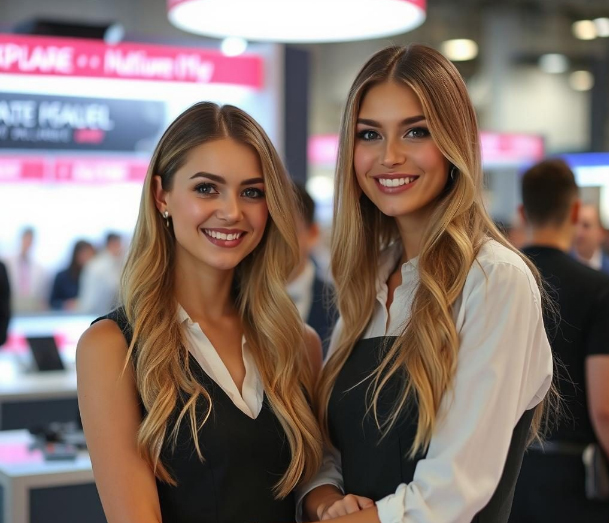
Shenzhen, China — The 27th ITES Shenzhen Industrial Show opened on March 31 at the Shenzhen World Exhibition & Convention Center, bringing together over 1,800 industrial brands across 160,000 square meters of exhibition space. The four-day event focused on high-end equipment, robotics and automation, and precision components, showcasing everything from five-axis machining centers to embodied intelligence robots capable of loading, sorting, and assembly tasks in real factory scenarios. But behind every technical demonstration and supplier negotiation stands a workforce that rarely appears in the headlines: interpreters, stand assistants, hostesses, and models.
Interpreters: Bridging Technical Complexity
ITES is not a general trade fair. The products on display—five-axis machining centers, electric discharge machines, precision measurement systems, and industrial robots—demand interpreters who understand manufacturing terminology as much as language. The fair’s three core thematic zones cover the full industrial chain from machine tools to automation systems, and the concurrent forums bring together over 450 industry experts discussing semiconductor equipment, AI servers, embodied intelligence, and new energy vehicles.
For exhibitors at ITES, interpretation needs are highly specialized. A translator handling a discussion about a Swiss-made precision machining center must be comfortable with terms like “five-axis simultaneous machining,” “thermal compensation,” and “surface roughness Ra values.” When a Japanese machine tool manufacturer demonstrates its equipment to a Chinese buyer, the interpreter must bridge not only language but also technical conventions—explaining feed rates, spindle speeds, and tolerance specifications in terms the buyer can evaluate. The industrial sector’s interpretation market reflects this premium: technical exchange and business negotiation scenarios command rates of CNY 1,000 per day and above in Shenzhen, significantly higher than general business interpretation.
The work extends beyond the booth. ITES 2026 hosted more than 80 forums and conferences, covering topics from embodied intelligence industrialization to semiconductor equipment localization. Interpreters supporting these sessions face the additional challenge of dense technical presentations delivered at speed, often requiring familiarity with industry acronyms and emerging terminology that may not yet have standardized translations.
Stand Assistants: The Operational Layer
With over 1,800 exhibitors spread across multiple halls, stand assistants handle the practical work that keeps booths functional. They guide visitor traffic, distribute materials, manage sample displays, and respond to exhibitor requests throughout the four-day run.
The scale of the operation is considerable. ITES 2026 occupied 160,000 square meters, with exhibitors ranging from global machine tool giants like Yamazaki Mazak and Makino to specialized precision component manufacturers. Stand assistants at such events are typically recruited through temporary staffing channels, with rates in the Shenzhen market ranging from CNY 130 to 150 per day for general support roles. The work is physically demanding—shifts run from early morning to late afternoon, with exhibitors requiring booth staffing throughout the show hours.
For international exhibitors particularly, locally recruited stand assistants provide essential support: navigating the venue’s logistics, coordinating with official contractors, and managing the flow of Chinese-speaking visitors who may not speak English. The work content often includes guiding visitors, assisting with registration, distributing promotional materials, and providing information desk support.
Hostesses: Reception in a Technical Context
The hostess role at ITES differs from consumer exhibitions. In a B2B industrial environment, the emphasis shifts toward professional reception and directional competence. The opening ceremony alone—attended by government officials, industry association leaders, and executives from major equipment manufacturers—requires hostesses capable of managing VIP arrivals, guiding seating, and supporting the flow of a high-profile event.
At the booth level, hostesses serve as the first point of contact for visitors navigating a complex exhibition layout. They identify qualified visitors, coordinate meeting schedules, and maintain a professional atmosphere amid the crowds. The recruitment requirements typically emphasize image and temperament alongside communication skills. While specific hostess rates for ITES are not publicly standardized, the broader Shenzhen exhibition market for such roles ranges from CNY 200 to 500 per day depending on requirements and experience.
Models: Visualizing Industrial Applications
The modeling requirement at ITES is less about runway presence and more about practical demonstration. With the fair’s emphasis on embodied intelligence and industrial robotics, models may be called upon to interact with robotic systems in demonstration scenarios—showing how a collaborative robot assists a human worker, or how a wearable exoskeleton device functions in an industrial setting.
The fair featured a dedicated embodied intelligence zone where companies like Leju Robotics, AgiBot, and Flexiv demonstrated humanoid and collaborative robots performing real factory tasks: loading and unloading, flexible transport, precision assembly, and inspection. In these demonstrations, human presence helps visitors understand the intended workflow and scale of the technology. Models or demonstrators may wear or operate equipment, simulate production scenarios, or simply stand alongside robots to provide visual context for size and reach.
The modeling requirement at ITES is technical but not technical in the way interpretation is. The work involves hours of standing in crowded halls, interacting with visitors, and adapting to the flow of a B2B environment. Rates in the Shenzhen market for exhibition models typically range from CNY 300 to 600 per day.
An Ecosystem in the Shadows
ITES 2026 represents the industrial manufacturing sector at its most ambitious: 1,800 exhibitors, 160,000 square meters, and over 120,000 terminal brand enterprise representatives expected to attend. Interpreters make technical conversations possible. Stand assistants make booths operational. Hostesses make reception professional. Models make complex technology visible.
They are paid modestly by the standards of the industries they serve, and they work under conditions that are physically demanding and temporally compressed. Most will leave after four days, invisible in the official record.
But without them, one of South China’s leading industrial fairs would be a silent showroom. The equipment would be present. The deals would not happen. They are not the headline. They are the infrastructure.