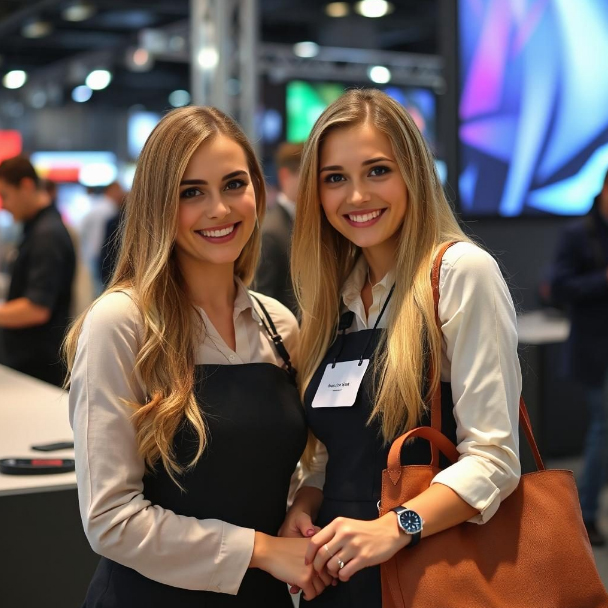
ARTDOM, the International Exhibition of Furniture, Interior Solutions and Art, stands as a key event for the design and art industry in Russia. Bringing together hundreds of international and Russian brands, interior designers, architects, artists, and buyers, ARTDOM serves as a platform where current trends are shaped and business connections are forged. The 2027 edition, scheduled for 18–20 February at Crocus Expo in Moscow, will occupy 32,000 square metres and is expected to attract over 45,000 visitors. With more than 450 international brands participating and an extensive business programme of lectures, discussions, and networking events, ARTDOM creates a demanding environment where professional support staff play a critical role in ensuring smooth operations and effective communication.
While the exhibitors and their furniture collections, interior solutions, and art pieces occupy the centre stage, a specialised workforce of interpreters, booth assistants, hostesses, and models works behind the scenes to ensure that the event functions effectively and that business communication flows without interruption.
Interpreters: Enabling Cross-Border Communication
At an exhibition where companies from Italy, Spain, Brazil, the United Kingdom, Germany, Greece, Denmark, Cyprus, the Netherlands, the UAE, Portugal, Belgium, Singapore, the United States, Turkey, France, the Czech Republic, and Belarus participate alongside Russian exhibitors, interpreters are indispensable. The diverse international presence creates a constant demand for language mediation across the exhibition halls.
Interpreters at ARTDOM work in various capacities. Consecutive interpreters accompany foreign exhibitors during negotiations with Russian distributors, showroom owners, architects, designers, and private clients. They must be fluent not only in general business language but also in the specialised terminology of the furniture and design industry—materials, finishes, construction techniques, designer collections, and production processes. A conversation about modular kitchen systems, premium upholstery fabrics, or limited-edition designer pieces requires an interpreter who understands the design context, not merely the words.
The business significance of interpretation at ARTDOM cannot be overstated. When an Italian furniture manufacturer negotiates with a Russian distributor, or when a Turkish fittings producer discusses terms with a Moscow-based showroom, the negotiation process depends on clear, precise communication. An interpreter’s ability to convey technical specifications, delivery terms, and commercial conditions accurately can determine whether a deal is concluded or lost.
The presence of dedicated interpreter-hostess services for ARTDOM confirms the exhibition’s international character and the practical need for bilingual staff capable of managing both reception duties and language mediation.
Booth Assistants: The Operational Core of Exhibition Stands
Booth assistants form the operational backbone of exhibitor stands at ARTDOM. Their role combines reception duties, product knowledge, and logistical support, making them essential to the smooth functioning of each exhibition space.
A typical booth assistant at ARTDOM is responsible for greeting visitors, managing the flow of attendees at the stand, distributing catalogues and technical documentation, and supporting the sales team in identifying serious business prospects. With the exhibition covering the full spectrum of furniture, interior solutions, and art—from designer collections and architectural products to decorative materials, lighting, and textiles—booth assistants must be prepared to engage with a diverse professional audience including designers, architects, buyers, showroom owners, and private collectors.
Documented examples from ARTDOM exhibitions illustrate the role in practice. At the Poliform stand during ARTDOM 2026, models worked as booth assistants in classic office attire, representing the well-known furniture brand. Throughout their working hours, they remained at the stand’s registration desk, greeted guests, helped potential clients scan their badges for entry into the exhibition zone, provided initial information about the company, and distributed leaflets with brief information. A similar arrangement was documented for the same brand at ARTDOM 2025, where the promotional models in laconic classic suits welcomed visitors and asked them to scan their badges for entry into a closed zone for a more detailed introduction to the new collection and consultation with managers.
These examples demonstrate that booth assistants at ARTDOM function not merely as greeters but as access managers and brand representatives, controlling entry to premium exhibition spaces and ensuring that only qualified visitors engage with the sales team.
Hostesses: From Greeters to Strategic Brand Ambassadors
The role of hostesses at ARTDOM has evolved considerably from simple greeting duties. In an exhibition environment where visitors include design professionals, architects, buyers, showroom owners, marketplace representatives, and high-profile private clients, the modern hostess functions as a brand ambassador and a critical component in a company’s lead generation efforts.
At ARTDOM, hostesses serve as the first point of contact for visitors, acting as an initial filter who greets attendees and quickly assesses their role and interest level. Is this a curious design enthusiast, or a high-potential procurement director from a major development company? By qualifying visitors through predefined questions, hostesses ensure that technical staff time is optimised for maximum return on investment.
Their responsibilities extend beyond welcoming. Hostesses manage the flow of visitors, schedule meetings, coordinate product demonstrations, and capture lead data accurately using tablets and CRM tools. In an industry built on aesthetics, quality, and design excellence, the hostess projects an image of organised, professional sophistication, making the company appear as refined as its products.
The ARTDOM hostess must also possess product literacy. While not expected to be furniture designers or engineers, top-tier ambassadors are thoroughly briefed on the company’s products and services. They understand key messaging, can identify a qualified lead based on a visitor’s questions, and know exactly which specialist on the team to introduce them to. They can articulate the value proposition of designer furniture, premium materials, or limited-edition art pieces with confidence.
The role also requires cultural and linguistic competence. A skilled hostess is often fluent in both Russian and English, and sometimes Italian given the significant participation from Italian brands. They can seamlessly greet a delegation from a Russian regional design community, converse with executives from Italy or Brazil, and explain product details to architects from Turkey or the UAE, all while navigating subtle cultural formalities.
Models: Presentation Beyond Aesthetics
Models at ARTDOM serve a functional role that extends beyond visual appeal. In the context of a design and art exhibition, models may be engaged for product presentations, showroom demonstrations, and promotional activities that require a polished, professional presence.
Documented examples from ARTDOM confirm that models are frequently deployed as booth assistants and brand representatives. At the Poliform stand during ARTDOM 2026, models with “model appearance” worked as booth assistants in classic office clothing, representing the furniture brand throughout the exhibition. The same arrangement was documented for ARTDOM 2025, where models represented the Italian furniture brand in laconic classic suits.
This dual role—combining visual presentation with functional reception and access management—reflects the specific demands of a design-oriented exhibition. Exhibitors showcasing premium furniture, designer collections, or luxury interior solutions use models not merely as decoration but as integrated brand ambassadors who contribute to the aesthetic atmosphere of the stand while performing essential operational tasks.
The distinction between models and hostesses at ARTDOM can be subtle. Models may focus more on visual presentation and promotional engagement, while hostesses typically handle informational and logistical tasks. In practice, the documented examples show that these roles often merge, with models performing booth assistant functions at registration desks and access points.
For ARTDOM specifically, models might be engaged by companies presenting premium furniture collections, Italian designer brands, or innovative interior solutions. The exhibition’s emphasis on quality, curation, and international design standards—with 92% of participating companies reporting satisfaction with their involvement—creates opportunities for exhibitors to use models in presentations that communicate both the aesthetic and commercial value of their products.
A Collaborative Professional Ecosystem
What unites interpreters, booth assistants, hostesses, and models at ARTDOM is their shared function as facilitators of communication, experience, and business interaction. The exhibition’s stated purpose is to foster interaction between brands, designers, manufacturers, and buyers, ensuring steady growth in orders for participating factories. The quality of the support workforce directly influences how effectively these objectives are achieved.
ARTDOM has established itself as a significant platform for the design and art industry, operating across multiple countries including Russia, Italy, the UAE, Saudi Arabia, Brazil, and other regions. The 2026 edition brought together more than 450 companies from 25 countries, with a business programme of over 45 lectures and discussions featuring international design stars. That scale and influence depend not only on the exhibitors and their products but also on the professional infrastructure that makes the event navigable, accessible, and productive for all participants. Whether interpreting a technical negotiation, welcoming a delegation from a national pavilion, or ensuring that an international exhibitor’s stand runs smoothly, these professionals contribute to the exhibition’s continued relevance in a changing design landscape.
The modern ARTDOM brand ambassador—whether called interpreter, booth assistant, hostess, or model—is a strategic investment. They are the human face of a design-driven brand, the friendly guide in a vast sea of creative expression, and the critical first connection that can lead to significant business partnerships. In the competitive world of Moscow’s design exhibitions, where major contracts are negotiated and aesthetic standards are set, these professionals are the human connection that illuminates the path to new business.