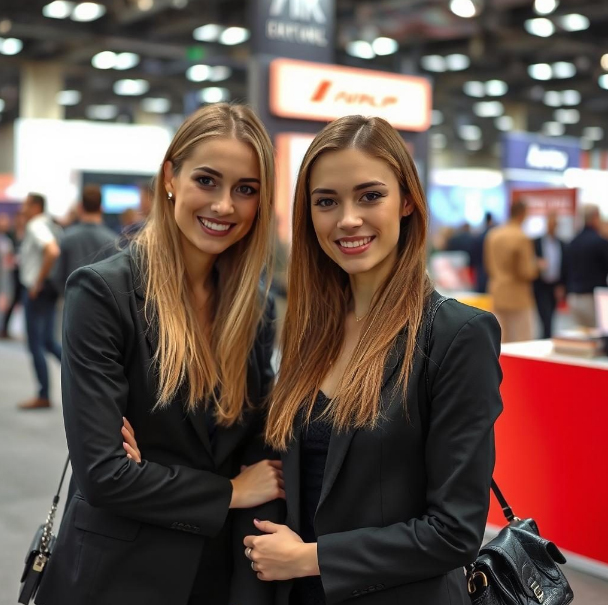
At a trade fair, the first impression often comes before the first handshake. IMEX Frankfurt is the global meeting place for the events industry, bringing together thousands of participants from destinations, venues, technology providers, and event agencies. With over 13,000 participants, nearly 3,000 exhibiting companies, and more than 4,700 buyers from 94 countries in 2026, the show floor is a genuinely international environment where communication, hospitality, and brand presentation are paramount. Behind every well-run stand are professionals whose roles are frequently blurred but essential: stand assistants, hostesses, models, and interpreters.
Distinct Roles, Shared Goals
While these positions often overlap in practice, they serve different primary functions.
Stand assistants focus on operational support and organization. Their tasks include managing the information desk, answering visitor inquiries, restocking catering supplies such as water, coffee, and juice, and ensuring the stand remains presentable throughout the day. They may also assist with visitor registration and general organizational tasks to keep everything running smoothly.
Hostesses (and hosts) are the welcoming face of a company at its booth. They greet visitors, create a pleasant atmosphere, and direct guests to the appropriate representatives. Their role is fundamentally communicative and service-oriented: making attendees feel acknowledged and guiding them through the stand experience. At IMEX, hostesses often need to engage with visitors continuously throughout the exhibition, remaining at the reception area and representing the brand professionally. Some exhibitors even employ costumed hosts to draw attention to their stands, with performers wearing character costumes for short intervals throughout the day.
Models at trade fairs combine brand representation with guest engagement. Their presence is designed to attract attention, enhance the booth’s visual appeal, and support promotional activities. While physical appearance is part of the role, successful trade show models are also skilled communicators who can engage visitors and support sales representatives as needed. At a show like IMEX, where competition for buyer attention is intense, models help exhibitors stand out on a crowded floor.
Interpreters provide professional language mediation. For a fair of IMEX’s scale, this function is critical. Exhibitors from Germany, the United States, the United Kingdom, and beyond need to conduct substantive business discussions with international visitors. While English is the primary language of the show, with learning sessions delivered in both English and German, the global reach of the event means that multilingual support remains valuable. Interpreters may be called upon for hosted-buyer meetings, breakout sessions, and stand conversations where technical terminology or nuanced negotiation demands precise communication.
Why These Roles Matter at IMEX Frankfurt
IMEX Frankfurt is fundamentally a business event. The 2026 edition saw a record-breaking 73,000 pre-scheduled meetings, including 63,500 one-to-one appointments, take place across three days. These are not casual conversations; they are business negotiations with real commercial outcomes. An exhibitor presenting a new venue, a destination marketing campaign, or an event technology platform cannot afford misunderstandings.
The hosted-buyer program is central to IMEX’s model, bringing qualified buyers from around the world to the show floor with pre-arranged meetings. Hostesses and stand assistants who can quickly assess a visitor’s needs and direct them to the right expert add tangible value to the exhibitor’s lead generation efforts. For international exhibitors, multilingual staff and interpreters bridge language gaps that could otherwise derail promising conversations.
Beyond language, the scale of the fair creates logistical challenges. With nearly 3,000 exhibitors across the Messe Frankfurt halls, visitors must navigate efficiently. Stand personnel who can manage the flow of visitors and keep meetings on schedule contribute directly to the exhibitor’s return on investment.
Qualities That Define Success
Across these roles, certain qualities recur. Communication skills are non-negotiable. Stand staff must be approachable, attentive, and capable of reading visitors’ intentions—knowing when to engage and when to allow browsing. At IMEX, where attendees are themselves professionals in the events industry, the standard of interaction is particularly high.
Professional appearance and demeanor matter, particularly for hostesses and models who represent the brand visually. Reliability is essential given the structured schedule of a three-day fair with fixed opening hours and pre-scheduled meetings. And cultural sensitivity plays an increasingly important role at an event with participants from over 90 countries.
For interpreters specifically, linguistic precision and preparation are paramount. Familiarity with the events industry’s terminology—from venue specifications and destination marketing to technology platforms and sustainability practices—enables smooth, accurate communication. While much of IMEX operates in English, the ability to support conversations in German, Arabic, or other languages can be a decisive advantage for exhibitors targeting specific markets.
Behind the Scenes
The professionalism on display is the product of preparation. Before the fair opens, stand supervisors brief their teams on company goals, stand rules, and visitor management procedures. Hostesses and models may receive specific instructions on dress code and behavior; one agency recruiting for IMEX specified that staff should be willing to wear either traditional Emirati attire or a formal suit, depending on the client’s requirements. Duty rosters are organized, and daily briefings keep everyone informed about important visitors and priorities. This structure ensures that even temporary staff can contribute effectively from day one.
The Bottom Line
At a trade fair, the overall impression a company makes depends heavily on the people visitors encounter. Stand assistants, hostesses, models, and interpreters each play distinct but complementary roles in creating that impression. They are not merely decorative or auxiliary—they are operational assets who facilitate communication, manage visitor flow, and embody the brand. For exhibitors at IMEX Frankfurt, investing in the right team is not an expense but a strategic decision that directly influences the quality of leads, conversations, and relationships built over three intensive days in the global capital of the events industry.