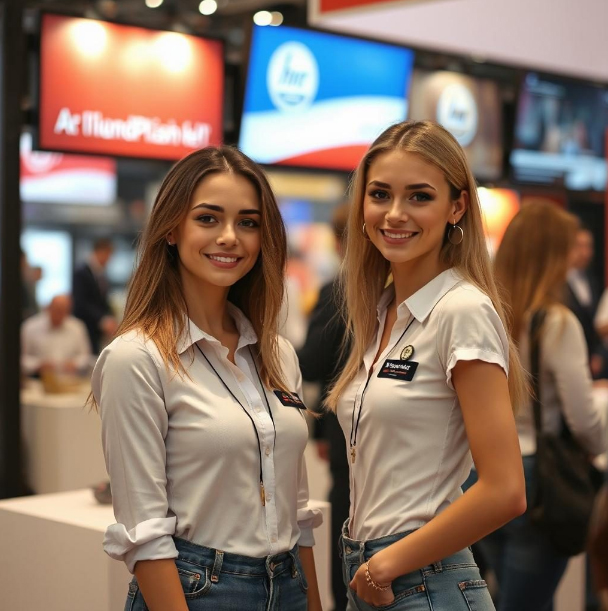
Baku Energy Week transforms the Azerbaijani capital into a global energy crossroads each June. The 2026 edition, running from June 1–3, brings together 276 companies from 46 countries for the 31st Caspian Oil & Gas exhibition, the 14th Caspian Power exhibition, and the 31st Baku Energy Forum. Yet behind the high-level panel discussions and multi-million-dollar memoranda lies a workforce rarely mentioned in the official communiqués: the hostesses, models, interpreters, and booth assistants who make international business possible on the exhibition floor.
A Calendar Built for Multilingual Business
Baku has cemented its position as the exhibition capital of the Caucasus. The Baku Expo Center hosts major international trade fairs almost year-round, organized primarily by Iteca Caspian and Caspian Event Organisers. For the 2026 energy week, roughly 60 percent of exhibitors are foreign companies, with national pavilions from Germany and Russia, and participants hailing from countries including the United States, China, France, Italy, Türkiye, Kazakhstan, and Saudi Arabia.
This multinational composition creates immediate demand for language services. A single major exhibition in Baku has confirmed participation from more than 270 companies across 29 countries, with national displays from multiple nations and official delegations from dozens of governments. For exhibitors, the ability to communicate with Azerbaijani government officials, local distributors, and potential partners determines whether a trade fair appearance translates into actual business.
The Linguistic Demands of Baku Energy Week
The range of assignments in Baku mirrors the city’s role as a crossroads between Turkic, Slavic, and Western business worlds. English-Russian remains the baseline for international business in Baku. But Azerbaijani-Russian pairings are equally critical for engaging with local government and business structures. Turkish language skills carry particular weight given the close economic ties between Azerbaijan and Türkiye. Chinese has grown in importance as Chinese companies expand their presence in Caspian infrastructure and construction projects.
The technical content of Baku Energy Week amplifies these linguistic challenges. The exhibition covers oil and gas field development, transportation and production, telecommunications and IT, refining, construction and installation works, and innovative technologies including artificial intelligence and decarbonisation. A single day at the Baku Expo Center can involve back-to-back conversations with engineers, procurement managers, government regulators, and journalists—each requiring different registers of language and different cultural expectations.
The program for Caspian Oil & Gas 2026 includes panel discussions on “Smart Manufacturing: AI, Smart Drilling” and innovation sessions on digital logistics, requiring assistants to navigate technical terminology across energy, logistics, and digital transformation.
Beyond Language: The Skills That Matter
What separates an effective trade show assistant from a general interpreter? The demands of a major exhibition like Baku Energy Week go beyond vocabulary.
Business etiquette is as important as linguistic accuracy. Azerbaijani business culture places significant weight on relationship-building and respect for hierarchy. An assistant who understands when to translate directly, when to soften, and when to simply facilitate the social rituals around a negotiation becomes far more valuable than a purely technical translator.
Stamina matters. Exhibition halls are exhausting environments. With the exhibition area spanning more than 10,000 square meters and events running across two venues—the Baku Expo Center and the Baku Congress Center—assistants must maintain focus through long days of rapid context-switching.
Adaptability across roles. The line between “hostess,” “model,” “interpreter,” and “booth assistant” often blurs at major exhibitions. A professional representing a company at its stand may be greeting visitors, explaining technical specifications, facilitating introductions, and interpreting for a visiting delegation—all within the same hour.
The Organizational Structure Behind the Shows
For those seeking work at Baku Energy Week, the path often runs through the exhibition organizers themselves. Iteca Caspian, founded in 2000, organizes more than 20 specialized exhibition events annually and is a member of the World Association of the Exhibition Industry (UFI) and the International Congress and Convention Association (ICCA). Its events receive active support from Azerbaijani government ministries.
This structure means that staffing and interpretation needs are managed through established channels. Exhibition organizers coordinate with service providers who maintain rosters of vetted professionals. Freelancers who perform well on one event are called back for subsequent seasons. For newcomers, registering with platforms that serve the Baku market provides an entry point, though the highest-profile assignments typically flow through personal networks and agency relationships.
A typical full-time translator position in Baku offers a monthly salary in the range of 700 to 800 AZN for entry-to-mid-level roles, with higher compensation available for specialized language combinations or candidates with significant experience.
The Strategic Context
Baku’s exhibition economy is not simply a calendar of trade fairs. It is a deliberate instrument of Azerbaijan’s economic strategy. The organizers describe their events as positioning Baku as “one of the key centres for international dialogue, technology exchange” and a platform for shaping the future of energy.
Baku Energy Week has evolved into an international business ecosystem uniting energy transition, green energy, digitalisation, artificial intelligence technologies, logistics, industry, and infrastructure. The presence of companies like bp, ExxonMobil, TotalEnergies, Masdar, SLB, and SOCAR underscores the commercial stakes.
In this context, the hostesses, models, interpreters, and booth assistants are not decorative additions. They are the human interface between international exhibitors and local partners, ensuring that deals move forward across language barriers. They are, in a real sense, the multilingual engine behind Azerbaijan’s exhibition economy.
For the 2026 edition, free shuttle buses operate from “Koroghlu” metro station to Baku Expo Center, and from the venue toward Park Bulvar Mall—a small logistical detail that nonetheless reflects the scale of the operation. The professionals who staff the stands, interpret the negotiations, and represent the brands are essential to making it work.