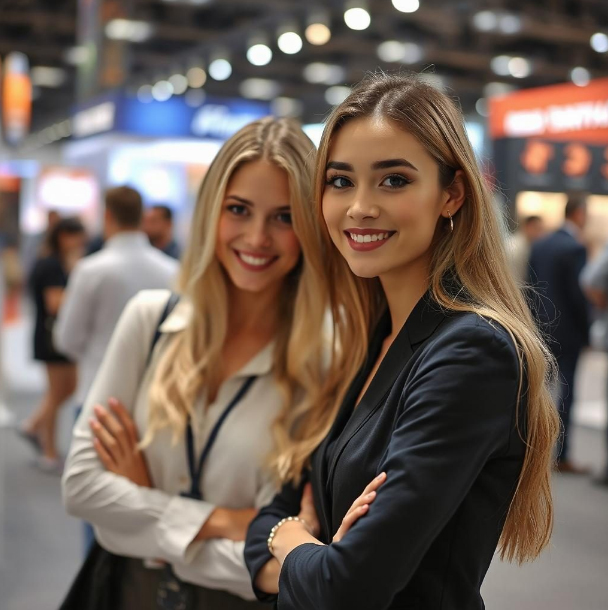
The Global Fishery Forum & Seafood Expo Russia is the largest event of its kind in the Russian fishery industry, bringing together over 20,000 specialists from more than 80 countries. Behind every successful stand, every productive negotiation, and every international partnership stands a team of support professionals whose contributions are often invisible but absolutely essential.
Held annually in St. Petersburg at the ExpoForum Convention and Exhibition Centre, the event spans three days in September and encompasses the entire fishery supply chain—from catching and aquaculture to processing, logistics, storage, packaging, and delivery of finished products to consumers. With 347 exhibitors from 37 Russian regions and 11 countries, and delegations from nations including China, India, Turkey, Venezuela, Vietnam, and EAEU member states, the exhibition is a genuinely international marketplace.
For exhibitors navigating this complex environment, the quality of on-site support staff—hostesses, models, interpreters, and booth assistants—can determine whether three days of exhibition translates into contracts, partnerships, and market access, or simply into collected business cards that never convert.
Hostesses: The First Point of Contact
At an exhibition of this scale, hostesses serve as more than a welcoming face. They are the operational front line of any stand, managing the flow of visitors, collecting contact information, and ensuring that the stand presents a professional image at all times.
The role at a fishery exhibition like Seafood Expo Russia differs meaningfully from consumer-facing events. The audience consists of industry professionals—fishing company executives, processing plant managers, logistics specialists, and government officials. Hostesses at these stands must combine warmth with efficiency, understanding that their primary task is to identify and direct qualified visitors to the appropriate representative rather than to engage in prolonged conversation themselves.
Typical responsibilities include greeting visitors, managing the reception desk, preparing and serving refreshments, collecting business cards and contact details, and maintaining the stand’s presentable appearance throughout the day. In the context of Seafood Expo Russia, where tasting sessions and product demonstrations are common features, hostesses may also assist with the logistics of these activities, ensuring that visitors experience the stand’s offerings in an organized and inviting manner.
Language capability is a significant advantage for hostesses at this event. With visitors from 81 countries and regions including China, India, Turkey, South Korea, and Spain, even basic English or other language skills enable hostesses to welcome international guests and direct them effectively until an interpreter or specialist becomes available.
Models: Attention and Orientation
The presence of models at a fishery exhibition may seem counterintuitive, but their function at an event like Seafood Expo Russia is both practical and strategic.
The exhibition spans 26,000 square meters, including 9,700 square meters of exposition space across Pavilions F and G. In this expansive environment, models serve as visual points of orientation—figures who draw visitors toward a particular stand and create the initial moment of engagement that precedes any business discussion.
For fishery companies, the challenge is often one of perception. Seafood is a product category that benefits from sensory appeal: appearance, freshness, and quality are communicated visually. Models can help bridge the gap between the industrial nature of a B2B exhibition and the consumer-facing dimension of fishery products. Whether demonstrating packaging, presenting product samples, or simply creating an inviting presence, models contribute to the stand’s ability to attract and hold attention in a competitive exhibition hall.
Beyond attracting visitors, models at Seafood Expo Russia also play a role in the festival atmosphere that the event has cultivated. The exhibition includes tasting sessions, gastronomic demonstrations, and competitive events. Models who are briefed on the company’s products and comfortable engaging with visitors can enhance these activities, adding a dimension of hospitality that complements the professional content of the stand.
Interpreters: The Infrastructure of International Business
The Global Fishery Forum & Seafood Expo Russia is explicitly international in its scope. The business program includes sessions on supply chains among BRICS+ countries, export models in a transforming global trade environment, and technological solutions for long-term competitiveness. These discussions require interpretation that is not merely linguistically accurate but contextually precise.
Interpreters at this event operate in high-stakes environments. A session on “New Supply Chains and Emerging Routes for Seafood Trade Expansion in BRICS+” involves discussions of logistics, settlements, quality standards, certification, and infrastructure access—topics where a single mistranslation can create confusion or misrepresentation. The fishery sector has its own specialized vocabulary: terms related to fishing methods, processing technologies, cold chain logistics, and regulatory compliance. An interpreter who understands the difference between “aquaculture” and “mariculture,” or who can accurately convey technical specifications of processing equipment, is invaluable.
Beyond formal conference sessions, interpreters serve a quieter but equally critical function on the exhibition floor. In one-on-one meetings between Russian fishery companies and their Chinese, Turkish, or Indian counterparts, an interpreter may be the only person capable of ensuring that both parties leave the conversation with the same understanding of what was discussed. For Chinese exhibitors—whose presence at the event has grown significantly, with the Chinese exposition described as the largest in the exhibition’s history—Russian-speaking interpreters with fishery vocabulary are among the most valuable members of their teams.
The event’s scale and the diversity of its international participation make interpreter services not a luxury but a practical necessity for any exhibitor serious about developing cross-border partnerships.
Booth Assistants: The Operational Backbone
While hostesses manage the front of the stand and interpreters enable communication, booth assistants keep the exhibition stand functioning behind the scenes.
The demands of a three-day exhibition are considerable. Seafood Expo Russia runs from 10:00 to 18:00 on the first two days and closes at 16:00 on the final day. During these hours, a booth assistant may be responsible for restocking brochures and promotional materials, managing product samples, coordinating the meeting schedule, directing visitors to the correct specialist, and troubleshooting technical displays or equipment.
At an event where many exhibitors are showcasing complex technology—refrigeration systems, processing equipment, aquaculture installations, and logistics solutions—booth assistants often need a working knowledge of the products they support. They may be called upon to provide preliminary information about a machine’s capabilities while a specialist is occupied, or to explain the basics of a service offering to a visitor who is not yet ready for a detailed technical discussion.
The logistical complexity of the event is substantial. With over 20,000 visitors expected across the three days, the ability to track which visitors have been attended to and which are waiting, to manage the flow of traffic around product displays, and to ensure that no promising lead is left unattended—these are the operational tasks that booth assistants perform, often without recognition, but with direct impact on the exhibitor’s return on investment.
The Collaborative Ecosystem
What these four roles share is a fundamental truth about exhibition success: it is never the work of a single person or even a single team. A productive meeting at Seafood Expo Russia requires a chain of coordinated actions. A hostess greets a visitor and confirms their interest. A booth assistant escorts them to the correct meeting area. An interpreter ensures that the conversation is accurate and complete. A model, visible from across Pavilion F, drew that visitor to the stand in the first place.
For companies preparing to exhibit at the Global Fishery Forum & Seafood Expo Russia, investing in the quality and preparation of these support roles is not an expense to be minimized. It is an investment in the translation of presence into results. The exhibitors who understand this—who brief their interpreters thoroughly on fishery terminology, who train their booth assistants on the products, who select hostesses for professionalism and language capability—are the ones who leave St. Petersburg with contracts, partnerships, and a clear return on their exhibition investment.
The 2026 edition of the event, scheduled for September 16–18 at the ExpoForum, will once again bring together the full spectrum of the fishery industry. Behind every successful stand will be a team of professionals whose contributions, though often unseen, are absolutely indispensable.