Fiera Milano is not a single trade fair—it is an ecosystem. The Rho exhibition centre hosts approximately 60 major events each year, bringing together around 40,000 exhibitors and 4.5 million visitors annually. From the Salone del Mobile to Plast, from Milano Unica to BI-MU, these events span industries as diverse as furniture, fashion, plastics, robotics, and textiles.
For international exhibitors participating in this sprawling complex, the human interface at the booth level—interpreters, booth assistants, hostesses, and models—often determines whether a presence at Fiera Milano translates into commercial results. This article examines what each role entails in the specific context of Milan’s exhibition ecosystem.
Interpreters: Technical Precision in a Multilingual Market
Fiera Milano’s international character is not incidental—it is structural. At Plast 2026, 44 percent of the more than 1,000 exhibitors were international companies, and approximately 9,000 of the 35,000 trade visitors came from abroad, representing 110 countries. At Lineapelle, the leather and materials fair, more than 1,000 exhibitors gather from across the global supply chain. This international density creates consistent demand for professional interpreting services.
Milan’s interpreting market reflects this demand. Agencies operating in the city provide interpreters for trade fairs, business meetings, technical negotiations, and conference sessions, covering European languages as well as Chinese, Arabic, and other non-European languages. The most common formats for exhibition work are consecutive interpreting for one-on-one meetings and booth negotiations, and chuchotage (whispered simultaneous interpretation) for small groups without technical equipment.
The technical threshold varies by sector. At a plastics industry fair like Plast, interpreters must navigate terminology around injection molding, extrusion, and polymer chemistry. At Milano Unica, the focus shifts to fabric composition, textile finishes, and fashion terminology. At BI-MU, the machine tool and robotics exhibition, the vocabulary centers on CNC machining, automation systems, and digital manufacturing.
For exhibitors, the practical implication is clear: a general interpreter, however fluent, may not suffice. The selection of an interpreter should be based on the specific industry, the technical depth of the discussions expected, and the language pairs required. Agencies in Milan typically select professionals based on the topic, the sector, and the characteristics of the event.
Booth Assistants: The Operational Filter
The booth assistant role at Fiera Milano events extends well beyond greeting visitors. With exhibition halls spanning multiple pavilions—Milano Unica alone occupies Halls 1, 3, 5, and 7, each dedicated to different product categories—booth assistants function as navigational anchors for visitors and operational support for exhibitors.
At international trade fairs in Milan, booth assistants typically handle several core functions. They provide first-contact information, answering routine questions and directing visitors to the appropriate technical specialists. They manage lead capture, collecting contact details and recording specific product interests for follow-up. And they support crowd flow management, ensuring that visitors who require deeper discussion reach the right person without overwhelming the technical team.
Milan’s staffing agencies describe their personnel as experts in reception and assistance during trade fairs and congresses, ensuring that every event runs smoothly. The emphasis is on professionalism and the ability to put clients at ease while maintaining an appropriate image for the event type. For exhibitors with complex technical offerings, the ideal booth assistant combines language skills with enough industry literacy to identify whether a visitor is a procurement manager, an engineer, or a distributor—and to respond accordingly.
Hostesses: Reception as a Professional Discipline
The hostess role in the Italian exhibition market is a recognized professional category with its own expectations and standards. Milan-based agencies select hostesses and stewards for professional presence and elegance, with particular attention to the type of event in which they participate. At a consumer-facing event, the emphasis may lean toward approachability and visual appeal. At B2B fairs like BI-MU or Plast, the emphasis shifts toward competence, information management, and professional decorum.
Hostesses at Fiera Milano typically manage registration desks, guide visitors through accreditation processes, distribute materials, and maintain the professional tone of the exhibition environment. At the Rho complex, where events can span dozens of halls, their navigational role is particularly important—directing visitors to the correct pavilion, the right meeting room, or the nearest transport connection.
The hierarchy within the hostess category is also relevant. Some roles require senior commercial hostesses with relational and commercial skills, while others focus primarily on reception and information provision. Rates reflect this differentiation: daily compensation for senior hostesses at international fairs in Milan ranges from approximately €90 to €120 gross per day.
Models: Visual Traffic in a Competitive Environment
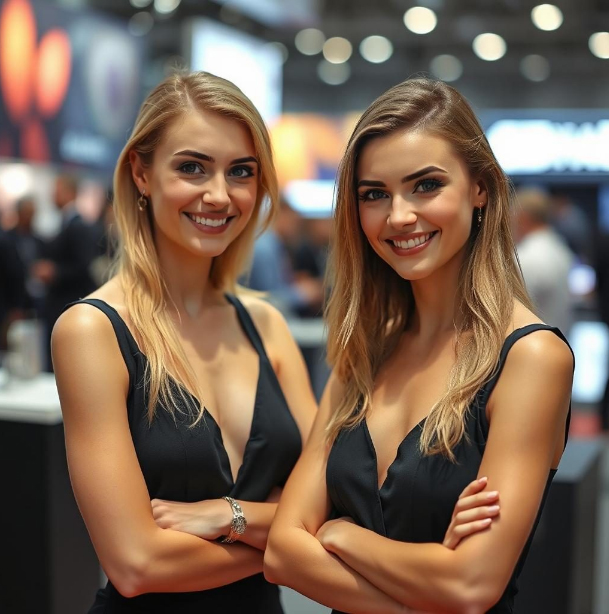
At an exhibition centre hosting 4.5 million visitors annually across dozens of concurrent and sequential events, visual competition is intense. Models—sometimes functioning as promoters—serve a specific commercial purpose: drawing foot traffic to a booth in an environment where visitors make rapid decisions about where to invest their time.
Milan’s casting and staffing agencies maintain large databases of models and promoters for trade fair work, covering fashion weeks, the Salone del Mobile, and Fiera Milano events. At shows like Milano Unica, which serves the high-end textile and fashion industry, the presence of models can align naturally with the brand positioning of exhibitors in fabrics, accessories, and design. At more technical fairs, models may participate in product demonstrations, photo opportunities, or the distribution of branded materials.
The distinction between models and hostesses in the Italian market is practical rather than rigid. Agencies often describe their offering as hostesses, models, and promoters for fairs and events. The overlap reflects the reality that at many stands, a single professional may be expected to combine visual presence with functional reception and information duties.
Practical Considerations for Fiera Milano Exhibitors
For companies planning a presence at Fiera Milano events, several staffing considerations merit attention.
Plan around the event’s international profile. Events like Plast, with 44 percent international exhibitors and visitors from 110 countries, require multilingual staffing at scale. Events with a primarily Italian audience may prioritize Italian fluency and industry knowledge over additional languages.
Match interpreting format to use case. Consecutive interpreting is the practical standard for booth negotiations and small meetings. Simultaneous interpretation with equipment is reserved for conference sessions and large presentations. Chuchotage works for small group discussions where equipment is impractical.
Leverage Milan’s agency infrastructure. The city has a mature ecosystem of event staffing agencies with decades of experience serving Fiera Milano events. Some agencies have operated in Milan for over 50 years, coordinating audiovisual services, interpreting, and hostess and steward staffing under one roof. Others have selected hostesses, booth assistants, models, and promoters since the 1970s. This infrastructure reduces the logistical burden on exhibitors.
Book early and brief thoroughly. Milan’s exhibition calendar is dense, and demand for experienced bilingual staff peaks during major events. Providing advance access to product materials, terminology glossaries, and target visitor profiles allows assistants and interpreters to function as informed representatives rather than passive presences.
The combined efforts of interpreters, booth assistants, hostesses, and models create the human infrastructure that allows Fiera Milano to function as a productive international marketplace. While the headlines focus on product launches and industry trends, the ability to communicate those innovations effectively—across languages, cultures, and professional contexts—remains a fundamental prerequisite for exhibition success.