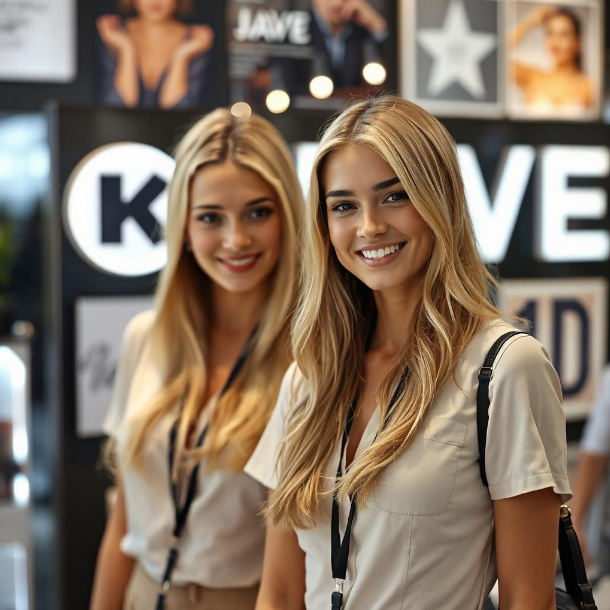
Shenzhen, China — The 27th China International Optoelectronic Exposition (CIOE 2026) opened on September 9 at the Shenzhen World Exhibition & Convention Center, marking its largest edition ever. Spanning 260,000 square meters with over 4,000 exhibitors from more than 30 countries, CIOE has evolved into a 320,000-square-meter “Mega Show” through co-location with the International Integrated Circuit Innovation Expo and elexcon, drawing an estimated 240,000 professional attendees. But behind the optical modules, laser systems, and AI infrastructure on display stands a workforce that rarely appears in press releases: interpreters, stand assistants, hostesses, and models.
Interpreters: Bridging the Technical Divide
CIOE is not a general trade fair. The products on display—800G and 1.6T optical modules, silicon photonics, co-packaged optics, high-power laser systems—demand interpreters who understand the physics as much as the language. The fair’s eight thematic expos cover the full optoelectronics chain, from semiconductor materials to end-user applications, and the concurrent forums bring together experts discussing AI-driven optical interconnects, quantum sensing, and laser micro-machining.
For laser equipment exhibitors, the interpretation demand is particularly intense. The laser sector requires interpreters familiar with technical terminology spanning equipment type positioning, laser power specifications, and processing format parameters. Industry guidance suggests that during peak seasons like CIOE in September, exhibitors should lock in interpreter schedules at least two weeks in advance to avoid the “one interpreter, many suitors” problem. Market rates for exhibition booth interpretation in the laser sector range from CNY 1,500 to 3,000 per day, reflecting the premium attached to technical fluency.
The work extends beyond casual conversation. A translator handling a laser equipment negotiation must be comfortable with terms like “IEC 60825-1 laser safety classification,” “CE certification clauses,” and “cutting precision verification.” For certification and factory inspection scenarios, where alternating interpretation is recommended, rates rise to CNY 6,000–10,000 per day.
Stand Assistants: The Operational Layer
With over 4,000 exhibitors spread across the Shenzhen World Exhibition & Convention Center, stand assistants handle the practical work that keeps booths functional. They guide visitor traffic, distribute materials, manage queues, and respond to exhibitor requests.
The scale of the operation is staggering. CIOE 2026 occupied 260,000 square meters across the venue’s halls, with exhibitors ranging from semiconductor giants to specialized optics startups. Stand assistants at such events are typically recruited through temporary staffing channels, with rates in the Shenzhen market ranging from CNY 150 to 300 per day depending on language requirements and experience. The work is physically demanding—shifts run from 9:00 AM to 5:00 PM during the exhibition, with exhibitors requiring booth staffing throughout the show hours.
For international exhibitors particularly, locally recruited stand assistants provide essential support: navigating the venue’s logistics, coordinating with official contractors, and managing the flow of Chinese-speaking visitors who may not speak English.
Hostesses: Reception in a Technical Context
The hostess role at CIOE differs from consumer exhibitions. In a B2B technical environment, the emphasis shifts toward professional reception and directional competence. The opening ceremony alone—attended by hundreds of guests including academicians, government officials, and industry leaders—requires hostesses capable of managing VIP arrivals, guiding seating, and supporting the flow of a high-profile event.
At the booth level, hostesses serve as the first point of contact for visitors navigating a complex exhibition layout spanning eight thematic zones. They identify qualified visitors, coordinate meeting schedules, and maintain a professional atmosphere amid the crowds. The recruitment requirements typically emphasize “image and temperament” alongside communication skills. While specific hostess rates for CIOE are not publicly standardized, the broader Shenzhen exhibition market for such roles ranges from CNY 500 to 1,000 per day depending on requirements.
Models: Visualizing Optoelectronic Applications
CIOE 2026 placed significant emphasis on application scenarios, with dedicated pavilions for in-vehicle optical communication, embodied robotics, XR glasses, and automotive displays. This application-focused approach creates space for models in ways that a purely component-focused exhibition might not.
In the AR/VR Expo, models demonstrate the wearability and form factor of AI glasses and XR headsets—products where fit, weight, and visual experience matter as much as technical specifications. The XR Glasses Teardown Zone, which displays disassembled AI and AR glasses, benefits from models who can wear and demonstrate the devices in realistic use scenarios. In the in-vehicle display zone, models may simulate driver or passenger interactions with cockpit displays.
The modeling requirement at CIOE is less about runway presence and more about practical demonstration. The work involves hours of standing in crowded halls, wearing or operating devices, and adapting to the flow of a B2B environment. Rates in the Shenzhen market for exhibition models typically range from CNY 500 to 1,000 per day.
An Ecosystem in the Shadows
CIOE 2026 represents the optoelectronics industry at its most ambitious: 4,000 exhibitors, 260,000 square meters, and a three-show convergence creating a 320,000-square-meter mega-event. Interpreters make technical conversations possible. Stand assistants make booths operational. Hostesses make reception professional. Models make products visible.
They are paid modestly by the standards of the industries they serve, and they work under conditions that are physically demanding and temporally compressed. Most will leave after three days, invisible in the official record.
But without them, the world’s leading optoelectronics fair would be a silent showroom. The technology would be present. The deals would not happen. They are not the headline. They are the infrastructure.