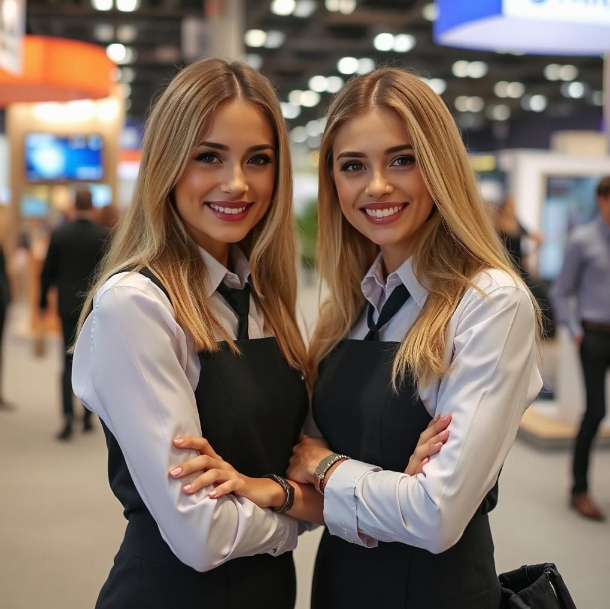
The China International Import Expo is where the world’s exporters converge on Shanghai. The 9th edition, running November 5–10, 2026, at the National Exhibition and Convention Center, will host thousands of exhibitors from over 130 countries and regions. Behind the national pavilions, the product launches, and the procurement negotiations, a temporary workforce makes international business physically possible: models, interpreters, booth assistants, and hostesses.
Interpreters: The Official Service and Its Scale
CIIE treats interpretation as an operational necessity, not an afterthought. The exhibitor manual lists “translation service” alongside freight forwarding, booth construction, and financial services as an official service category. The scale is substantial: at the second edition, 1,061 interpreters were booked by exhibitors, a nearly 20 percent increase over the first edition, with an additional 180 interpreters deployed for on-site support covering the six UN official languages and Korean.
The organizer also deploys technology alongside human interpreters. At the second edition, 83 translation machines were placed at consultation points across the venue, offering consecutive interpretation in 12 languages for multilingual inquiries, guidance, and business negotiations. The machines supplement, rather than replace, the human interpreters who handle the nuanced conversations that machines cannot.
For the 9th edition, the professional volunteer program is recruiting 45 multilingual translators. The language requirements specify that in addition to English, candidates must be proficient in at least one of French, German, Spanish, Portuguese, Russian, Arabic, Japanese, or Korean. The preference for “composite volunteers” — those with both industry expertise in technical equipment, consumer goods, food and agricultural products, automobiles, medical devices, or healthcare, and foreign language proficiency — signals that CIIE values subject-matter knowledge alongside linguistic skill.
The pricing benchmark for booth interpreters at major Chinese trade fairs suggests the market rate for English interpreters ranges from 800 to 1,200 RMB per day, with senior interpreters reaching higher tiers and less common languages commanding premiums.
Booth Assistants: The Operational Backbone
Booth assistants at CIIE handle the logistics that make commercial conversations possible. A 2022 procurement document from the Philippine Department of Trade and Industry for its CIIE pavilion describes the role in concrete terms: acting as interpreter for buyers and exhibitors, entertaining and ushering buyers, collecting business cards, assisting exhibitors in distributing promotional materials, and procuring supplies needed for daily pavilion operations.
The contract specified six personnel working from 8:00 AM to 6:00 PM over six days, at a budget of USD 176.67 per person per day. That rate reflects the entry-level nature of the work, but the responsibilities are broader than the pay suggests. A competent booth assistant ensures that the right visitor reaches the right person, that materials are stocked, and that the booth remains functional through long exhibition days.
The CIIE exhibitor manual provides a formal framework for booth staffing. Exhibitor badges are issued free of charge but may not be used for contractors or persons not working on the booth, a restriction that acknowledges booth staffing as a defined operational role rather than a casual arrangement.
Hostesses and Models: Presentation as Commercial Function
CIIE covers categories where visual presentation matters: consumer goods, food and agricultural products, apparel, and lifestyle products. Hostesses and models serve as the first point of contact for visitors, creating the visual anchor that draws traffic into the booth and maintaining the professional appearance that exhibitors expect.
The professional volunteer program includes a “reception and professional docent” role for the Business Exhibition areas. Eighty volunteers are being recruited for this function, tasked with assisting the organizer in delivering professional presentations within the exhibition area and providing expert commentary on tour routes for important visiting delegations. The requirement is a professional background related to one of CIIE’s six major exhibition areas.
Another 15 volunteers are recruited as professional docents for Country Exhibition pavilions, assisting Belt and Road participating countries in showcasing their unique cultures and key industries. The requirement is familiarity with the history and culture of BRI countries and experience in organizing large events.
These roles blur the line between hostess and interpreter. A docent guiding a VIP delegation through a national pavilion is simultaneously performing reception, translation, and cultural interpretation.
The Volunteer Infrastructure
CIIE’s professional volunteer program provides the organizational backbone for much of the booth staffing and interpretation that occurs across the venue. For the 9th edition, the recruitment targets professionals from foreign-funded enterprises, non-public enterprises, new economic organizations, and new social organizations — not just students, but working professionals with industry experience.
The 8th edition selected 168 qualified on-site volunteers, including four from abroad and nine from Taiwan, assigned across five categories and 16 specific positions. The broader volunteer corps — known as “little leaves” for the venue’s four-leaf clover shape — numbered 3,865 for the 8th edition, including 30 international students. A multilingual volunteer alliance was established with nine Shanghai universities, recruiting 129 volunteers proficient in 12 languages including German, French, Spanish, Russian, and Arabic.
The volunteer model at CIIE differs from the commercial staffing model at industrial trade fairs. Volunteers receive meals, supplies, transportation services, and personal accident insurance, but not commercial wages. The professional volunteer program is framed as a service contribution rather than employment, which shapes both the caliber of candidates and the nature of their engagement.
The Day-to-Day Reality
A CIIE workday for booth staff and interpreters runs from approximately 8:00 AM to 6:00 PM over the six-day exhibition period. The National Exhibition and Convention Center is vast, and the aisles are crowded with buyers from over 130 countries. For interpreters, the rhythm involves rapid context-switching: a morning spent facilitating a medical device negotiation, an afternoon supporting a food and agricultural products meeting. For booth assistants and hostesses, the work is more continuous: managing visitor flow, answering directional questions, replenishing materials, and maintaining professional composure through hours of standing and repetitive interaction.
Why This Workforce Matters at CIIE
CIIE describes itself as a platform for international procurement, investment promotion, cultural exchange, and open cooperation. That function depends on communication. A German machinery manufacturer demonstrating a production line to a Chinese buyer, a Brazilian food exporter negotiating with a Shanghai distributor, an Italian fashion brand presenting a collection to a Beijing retail group: each of these conversations begins with a language bridge and a welcoming booth.
The models, interpreters, booth assistants, and hostesses are not the headline of CIIE. The headline is the thousands of exhibitors, the national pavilions, the procurement contracts signed on the show floor. But the headline only reaches its audience because of the people who stand at the edges of the booths, hold the products, translate the negotiations, and guide the visitors. They are the human infrastructure of China’s import gateway.