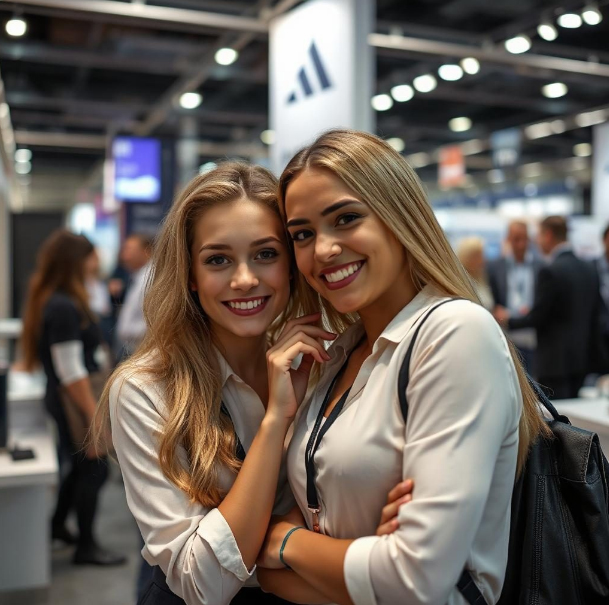
When the 17th Central Asian International Textile Machinery Exhibition opens its doors at Tashkent’s Uzexpocentre from September 8–10, 2026, the focused rightly be on the machinery, technologies, and business deals. But behind every successful exhibition stand, there is a team of professionals whose contributions are often overlooked but absolutely essential: hostesses, models, interpreters, and stand assistants.
These roles form the human infrastructure that transforms a trade fair from a collection of equipment into a functioning marketplace of ideas, relationships, and commerce.
The Frontline of First Impressions
Hostesses and models at CAITME serve as the welcoming face of exhibitors. With over 250 companies and brands from 18 countries participating, the competition for visitor attention is intense. A professional hostess does far more than smile and hand out brochures. She is the first point of contact, the person who must quickly assess whether a passing visitor is a potential buyer, a competitor, or simply a curious observer. She directs traffic, manages queues during peak hours, and creates the atmosphere of professionalism that reflects well on her employer’s brand.
For German companies participating under the National Pavilion—including names like Brückner Textile Technologies, Groz-Beckert, and Thies—the presence of well-prepared hostesses who understand the German reputation for precision and quality is particularly important. These companies are not simply selling machines; they are selling trust in a brand. A hostess who can confidently greet visitors in English, Russian, and Uzbek, while maintaining composure in a crowded hall, is an asset that directly contributes to an exhibitor’s return on investment.
The role of the “model” at a textile machinery exhibition may seem less obvious than at a fashion show, but it is no less important. Some stands use models to demonstrate how finished textile products look when worn or displayed, particularly in the TextileExpo Uzbekistan Sourcing Hub area where garment manufacturers and buyers meet. A model who can present fabric samples, drape materials, or showcase finished garments adds a tactile, human dimension to what might otherwise be an abstract display of machinery.
Interpreters: The Bridge Between Languages
With exhibitors from China, Türkiye, Germany, Italy, India, and beyond, CAITME is a Tower of Babel in miniature. The top five exhibiting countries alone represent four different native languages, and the working language of most negotiations is often English—but not always. Chinese equipment manufacturers may negotiate in Mandarin with their Uzbek distributors, while Turkish companies may prefer to conduct business in Turkish or Russian.
This is where professional interpreters become indispensable. A skilled interpreter at CAITME does more than translate words. She must understand textile terminology: the difference between warp and weft, the specifications of a circular knitting machine, the chemical properties of dyes. When a Chinese manufacturer explains the AI chip that optimizes fabric cutting to an Uzbek factory owner, the interpreter must convey not just the technical specifications but the value proposition.
The stakes are high. A misinterpretation during a negotiation can cost a contract worth hundreds of thousands of dollars. An interpreter who can smoothly facilitate a B2B meeting between a German machinery supplier and an Uzbek textile producer is not a luxury—she is a necessity. With 83% of participants being international exhibitors, the demand for skilled interpreters fluent in English, Russian, Uzbek, Chinese, Turkish, German, and Italian is substantial.
Stand Assistants: The Operational Backbone
While hostesses greet and interpreters translate, stand assistants keep the operation running. These are the professionals who know the exhibition catalog inside out, who can locate a specific spare part supplier in Pavilion 4, who know when the next B2G meeting is scheduled and which government representatives are expected.
A stand assistant at CAITME must be a multitasker of the highest order. She manages appointment schedules, coordinates with the organizer’s technical staff when a machine needs repair or adjustment, tracks inventory of promotional materials, and handles the dozens of small crises that inevitably arise during a three-day event. When a VIP delegation from the Ministry of Light Industry arrives unexpectedly, it is the stand assistant who ensures that the right person greets them and that the meeting room is ready.
What the Role Demands
These positions require more than just a pleasant appearance or a talent for languages. The successful candidates at CAITME possess specific qualities that set them apart.
Adaptability is paramount. The exhibition floor is unpredictable. A scheduled meeting may be cancelled, a machine may malfunction, a visitor may ask an unexpected question. The professionals who thrive are those who can pivot without losing their composure.
Industry knowledge separates the good from the exceptional. A hostess who understands the difference between spinning and weaving equipment can have a meaningful conversation with a visitor rather than simply directing him to a brochure. An interpreter who has studied textile engineering terminology can prevent costly misunderstandings.
Stamina matters more than many realize. Exhibition days are long—often extending into evening networking events. Standing for hours, maintaining energy and enthusiasm, and remaining alert through dozens of conversations requires physical and mental endurance.
The Business Case for Investing in Frontline Staff
For exhibitors, the temptation to economize on hostess, model, interpreter, and stand assistant services is understandable. Exhibition participation is already expensive: booth space, equipment shipping, travel, and accommodation add up quickly.
But the arithmetic of a poorly prepared frontline team is unforgiving. A disengaged hostess drives visitors away. An incompetent interpreter poisons a negotiation. An overwhelmed stand assistant creates chaos. In each case, the exhibitor has spent tens of thousands of dollars to rent space, transport machinery, and travel to Tashkent—only to see the investment undermined by a weak human interface.
Conversely, a well-trained team multiplies the value of every other investment. A hostess who qualifies leads effectively ensures that sales managers spend their time with genuine prospects. An interpreter who facilitates a smooth negotiation accelerates deal closure. A stand assistant who keeps the booth running smoothly allows the technical experts to focus on technical conversations.
A Professional Community
In Tashkent, as in exhibition cities around the world, there exists a community of professionals who work these events. They move from CAITME to other trade fairs, building reputations and relationships. The best among them are known to the organizers, recommended by previous clients, and booked months in advance.
For young professionals in Uzbekistan—students of foreign languages, international relations, or business—working at CAITME offers invaluable experience. It is a crash course in international business, a chance to meet people from dozens of countries, and an opportunity to develop skills that translate directly into career advancement.
The Unsung Contributors
When the doors of Uzexpocentre close on September 10 and the exhibitors pack up their machinery, the deals signed and relationships formed will be the headline story. But those deals were enabled by the interpreters who bridged languages, the hostesses who welcomed strangers, and the stand assistants who kept the wheels turning.
CAITME is, at its core, about technology and commerce. But technology does not sell itself, and commerce does not happen in a vacuum. It happens between people—and the hostesses, models, interpreters, and stand assistants are the ones who make those connections possible. They are the human face of an industry that, for all its machinery, still runs on trust, communication, and the simple act of a good first impression.