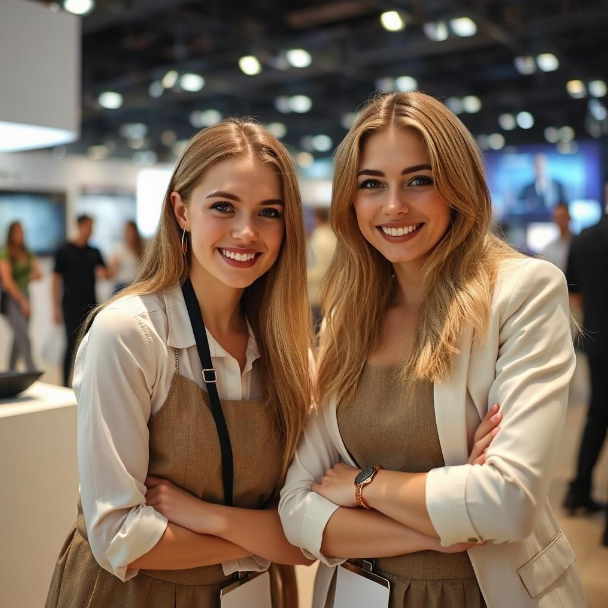
BUDEXPO is Belarus’s flagship international architecture and construction exhibition, held annually at the Minsk International Exhibition Center BELEXPO. With over 125 exhibitors and thousands of trade visitors from Belarus, Russia, China, Kazakhstan, and beyond, the three-day event is a dense concentration of business negotiations, product demonstrations, and professional networking. Behind the construction machinery, HVAC systems, and building materials on display, a specialized workforce makes the exhibition function: hostesses, promotional models, interpreters, and stand assistants. These roles are not ornamental. At a B2B trade fair where deals are negotiated on the floor, the quality of booth personnel directly influences whether a passing visitor becomes a signed contract.
Hostesses and Stand Assistants: The First Point of Contact
A hostess at BUDEXPO serves as the reception face of an exhibitor’s stand. The role encompasses greeting visitors, managing registration lists, distributing catalogs and promotional materials, and directing serious buyers to the appropriate sales representative. For the smaller Belarusian manufacturers and the international companies exhibiting at BUDEXPO, competent stand staff can be the difference between a casual glance and an extended product discussion.
The exhibition’s structure supports this function. Participant registration, badge distribution, and on-site information services are organized through designated information stands from the first day of setup. Exhibitors receive accreditation for representatives and permanent passes, meaning the personnel working a booth must be properly registered and prepared to operate within the exhibition’s strict access protocols.
A related and more specialized role is the product demonstrator or stand consultant. At BUDEXPO, where live demonstrations of machinery and material durability tests are central attractions, these individuals require genuine technical knowledge. The “Budakademia” program and various masterclasses held during the exhibition create demand for staff who can explain practical applications of construction technologies, not merely hand out brochures.
Promotional Models: Visual Communication for Construction Brands
While BUDEXPO is an industrial trade fair rather than a fashion event, promotional models remain part of the exhibition ecosystem. Their function differs from runway modeling: at a construction exhibition, models serve as visual anchors that draw visitor traffic to a stand and create photographic opportunities that extend a brand’s reach beyond the exhibition hall.
The 2025 edition of BUDEXPO attracted over 5,000 visitors, and the 2026 edition was projected to draw more than 10,000 professionals. In this competitive environment, exhibitors compete for attention on the floor. Promo models—often engaged through specialized agencies in Minsk that supply talent for exhibitions and corporate presentations—help smaller or first-time exhibitors achieve visibility that their display budget alone might not secure.
It is worth noting that BUDEXPO’s companion exhibition, “Nash Dom” (Our Home), focuses on housing and utilities, and the overlap in audience means that promotional strategies designed for consumer-facing segments of the construction industry can be effectively deployed alongside the purely industrial B2B presentations.
Interpreters: Enabling International Business at a Multilingual Fair
BUDEXPO is explicitly international. The 2025 edition drew exhibitors from Belarus, Russia, China, Kazakhstan, and Kyrgyzstan, and the 2024 exhibition featured a business program with over 50 speakers. The 2026 edition’s preliminary data indicated participation from multiple countries and a business program covering topics such as artificial intelligence applications and IT integration within the Union State.
In this environment, interpreters are indispensable. The primary working languages at BUDEXPO are Russian and English, with Chinese increasingly relevant given the participation of Chinese construction material and equipment suppliers. Minsk-based interpreting services offer exhibition and negotiation rates starting at approximately 35 EUR per hour or 265–280 EUR per day for English-Russian interpretation, with Chinese-Russian coverage available at similar rates.
Interpreters at BUDEXPO work in two principal capacities. First, official interpreters are engaged for the business program: plenary sessions, international roundtables, and panel discussions where simultaneous or consecutive interpretation is required. Second, exhibitor-hired interpreters work directly at stands, facilitating product presentations, pricing negotiations, and technical discussions between foreign buyers and company representatives. For Chinese exhibitors in particular, an interpreter who can navigate both the language barrier and the technical vocabulary of construction materials or machinery is a critical asset.
The organizational infrastructure for these services exists in Minsk. Trade support entities such as the Minsk branch of the Belarusian Chamber of Commerce and Industry maintain translation departments that provide written and oral interpretation for business negotiations, exhibitions, and technical documentation. Event service providers also list interpreter selection among their offerings for exhibition participants.
The Broader Service Ecosystem
The demand for exhibition personnel has created a supporting industry of agencies and service providers in Minsk. Specialized BTL agencies supply trained promoters, hostesses, and supervisors for trade shows and corporate events, with experience in managing personnel for exhibitions and conferences. Talent agencies focused on fashion and entertainment also maintain databases of models, interpreters with professional appearance, and promo-models suitable for trade show environments.
For international exhibitors unfamiliar with the Belarusian market, the practical implication is that capable staff can be sourced locally. The BelExpo organizer and associated service companies provide assistance with selecting stand assistants, hostesses, and interpreters, allowing foreign companies to focus their resources on product presentation and business development.
At BUDEXPO, the architecture and construction products on display tell only part of the story. The exhibition’s effectiveness as a business platform depends on the human layer: the hostess who identifies a serious buyer, the model who draws traffic to a first-time exhibitor’s stand, the interpreter who ensures that a technical specification is accurately conveyed during a negotiation between a Chinese manufacturer and a Belarusian distributor. For companies planning to exhibit at BUDEXPO—particularly those coming from outside Belarus—investing in trained, multilingual, and well-prepared booth personnel is not an afterthought but a core component of exhibition strategy.