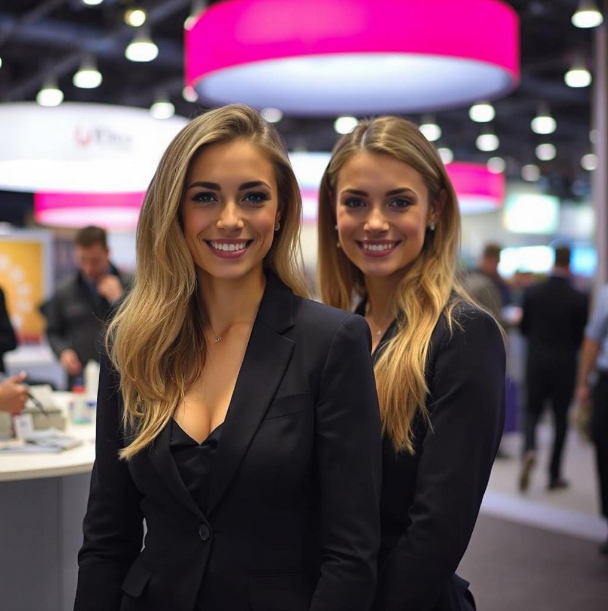
Auto China is the most authoritative and influential international A-class auto show in China. Held biennially in Beijing since 1990, the 2026 edition takes place from April 24 to May 3 at both the China International Exhibition Center (Shunyi Hall) and the newly opened Capital International Exhibition Center of China. With a record-breaking total exhibition area of 380,000 square meters, the event is the largest auto show in the world. Over 1,500 exhibitors and 290,000 visitors are expected, including tens of thousands of international guests. Behind the spectacle of gleaming vehicles and futuristic technology, a specialized workforce brings the exhibition to life: models, interpreters, stand assistants, and hostesses. Each role serves a distinct purpose in one of the world’s most competitive automotive showcases.
Models at Auto China: From Decoration to Information Source
The role of models at Chinese auto shows has undergone a dramatic transformation over the past decade. When the Beijing auto show first introduced the concept of “beautiful cars and beautiful women” in 1993, models were primarily decorative—glamorous figures positioned beside vehicles to draw photographers and crowds. For years, the auto show operated on a “human wave” strategy: a single vehicle might be accompanied by six or more models, and the models often attracted more attention than the cars themselves.
That era ended in 2016, when the Beijing auto show organizers introduced formal regulations designed to refocus the event on the vehicles themselves. The change was significant. Today’s models at Auto China are expected to do far more than stand and pose. Automotive brands now require models who can explain vehicle specifications, differentiate between battery technologies, and engage visitors in substantive conversations about the products they represent.
The transformation has also opened new opportunities. Male models, once dismissed as “human background” at auto shows, have found a new path by combining physical presence with technical knowledge. At recent Beijing auto shows, male models who can discuss suspension configurations, acceleration figures, and powertrain specifications have drawn crowds of their own, with visitors queuing for photos and detailed product questions. The formula that works today is “professionalism plus appearance”—models who can speak knowledgeably about the vehicles they stand beside.
The compensation structure reflects this professionalization. Top-tier models with significant social media followings can command daily rates of 8,000 to 30,000 yuan, while mid-tier professional models earn between 2,000 and 8,000 yuan per day. Entry-level models and part-time students may earn 500 to 1,500 yuan daily, often working small brand booths or performing general support tasks. The work itself is demanding: models typically arrive by 6:00 AM for makeup and preparation, stand for eight to ten hours in high heels, and maintain a professional demeanor throughout.
Interpreters: Bridging Global Business at Auto China
Auto China’s status as an international A-class auto show means that interpreters are essential to its operation. The 2024 edition attracted over 23,000 media professionals, including 1,148 foreign journalists from 956 media outlets across 131 countries. Overseas dealers and international visitors number in the tens of thousands. For global automotive brands launching new vehicles in the Chinese market, and for Chinese manufacturers seeking international partnerships, interpretation services are not a luxury but a necessity.
The interpreting work at Auto China spans multiple formats. During press days (April 24–25), simultaneous and consecutive interpreting is required for press conferences, executive interviews, and media briefings. A single interview session may require interpreters to facilitate communication between a European automotive CEO and a group of Korean journalists, as was the case at Auto China 2026. During professional and public visitor days, consecutive interpreting on the exhibition floor becomes the primary mode—interpreters accompany brand representatives, facilitate conversations with potential dealers, and help international visitors understand product features.
The linguistic demands are substantial. Automobile industry terminology requires precision: powertrain specifications, battery energy density, chassis architecture, and intelligent driving system capabilities must be rendered accurately across languages. Interpreters working at Auto China must be comfortable with technical vocabulary while also possessing the interpersonal skills to facilitate business discussions in a fast-paced exhibition environment.
The demand for qualified interpreters is well established in Beijing. Local and international translation agencies recruit specifically for Auto China, recognizing that the event requires more than general language proficiency—it requires industry knowledge and the ability to perform under the pressure of a major international trade show.
Stand Assistants: The Operational Backbone of Exhibition Success
Stand assistants at Auto China perform the functional work that keeps exhibition booths running smoothly. Unlike models or hostesses, whose roles are primarily visual or welcoming, stand assistants handle registration, collect contact information, distribute marketing materials, manage visitor flow, and direct inquiries to the appropriate brand representatives.
The scale of Auto China creates unique operational challenges. With 128 million visitors passing through the exhibition halls during the 2026 event and 65,000 international visitors in attendance, efficient visitor management is critical. Stand assistants help brands capture leads in an environment where thousands of visitors compete for attention.
For automotive brands specifically, stand assistants often perform a qualification function. A visitor approaching a luxury vehicle display may be a potential customer, a competitor gathering intelligence, a journalist, or simply a curious attendee. A skilled stand assistant can quickly assess visitor intent and route them appropriately, allowing sales staff and engineers to focus on high-value conversations.
The role often involves physical demands beyond communication. At Auto China, stand assistants may be responsible for maintaining vehicle displays, managing test drive sign-ups, and coordinating with logistics teams. Some positions require standing for extended periods, managing queues, and working under the pressure of high visitor traffic.
Hostesses: The First Point of Contact
Hostesses serve as the welcoming face of exhibition stands at Auto China. Their primary function is to greet visitors, create a positive first impression, and initiate conversations that can lead to deeper engagement with the brand’s representatives.
The historical evolution of hostesses at Chinese auto shows mirrors that of models. After the 2016 regulations, the role of etiquette hostesses gained prominence as shows moved away from the “car model” concept. Hostesses were positioned as a more professional and family-friendly alternative—presentable, articulate, and trained to provide basic product information.
At Auto China, the distinction between hostesses, models, and stand assistants often blurs in practice. Many staff members perform hybrid roles, greeting visitors while also providing information and managing booth operations. For international brands, hostesses with English or other foreign language skills are particularly valuable, as they can welcome both domestic and international visitors and facilitate initial communication across language barriers.
The working conditions for hostesses are demanding. Those working major brand booths often operate on rotating shifts, standing for 30 minutes at a time before brief rest periods, and working nearly 12 hours including preparation and travel time. The physical toll is significant: hostesses at previous Beijing auto shows reported blistered feet from standing in heels all day, with rest areas often filled with staff sitting barefoot to relieve discomfort.
Practical Considerations for Exhibitors
Exhibitors planning staff for Auto China should recognize that these roles serve distinct functions and require different skill sets. Models need to combine visual presentation with product knowledge. Interpreters require industry-specific vocabulary and business communication skills. Stand assistants need operational reliability and the ability to manage crowds. Hostesses need warmth, professionalism, and often language capabilities.
The recruitment process for major brands typically involves casting calls for models and hostesses, while interpreters and stand assistants may be sourced through staffing agencies or recruited from universities. Beijing institutions such as Gengdan Institute and Beijing Youth Politics College have supplied hundreds of student volunteers and staff for Auto China, with some students working in VIP reception roles that require English proficiency and professional hospitality training.
Budget planning should account for the full duration of the exhibition, which spans press days, professional visitor days, and public days over ten days. Top models and experienced interpreters command premium rates, while entry-level staff and student volunteers work at lower compensation levels. The investment in staff quality directly affects brand perception at an event where hundreds of thousands of visitors form impressions within seconds of approaching a booth.
The Beijing International Automotive Exhibition represents the highest level of automotive showcase in China and one of the most significant in the world. The professionals who staff its booths—models, interpreters, stand assistants, and hostesses—are not peripheral to the experience. They are the human interface between brands and the public, between products and perceptions, and between Chinese automotive ambitions and the global market.