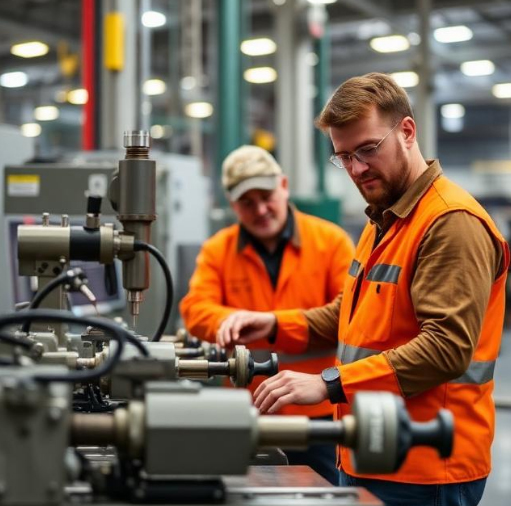
The Russian machine tool industry, the foundational sector that manufactures the machines for all other industries, is currently trapped between high ambition and stark technological reality. A massive state-led push for “technological sovereignty” is colliding with deep-seated structural dependencies, a shortage of skilled engineers, and the persistent challenge of competing with established global manufacturing giants like China. The result is an industry that showcases pockets of progress while grappling with a fundamental dependence it has yet to overcome.
A Market Dominated by Imports
While there have been notable efforts to boost domestic production, the Russian machine tool market remains overwhelmingly reliant on foreign supply. Even after years of import substitution initiatives, over 80% of the market is still met through imports. This reliance is not merely a matter of volume but also of technological sophistication.
Russia’s position on the global stage is peripheral. The country’s total machine tool production in 2024 was approximately $215 million, placing it 20th globally. By stark contrast, China—the world leader—produced machine tools worth $27.3 billion, a scale 127 times larger. As an importer, however, Russia is a significant player, ranking 9th in the world with $1.2 billion in purchases in 2024. This dynamic, where Russia is a major buyer but a minor producer, underscores its core challenge: the domestic industry is not keeping pace with domestic demand.
The financial strain is also acute, exacerbated by a punishing central bank rate of 14% in mid-2026. High borrowing costs have made it prohibitively expensive for enterprises to invest in the new machinery and modernization that could drive growth, effectively stalling investment across the sector.
The Illusion of Self-Sufficiency
The drive for import substitution, a central pillar of state industrial policy, has yielded mixed results. On paper, progress is evident. The government reports that Russian enterprises produce machinery and components that fill over 25,000 positions in the national registry of industrial products. However, a closer look reveals that much of this “substitution” is merely assembly.
According to Ukrainian intelligence reports—which align with the findings of Russian industry surveys—the Russian machine tool industry is characterized by “formal import substitution.” While domestic manufacturing may account for 70% of the final product, this figure masks a crippling dependence on foreign components. Dependence on imported numerical control systems and sensors, the “brain” of a modern machine, remains as high as 80-95%. This creates a precarious situation where Russian plants are assembling machines that are still essentially dependent on foreign technology.
The 26th International Exhibition for the Metalworking Industry, “Metalloobrabotka-2026” held in May, served as a major showcase for these efforts. The event, which brought together 1,210 companies and over 39,000 professional visitors, demonstrated significant progress in automation, CNC systems, and robotics. However, the presence of a strong Russian contingent alongside exhibitors from China, India, and Turkey underscored the industry’s ongoing need for foreign expertise and components.
Structural Barriers: The Human and Economic Factor
The industry’s struggles extend beyond the factory floor. A severe shortage of qualified engineers and skilled workers is a primary constraint. Russia’s lack of a complete domestic production cycle for the most advanced components, from high-end microelectronics to specialized software, leaves it dependent on foreign technological ecosystems. Companies are not merely replacing parts; they are struggling to replicate the entire technological infrastructure that underpins modern machine tool production.
This dependency is illustrated by the government’s own revised targets. In a significant admission, the authorities recently lowered the target share of Russian equipment in state projects from an ambitious 80% to 58.7%, effectively acknowledging that nearly 40% of procurement will continue to depend on imports—primarily from China. This shift from a reliance on Western technology to dependence on Asian suppliers represents a shift in partners, not a true break from foreign dependency.
The Outlook: A Long Road Ahead
Analysts and industry insiders offer little comfort for the short term. The consensus is that breaking free from technological dependence is a generational endeavor. Some project that it will take 7 to 10 years of sustained, favorable conditions and active state support to achieve a meaningful escape from dependency. Even as state support for the industry has been substantial, with over 7 billion rubles allocated in 2025 and more than 45 billion planned through 2028, the structural challenges remain immense.
The Russian machine tool industry has proven its ability to stage impressive exhibitions and produce machines for the domestic market. Yet its core challenge remains: the “lathe” it seeks to build cannot be fully manufactured without foreign “brains.” The path to true sovereignty is not a short sprint but a long march, one that requires not just financial muscle but a transformation of its technological foundation, a task that is years, if not decades, away.