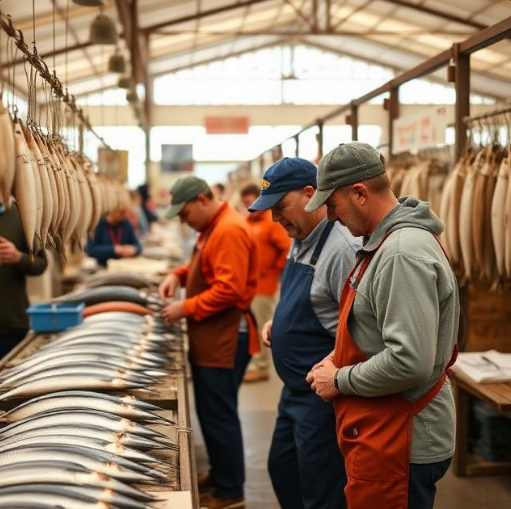
Russia’s fishery industry presents a picture of stark duality in 2026. It is a sector of enormous potential, backed by state investment and vast natural resources, yet it remains a relatively minor player on the global stage, grappling with sanctions, skyrocketing costs, and a domestic market that still struggles to fully embrace its own catch.
A Giant in Its Own Waters, A Minnow on the World Stage
Despite being a global powerhouse in terms of catch volume, Russia’s share of the international seafood market is surprisingly small. The country accounts for only 5.4% of the global catch, and an even smaller 2.3% of the world’s production and sales.
The domestic industry is, however, a significant economic engine. In 2025, the fishing sector generated over 1 trillion rubles in revenue, a 14% increase from the previous year. This growth is largely driven by a favorable global pricing environment. High prices for key exports like pollock and cod have resulted in a significant boost to export revenue, which reached over $1.7 billion in the first quarter of 2026 alone. This performance aligns with industry forecasts that project annual exports could exceed $7 billion by the end of the year.
The China Factor and the New Export Map
The export picture is increasingly focused on a single, dominant customer: China. As Western markets closed or became more difficult to access, China stepped in as the undisputed leader for Russian fish and seafood.
The numbers from the first four months of 2026 are telling:
- Export value to China surged by 46% to over $1.6 billion.
- Frozen pollock exports rose by 15% in volume and 55% in value.
- Live crab exports grew 20% in volume and 30% in value.
While South Korea and the Netherlands remain significant buyers, the concentration on a single market is a point of vulnerability. The industry recognizes the need to diversify, with Agroexport, the federal center, stating that “the industry faces the challenge of geographic diversification of supplies, expanding into new markets and expanding shipments to Africa, the Middle East, and Latin America.”
The Barents Sea Squeeze: Northern Catches Decline
The positive export numbers mask a brewing storm in the critical Northern Basin. The cargo turnover of the Murmansk fish port almost halved in 2025, reflecting a severe contraction in catches. The reasons for this decline are a mix of biology, sanctions, and geopolitics:
- Lower Quotas: Catches of key species in the Northern Basin, such as cod and haddock, fell significantly in 2025 compared to the previous year. Cod catches dropped from 210,600 to 151,700 tonnes.
- Sanctions and “Empty” Trips: Sanctions against companies like Norebo and MurmanSeafood have increased costs. Fishermen now face restrictions on supplies, forcing them to make longer “empty” trips to Murmansk or St. Petersburg for repairs and supplies, instead of using closer foreign ports. This burns more fuel and cuts into valuable fishing time.
- International Tensions: The delay of the Joint Russian-Norwegian Fisheries Commission meeting in late 2025 created significant uncertainty for the 2026 season. More worryingly, there are concerns that Norway might take the drastic step of barring Russian vessels from its fishing zone, which would be a major breach of long-standing fisheries agreements.
The Internal Market: A Struggle to Boost Consumption
While exports are booming, the internal market remains a paradox. A primary goal of state policy, as declared by President Putin, is to satisfy the domestic market with affordable, high-quality fish. Yet, Russian per capita fish consumption fell by 2.4% in 2025 to around 24 kg per person, below the Ministry of Health’s recommended standard.
This is occurring despite some positive measures:
- A new governmental decree bans foreign fish products for state and municipal needs, which could strengthen the domestic market by expanding access for local producers.
- An estimated 230,000 tons of salmon are expected to be caught in 2026, yielding about 12,000 tons of salmon roe, which should be more than enough for the domestic market.
The problem lies in pricing. Despite lower catches in some regions, high logistics costs (adding about 35% to final prices), rising labor and freight expenses, and general economic uncertainty are making fish increasingly expensive for Russian consumers. The industry also suffers from a lack of subsidies compared to agriculture, which hampers affordability.
The Trout Farmers: A Case Study in Prepping for the Future
The aquaculture sector, and specifically the trout farmers of Karelia, offers a microcosm of the challenges and strategic shifts taking place. While overall aquaculture revenue fell by 17% in 2025, the region’s trout production is growing, rising 11% in the first half of 2026 to 13,700 tonnes.
A key player, Kala-Ranta, illustrates the sector’s long-term thinking. The company is investing heavily to reduce its reliance on imported Western genetics and feed. Its plans include:
- Establishing its own breeding operation by 2030–31 to secure its supply of trout eggs, currently sourced from the US and Spain.
- Moving cages into deeper water to optimize growing conditions and extend the feeding season.
- Shifting sales to more profitable processed products, aiming to increase the share from 30% to 60%.
These investments serve a dual purpose: they protect the company against continued isolation from Western technology and position it to compete effectively if trade with Europe ever resumes.
Outlook
The Russian fishery industry is a sector in transition. It is a powerful exporter with a critical lifeline to China, but this dependency is a structural weakness. It is blessed with abundant natural resources, yet it struggles to feed its own population affordably. It benefits from massive state investment through the “keel quota” program, which has led to the construction of 48 new vessels and 30 processing plants, but the on-ground reality for its fishermen is one of rising costs and geopolitical uncertainty.
As one industry expert put it, “the prospects of the domestic fishing industry for 2026 are primarily determined by nature. If there is fish, people will catch it.” However, the path to a truly sustainable and sovereign fishery will require more than a bountiful catch; it will demand navigating a complex web of international sanctions, domestic economic pressures, and a consumer base that is increasingly feeling the pinch.